

Protecting EU funds from fraud after 2027
2026-11-24
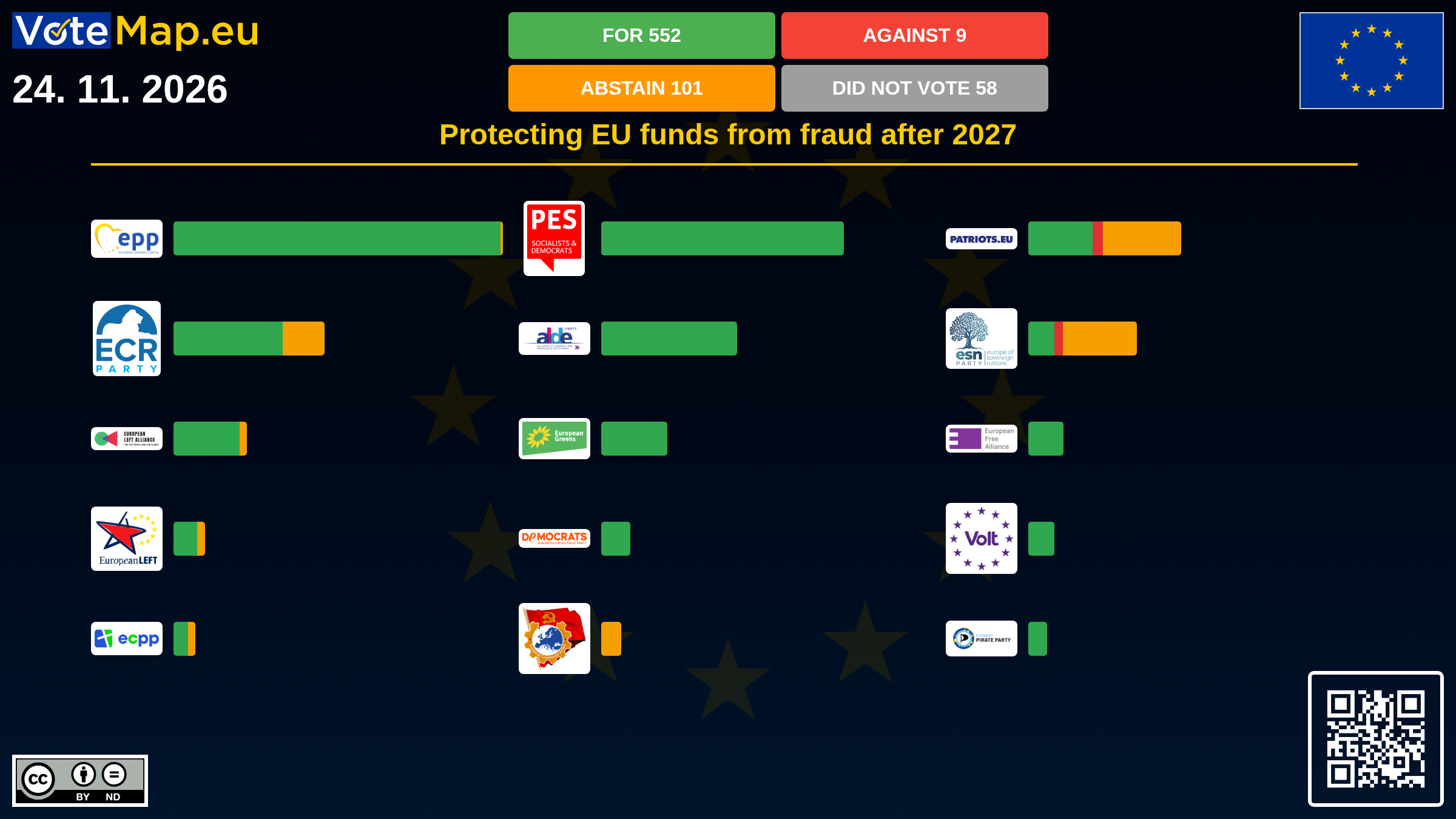
The resolution on protecting the EU budget against fraud after 2027 was adopted by 552 votes in favour, 9 against and 101 abstentions. The EPP, S&D, Renew and Greens/EFA groups – in other words, the entire pro-European majority – voted unanimously in favour. Disagreement only emerged during the separate votes: the paragraph on renaming the OLAF office was not adopted, and the PfE and ESN voted against the paragraph on the importance of the rule of law for access to funds.
The European Parliament has adopted an own-initiative resolution on how to protect European Union funds from fraud under the next multiannual financial framework – that is, the EU’s long-term budget for the period after 2027. This involves a review of the so-called anti-fraud architecture: the set of bodies and rules designed to protect European funds from misuse. The report was drawn up by the Committee on Budgetary Control (CONT) and had two joint rapporteurs, Tomáš Zdechovský (EPP, KDU-ČSL) and Dick Erixon (ECR).
The resolution was adopted by 552 votes in favour, 9 against and 101 abstentions. The EPP (171), S&D (127), Renew (75) and Greens/EFA (43) voted unanimously in favour; within each group, no one voted against or abstained. The Left (37 in favour, 2 abstentions) and the ECR (58 in favour, 21 abstentions) also voted in favour. Among the PfE, 31 MEPs voted in favour, 5 against and 43 abstained. The ESN was divided: 3 in favour, 3 against and 17 abstained. The majority of MEPs from both the PfE and the ESN therefore abstained, and an abstention does not count as a vote against.
Speakers from all four groups of the pro-European majority agreed during the debate on 23 November 2026 that the authorities responsible for safeguarding European funds must cooperate more effectively. Andreas Schwab, speaking on behalf of the EPP, said: “We do not need any new agency or a backdoor expansion of remit […], but better cooperation between existing agencies”. Giuseppe Lupo, speaking on behalf of the S&D, described it as essential to “strengthen cooperation between the EPPO and OLAF”, that is, between the European Public Prosecutor’s Office and the European Anti-Fraud Office, adding that “the fight against fraud cannot be waged without the rule of law”. Gilles Boyer, speaking on behalf of Renew, outlined two key changes: a joint mechanism for receiving reports and the replacement of the current ban on parallel investigations with a “targeted suspension mechanism”. Daniel Freund, speaking on behalf of the Greens/EFA, wanted the two most important anti-corruption bodies “not to compete with one another, but to complement one another”. (Quotes from Schwab, Lupa, Boyer and Freund as translated.)
Rapporteur Tomáš Zdechovský (EPP) said during the debate: “Protecting the financial interests of the European Union is not just about detecting fraud; above all, it is about ensuring that European funds do not become an easy source of income for organised groups of fraudsters and corrupt networks.”
The pro-European majority was divided on only one of the ten roll-call votes: the paragraph proposing to rename OLAF. Daniel Freund spoke in favour of the name change during the debate. He asked what people outside the Chamber think of when they hear “OLAF”, adding: “That is precisely why we should change the name.” The paragraph was rejected by a vote of 133 to 427, with 101 abstentions. The Greens/EFA supported it by 45 votes to 3; the EPP was split (77 in favour, 88 against); the S&D (1 in favour, 125 against) and Renew (75 against, none in favour) were against. The PfE (1 in favour, 71 against) and the ESN (23 against) also voted against; within the ECR, there were 6 in favour, 21 against and 51 abstentions.
On the other sub-points, the pro-European majority voted in favour, with opposition concentrated within the PfE and ESN. The paragraph emphasising the importance of upholding the rule of law for access to European funds, including the next multiannual financial framework, was adopted by a vote of 471 to 144 to 48; all 79 PfE MEPs who voted were against, whilst 22 from the ESN were against and none in favour. The paragraph calling on the Commission to ensure that assets confiscated following prosecutions by the European Public Prosecutor’s Office and allocated to the Union budget are treated as internal earmarked revenue was adopted by 459 votes to 109, with 94 abstentions; 43 MEPs from the PfE voted against and 35 abstained, whilst 23 from the ESN voted against.