

Parliament’s priorities for the 2027 EU budget
2026-04-28
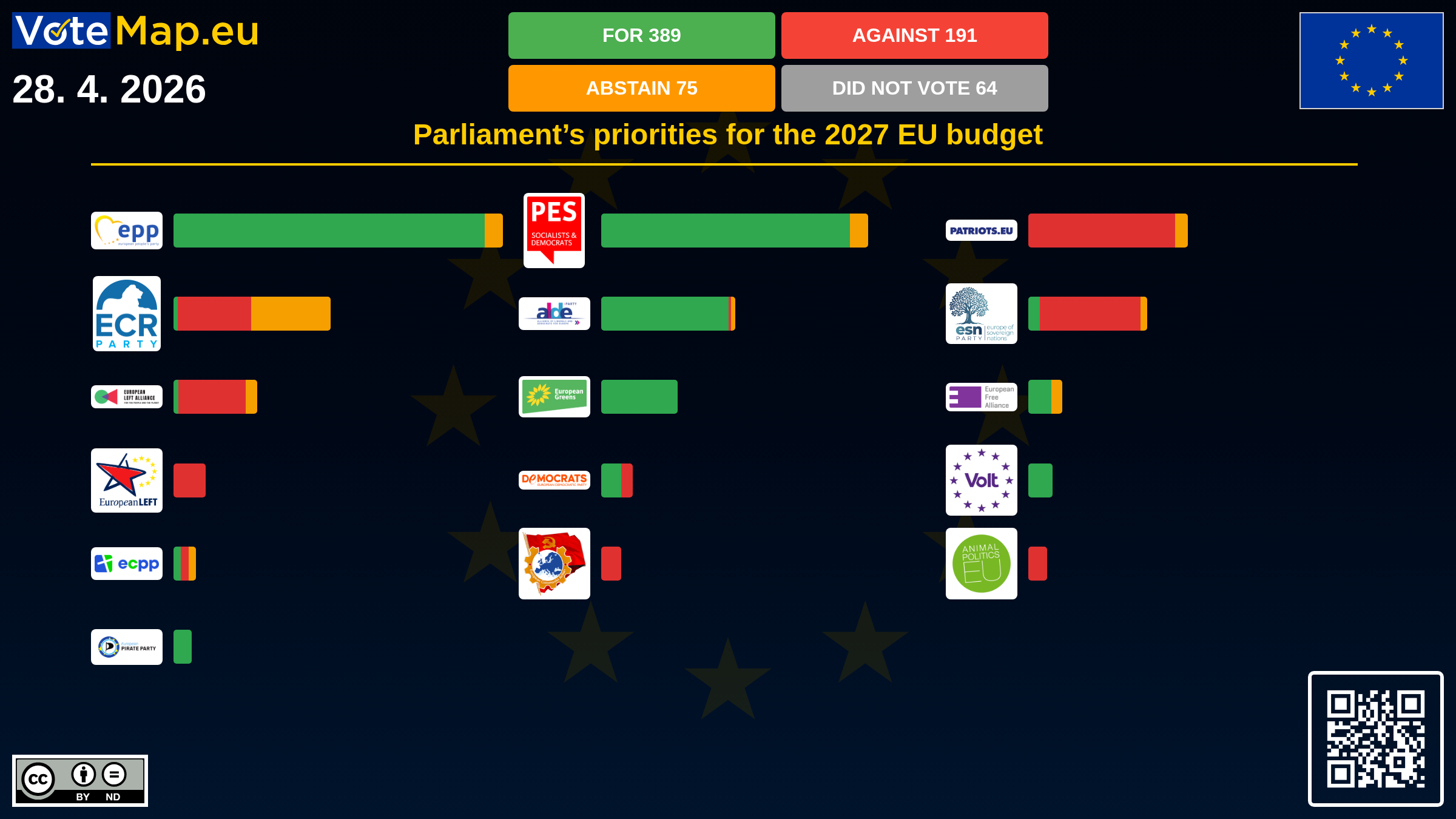
The resolution on the budgetary guidelines for 2027 – that is, the priorities with which the European Parliament will enter negotiations on the EU’s annual budget – was adopted by 389 votes in favour, 191 against and 75 abstentions. It was unanimously supported by all four groups of the pro-European majority – the EPP, S&D, Renew and Greens/EFA. The PfE and ESN, as well as the majority of The Left, voted against it; the ECR largely abstained. Among other things, the resolution calls for the disbursement of all EU funds to be conditional upon respect for the rule of law.
The budgetary guidelines are the first step in the European Parliament’s involvement in drawing up the EU’s annual budget. They do not set out specific figures. Through them, the Parliament sets out the political priorities and requirements that will guide its negotiations, even before the European Commission presents its draft budget for 2027 in June. The year 2027 is also the seventh and final year of the current multiannual financial framework (2021–2027). The resolution therefore describes it as a bridge to the next framework for the years 2028–2034.
The resolution was drafted in the Committee on Budgets by rapporteur Nils Ušakovs (S&D, Latvia). It was adopted by 389 votes in favour, 191 against and 75 abstentions. All four groups of the pro-European majority supported it unanimously: the EPP with 153 votes in favour (9 abstentions), the S&D with 117 in favour (9 abstentions), Renew with 66 in favour, 3 against and 2 abstentions, and Greens/EFA with all 46 votes in favour.
The PfE (71 against, 6 abstentions) and ESN (25 against, 1 in favour) voted against. The ECR largely abstained: 41 of its MEPs abstained, 34 voted against and 1 in favour. The far right therefore did not present a united front against the resolution. The Left (far left) voted predominantly against: 36 against, 2 in favour and 5 abstained.
According to the resolution, the 2027 budget should prioritise ensuring that funds are actually spent and reducing the volume of outstanding commitments. The condition of respect for the rule of law is to apply without exception to all EU funds, including performance-based instruments and funding under Article 122 of the Treaty on the Functioning of the EU. No payments are to be made whilst shortcomings persist.
On defence, the resolution calls for deeper defence integration, joint investment in research and development, and military mobility. It also proposes European maritime security and defence centres in the Black Sea, the North Sea, the Baltic Sea and the Mediterranean. With regard to Ukraine, it welcomes the Member States’ agreement on a loan of 90 billion euros as part of enhanced cooperation and the immobilisation of Russian assets frozen in the EU up to a total of 210 billion euros. At the same time, it insists on the use of the Ukraine Support Loan Instrument.
According to the resolution, the budget is intended to help bridge the investment gap in the energy sector, which the resolution puts at 660 billion euros per year, particularly in energy interconnections and strategic technologies. It is also intended to provide sufficient funding to tackle the housing crisis, healthcare – including mental health – and social cohesion. According to the Commission’s estimates, interest payments associated with the NextGenerationEU recovery plan could reach up to €10 billion in 2027. The resolution insists that this must not lead to any cuts to programmes or their funding. It also expresses deep concern that no progress has been made in the Council on new EU own resources.
Among the pro-European groups, Renew Europe issued a separate statement on the vote. Its budget coordinator, Lucia Yar (Progressive Slovakia), pointed out that it is no coincidence that the budget guidelines for 2027 are being adopted on the same day as the interim report on the multiannual financial framework. We were unable to find any specific statements from the EPP, S&D or Greens/EFA regarding this vote. Their position is reflected in how they voted.