

The Commission’s 2025 Report on the Rule of Law
2026-04-29
The European Parliament adopted a resolution on the Commission’s annual report on the rule of law by 387 votes in favour, 191 against and 46 abstentions. The EPP, S&D, Renew and Greens/EFA – all four groups of the pro-European majority – voted in favour, as did The Left, whose MEP Konstantinos Arvanitis was the rapporteur. The ECR, PfE and ESN – the far-right groups – voted against the resolution; none of them voted in favour. The resolution criticises Hungary and supports making the disbursement of EU funds conditional on respect for the rule of law.
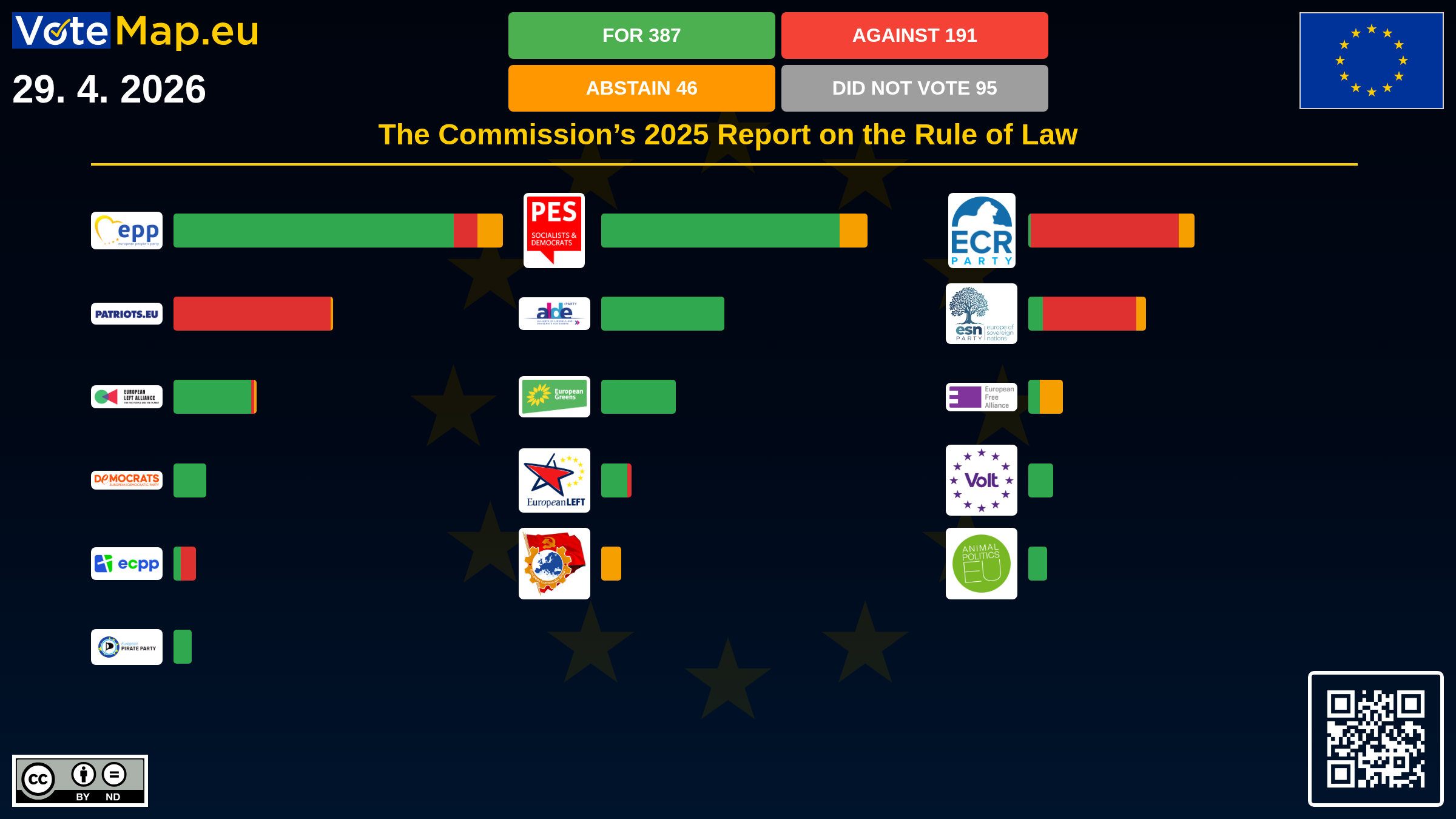
Each year, the Commission publishes a report on Member States’ compliance with the rule of law and other values set out in Article 2 of the Treaty on European Union, including democracy, freedom, equality and human rights. It adopted the sixth edition on 8 July 2025. Parliament responded with an own-initiative resolution from the Committee on Civil Liberties (LIBE), which approved the report on 14 April 2026 by a vote of 50 to 17, with 2 abstentions. The rapporteur was Konstantinos Arvanitis of The Left group. In plenary, the resolution was adopted with 387 votes in favour, 191 against and 46 MEPs abstaining.
The resolution calls for the independence of judges and prosecutors and the random allocation of cases. In the fight against corruption, it calls for the EU’s full membership of GRECO and a swifter revision of the regulation on the European Public Prosecutor’s Office (EPPO). It addresses the protection of journalists, media pluralism and the misuse of surveillance programmes such as Pegasus, Predator and Paragon Graphite. There is also a separate section on space for civil society. Among the demands are a binding directive against conversion therapy practised on LGBTIQ+ people and the ratification of the Istanbul Convention by all Member States.
On the budget, the resolution welcomes the Commission’s proposal to make nearly half of the funds under the 2028–2034 multiannual financial framework conditional on compliance with the rule of law and the Charter of Fundamental Rights. States that violate Article 2 are not to have funds that have already been frozen released. The resolution welcomes the fact that the Commission is also assessing Albania, Montenegro, North Macedonia and Serbia, and calls for the assessment to be extended to all candidate and potential candidate countries.
The resolution repeatedly and specifically criticises Hungary. It criticises the concentration of executive power over public prosecutors, the overuse of fast-track legislative procedures and the failure to implement six Commission recommendations dating from 2022. It refers to the ongoing proceedings under Article 7(1) of the Treaty on European Union, which, according to the resolution, the Council is unable to take further.
All four groups of the pro-European majority voted in favour. Renew voted unanimously (63 in favour), whilst Greens/EFA had 41 votes in favour and 3 abstentions. S&D had 107 votes in favour and 13 abstentions, 12 of which were from the Spanish delegation. Within the EPP, 132 MEPs voted in favour, 11 against and 12 abstained. The Left also voted in favour (39 in favour, 1 abstention). The ECR (67 against, 10 abstentions), PfE (73 against, 1 abstention) and ESN (26 against) voted against. Thus, no one from the far right voted in favour of the resolution.
The shadow rapporteurs of the pro-European majority defended the text during the debate on 28 April 2026. Fredis Beleris (EPP) described it as balanced and referred to the rule of law as “the pillar on which citizens’ trust in the institutions rests”. Juan Fernando López Aguilar (S&D) said that “double standards are not permissible in a state governed by the rule of law”. Sophie Wilmès (Renew) stated that the introduction of an annual rule of law cycle was “the subject of broad consensus amongst the democrats in this House”. Diana Riba i Giner (Greens/EFA) warned: “We are witnessing a democratic decline.” Rapporteur Konstantinos Arvanitis (The Left) said: “We have produced a report which, I believe, reflects a broad consensus.” The quotes have been translated from Greek, Spanish and French.