

European Shield for Democracy: recommendations against foreign interference and disinformation
2026-09-15
The Parliament in Strasbourg adopted, by 420 votes to 220 (with 26 abstentions), the final report and recommendations of the Special Committee on the European Democracy Shield (EUDS), which was established back in December 2024. The EPP, S&D, Renew and Greens/EFA voted almost unanimously in favour, whilst the ECR, PfE and ESN voted against in a coordinated manner. Turnout was high — over 92 per cent; the far-right ESN had the highest turnout among the participating political groups, whilst the PfE had the lowest. The recommendations target Russian interference, disinformation and the protection of elections.
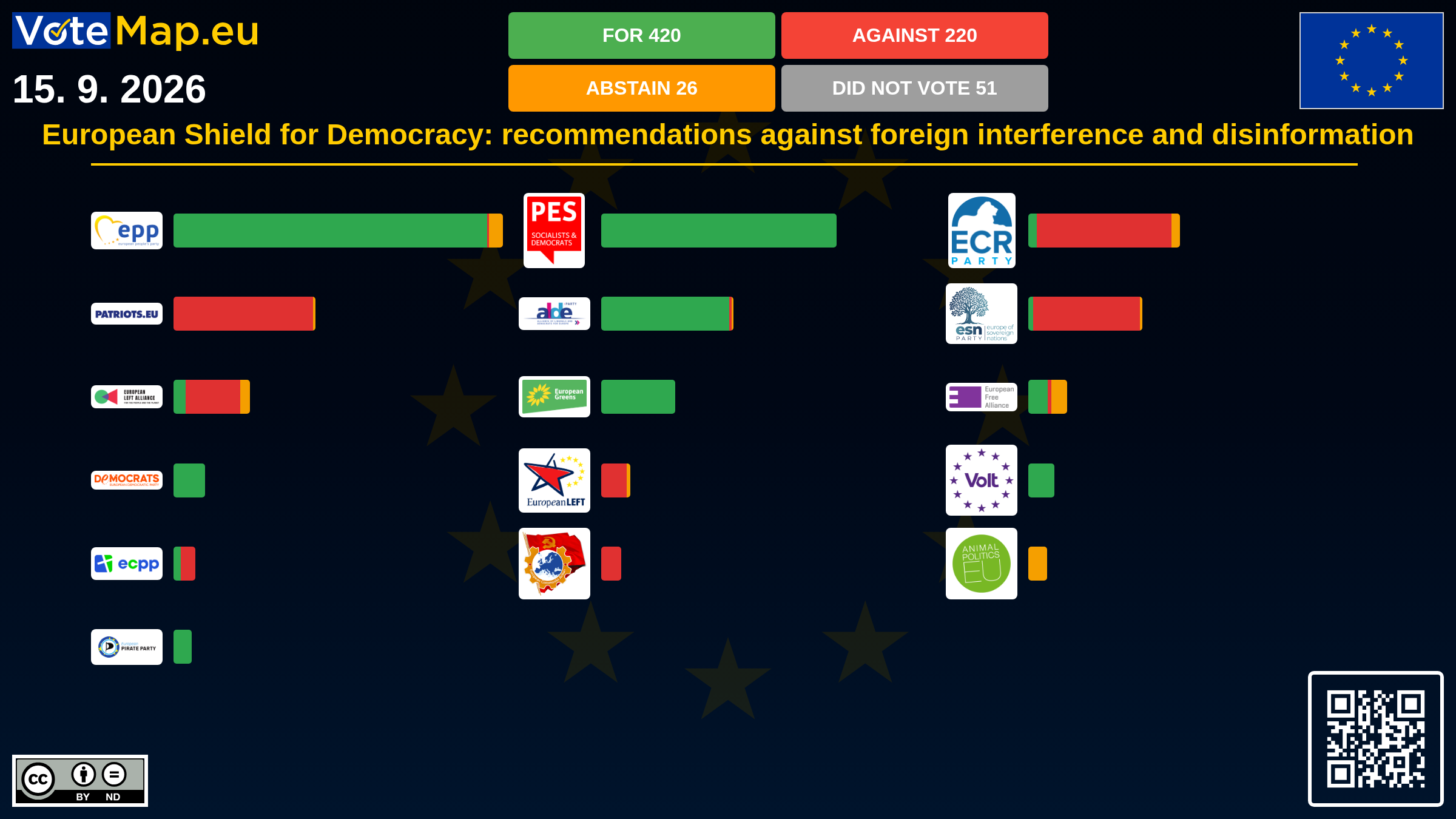
The Special Committee on the European Democracy Shield (EUDS) was established in the European Parliament as early as December 2024 as the successor to the previous INGE committees dealing with foreign interference. After a year and a half of work, it presented a final report containing recommendations, which the Parliament voted on during a plenary session in Strasbourg. The rapporteur was Tomas Tobé (EPP); the text was also contributed to by shadow rapporteurs from the S&D, Renew and Greens/EFA groups – that is, the remaining three democratic groups – as well as from the ECR, PfE, ESN and The Left; it was therefore a report with full political coverage across the spectrum.
At the heart of the recommendations is a proposal to establish an EU Centre for Democratic Resilience – an independent centre of excellence to counter foreign information interference and disinformation, with a clear mandate, budget and mandatory participation by Member States. The report identifies Russia as the main external threat to European democracy due to hybrid attacks on critical infrastructure (cyber-attacks, sabotage, arson, espionage, signal jamming) and names Belarus, China, Iran and North Korea. It calls for sanctions to be extended to those who facilitate disinformation or help circumvent existing sanctions, and condemns Russia’s politically motivated ‘blacklists’ of EU officials, journalists and MEPs.
In the digital sphere, the recommendations do not call for new legislation, but for the rigorous enforcement of the Digital Services Act (DSA) and the Artificial Intelligence Act – platforms should be held accountable for combating bots that influence elections. On electoral resilience, it proposes classifying electoral infrastructure as critical infrastructure, introducing a ‘know your donor’ principle for political donations made via cryptocurrencies, measures against deepfakes and misleading advertising, and the protection of female candidates. It also emphasises the need to strengthen media literacy, support an independent civil society, fund investigative journalism, and introduce a ‘European Day of Preparedness’ on 24 February – the anniversary of the Russian invasion of Ukraine.
The plenary adopted the recommendations by a vote of 420 in favour, 220 against, with 26 abstentions. There was almost complete consensus across the four democratic groups – the EPP, S&D and Renew voted unanimously in favour, whilst the Greens/EFA voted almost unanimously in favour. Conversely, the ECR, PfE and ESN opposed the motion in a coordinated manner – all three far-right groups voted against it by an overwhelming majority, which is consistent with the pattern whereby democratic consensus is met with staunch opposition from the far right.
Overall turnout was high, at over 92 per cent of occupied seats – in line with the usual level for final votes on Tuesdays. Among the participating groups, the far-right ESN had the highest turnout (over 96 per cent), whilst PfE had the lowest (just under 87 per cent) – yet both voted against the motion in a coordinated manner, demonstrating the same internal cohesion. The figures alone do not reveal the reason for this difference.