Carbon farming certification methodologies
2026-10-20
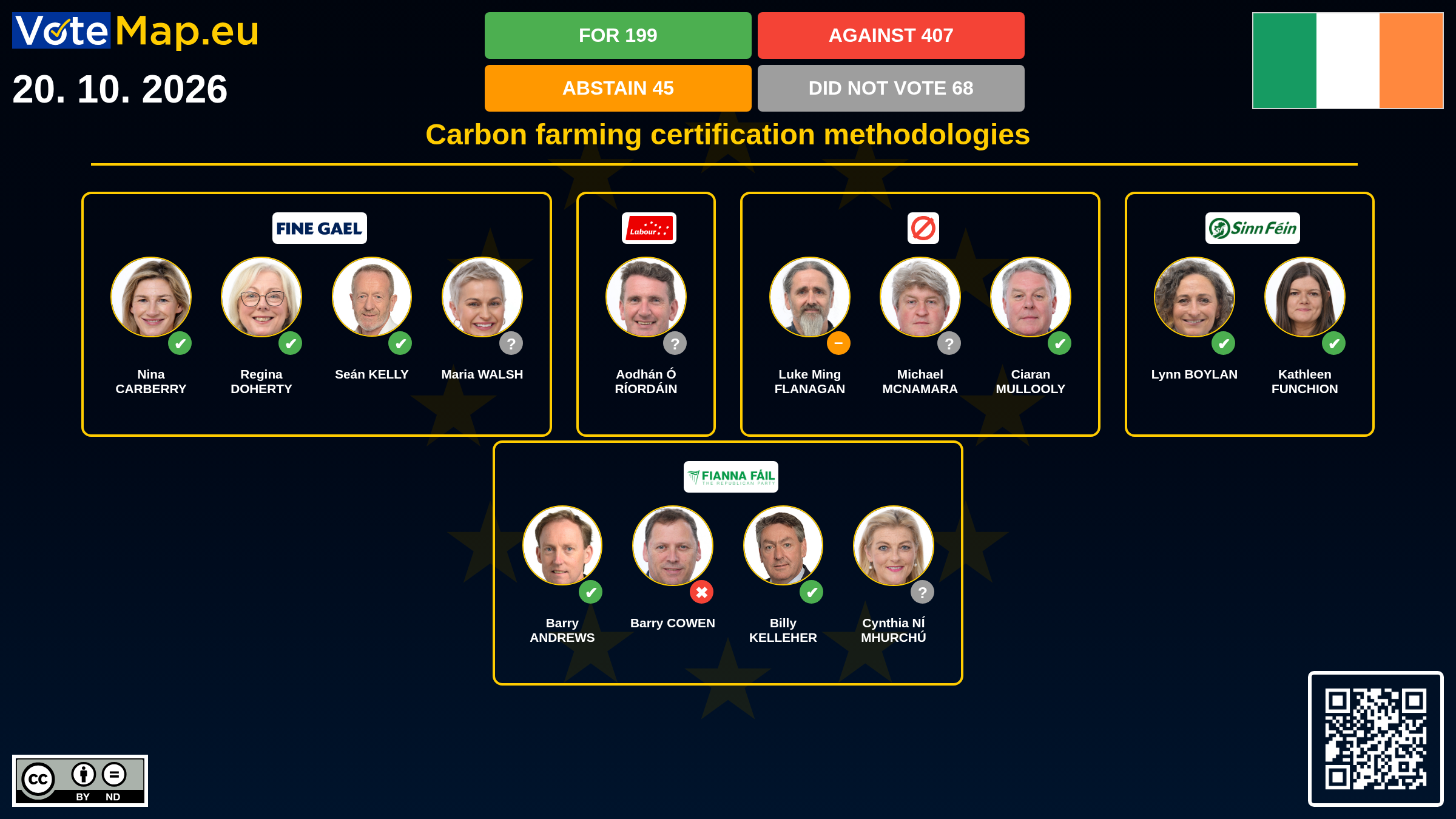
The objection raised by the S&D, Greens/EFA and The Left against the Commission’s methodologies for certifying low-carbon agriculture was not upheld. 199 MEPs voted in favour, 407 against and 45 abstained; 361 votes in favour were required to block the measure. The EPP and Renew voted against the objection alongside the ECR, PfE and ESN; the S&D supported it by a majority, whilst the Greens/EFA backed it almost unanimously. Commission Regulation C(2026)4666 was therefore not blocked.
Regulation (EU) 2024/3012 established a framework within the EU for the certification of carbon removal and carbon farming. Carbon farming refers to agricultural practices designed to sequester carbon in the soil and landscape, such as soil management, the restoration of peatlands and wetlands, or afforestation. The certificate is intended to demonstrate that carbon sequestration has actually taken place and in what quantity. The Commission has set out how this is calculated and verified in the methodologies adopted by Delegated Regulation (EU) C(2026)4666.
Such an act is adopted by the Commission itself, but the European Parliament may block it by raising an objection. This must be supported by an absolute majority of all MEPs, i.e. at least 361 votes in favour, regardless of how many MEPs vote against. If the objection does not reach this threshold, the act may enter into force.
The objection was tabled on behalf of their groups by Tiemo Wölken (S&D), Michael Bloss (Greens/EFA) and Martin Günther (The Left). In their view, the methodologies do not take into account direct or indirect greenhouse gas emissions over the entire lifetime of the activity, including indirect land-use change. The proposers regard this as a breach of the mandate set out in Regulation 2024/3012 and as rules that are less stringent than those required by the mechanism under Article 6(4) of the Paris Agreement. They also criticise the fact that existing projects are exempt from the financial additionality test. Consequently, revenue from certification may flow to projects that would have been established even without it. In their view, there is also no ‘business-as-usual’ test. According to the proposers, the risk rates for the reserve fund are unusually low (a ceiling of 15 per cent for mineral soils). In the case of peatlands, they argue that risk is not assessed at all, and the methodology for their rewetting lacks a mechanism to hold parties accountable should the sequestered carbon be released again. They further state that the methodologies lack safeguards against land speculation. In doing so, they refer to the warning from the European Scientific Advisory Board on Climate Change against over-reliance on temporary CO₂ removal.
The objection was rejected: 199 MEPs voted in favour, 407 against and 45 abstained. The EPP was opposed, with the exception of four MEPs (166 against, 4 in favour), as was Renew (59 against, 13 in favour). The Greens/EFA supported the objection with 47 votes, whilst one MEP abstained. The S&D Group was largely in favour, but was the least united of the four groups: 92 in favour, 24 against, 7 abstentions. The pro-European majority was therefore divided, and no common position could be found on this issue. The S&D and Greens/EFA sought to block the measure, whilst the EPP and Renew did not.
The EPP and Renew voted against the objection alongside the ECR (70 against, 4 in favour), the PfE (51 against, 28 abstentions) and the ESN (20 against, 1 abstention). More than a third of PfE voters abstained, meaning the far right did not vote as a unified bloc. The Left, i.e. the far left, supported the objection (37 in favour, 1 abstention).
The votes of the far right did not decide the outcome. Without them, there would have been 195 votes in favour of the objection, well below the threshold of 361. The decisive factor was that the EPP and Renew did not support it. The Commission’s act was therefore not blocked and can enter into force.
We collect and visually present data publicly available at the page of European Parliament. Votemap.eu denies any responsibility for possible inconsistencies of the data or its changes after the publication.
Descriptions are created using DeepL Translate machine translation. We apologize for any possible imperfections or inconvenience.