Parliament’s position on the EU budget for 2027
2026-10-21
The European Parliament has adopted its position on the EU budget for 2027 by a vote of 400 in favour, 189 against and 84 abstentions. It restores funds that the Council had cut and, in addition, increases funding for, amongst other things, transport networks, Erasmus+, civil protection, agriculture and the environment. The EPP, S&D, Renew and Greens/EFA groups mostly voted in favour. The PfE and ESN groups mostly voted against, whilst the ECR was divided, with most of its MEPs abstaining. The Left also voted mostly against. Conciliation proceedings with the Council will now follow.
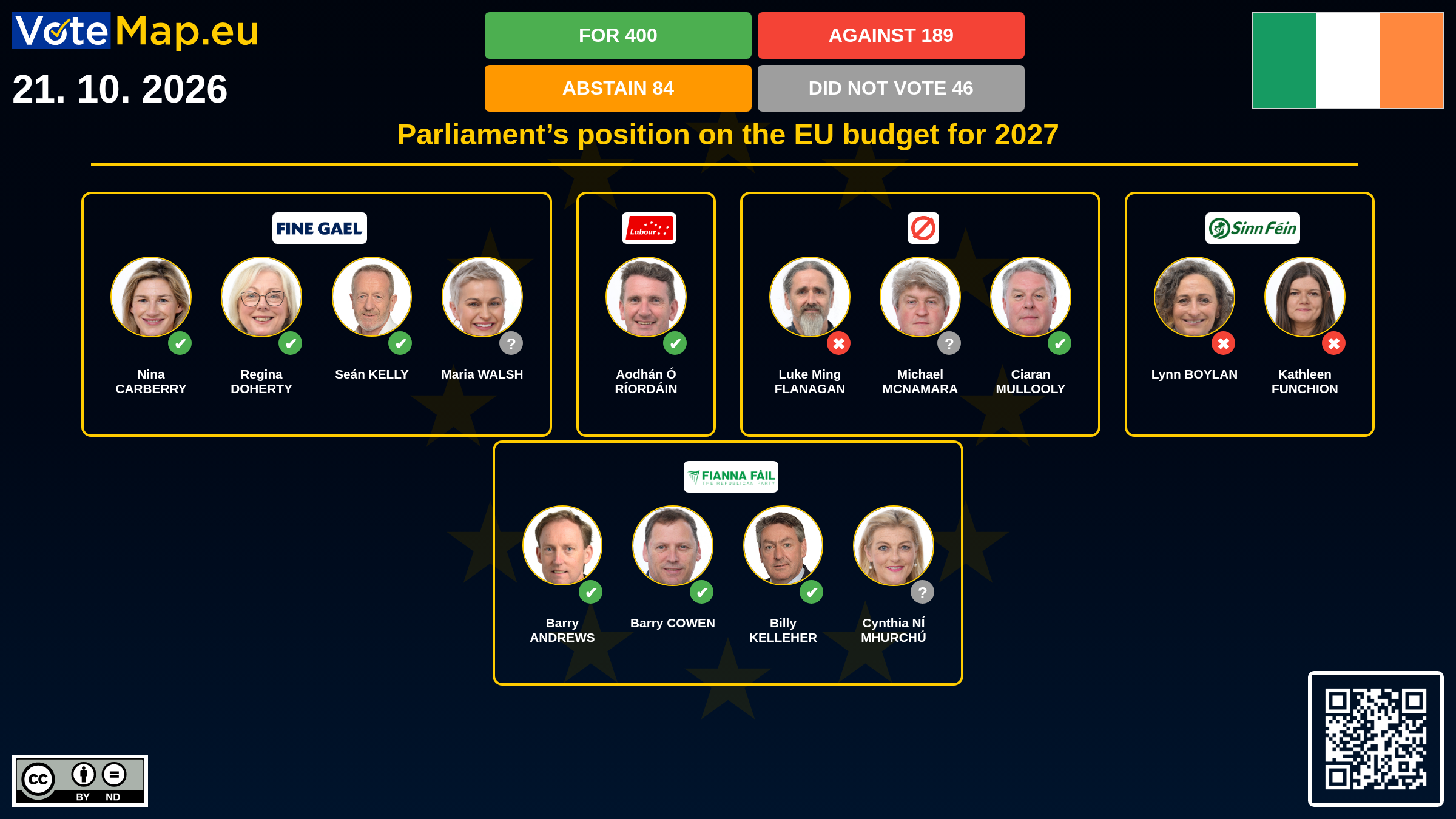
The EU’s annual budget must be approved by the Council, which comprises the governments of the Member States, and by the European Parliament. The Council adopted its position on the draft budget for 2027 on 4 September 2026. The Parliament responded with a resolution amending the Council’s position. The report on behalf of the Committee on Budgets was drawn up by the rapporteurs Nils Ušakovs (S&D) and Michalis Hadjipantela (EPP).
The resolution was adopted by 400 votes in favour, 189 against and 84 abstentions. The amendments to the Council’s position, which were voted on separately, require, under Article 314 of the TFEU, a majority of all Members, i.e. at least 361 votes.
The resolution was supported by the EPP, S&D, Renew and Greens/EFA – that is, the pro-European majority – but none of these groups voted as a bloc. The EPP recorded 163 votes in favour, 3 against and 4 abstentions; the S&D, 122 in favour, 1 against and 8 abstentions; and the Greens/EFA, 44 in favour, 1 against and 2 abstentions. Of these four groups, Renew had the highest number of votes against: 64 in favour and 10 against.
The ESN voted against, with the exception of one MEP who abstained (23 against, 1 abstention). The PfE was mostly against (63 against, 18 abstentions). The ECR was divided: 44 of its MEPs abstained, 28 voted against and 4 in favour. The Left (far left) voted mostly against: 39 against, 1 in favour and 4 abstentions.
In its position, the Council reduced commitments across the headings of the multiannual budget by €1,003.2 million to €191,877.9 million and payments by €501.8 million to €202,065.8 million. The resolution strongly disagrees with this. It argues that the Council is misleadingly presenting the cuts across programmes as prudent budgeting and is thereby creating artificial margins.
The resolution restores the funds cut by the Council and adds further funds. For the Single Market, Innovation and the Digital Agenda, it restores €435,527,000 and adds €376,657,801 to the original draft budget. These include, amongst others, Horizon Europe (63 million) and the Connecting Europe Facility (260,460,201 euros, of which 205,460,201 is for transport). For resilience and values, it is restoring €523,143,000 and adding €275.1 million, for example to civil protection (€80 million), EU4Health (€50 million) and Erasmus+ (€96 million). It is adding 85 million each to the Agricultural Guarantee Fund and the LIFE programme. A further 20 million is allocated to asylum, migration and integration, and 40 million to border management and visas. In defence, it is adding, amongst other things, 20 million for military mobility. In the area of foreign policy, it is allocating 99 million to the NDICI-Global Europe instrument and 40 million to humanitarian aid. It is also calling for the full utilisation of the loan facility to support Ukraine, amounting to 1,115 million euros.
The Council left the Parliament’s own budget unchanged at 2,656,435,753 euros. Parliament is adding 10,028,000 euros to this for the voluntary pension fund for MEPs. On 15 June 2026, its Bureau noted that, as the fund had exhausted its assets, pensions from it would be paid directly from Parliament’s budget from 1 January 2027. According to the resolution, this will not affect the 2 per cent ceiling for non-statutory expenditure.
The amended proposal will now be forwarded to the Council and the Commission. The final form of the 2027 budget will be negotiated in the Conciliation Committee between Parliament and the Council.
We collect and visually present data publicly available at the page of European Parliament. Votemap.eu denies any responsibility for possible inconsistencies of the data or its changes after the publication.
Descriptions are created using DeepL Translate machine translation. We apologize for any possible imperfections or inconvenience.