Council of Europe Convention on AI and Human Rights
2026-03-11
The motion for the European Union to accede to the Council of Europe’s Framework Convention on Artificial Intelligence, Human Rights, Democracy and the Rule of Law was supported by 455 MEPs, with 101 voting against and 74 abstaining. The EPP, S&D, Renew and Greens/EFA – in other words, the entire pro-European majority – voted unanimously in favour, as did The Left. The PfE and ESN voted against, whilst the majority of ECR MEPs abstained.
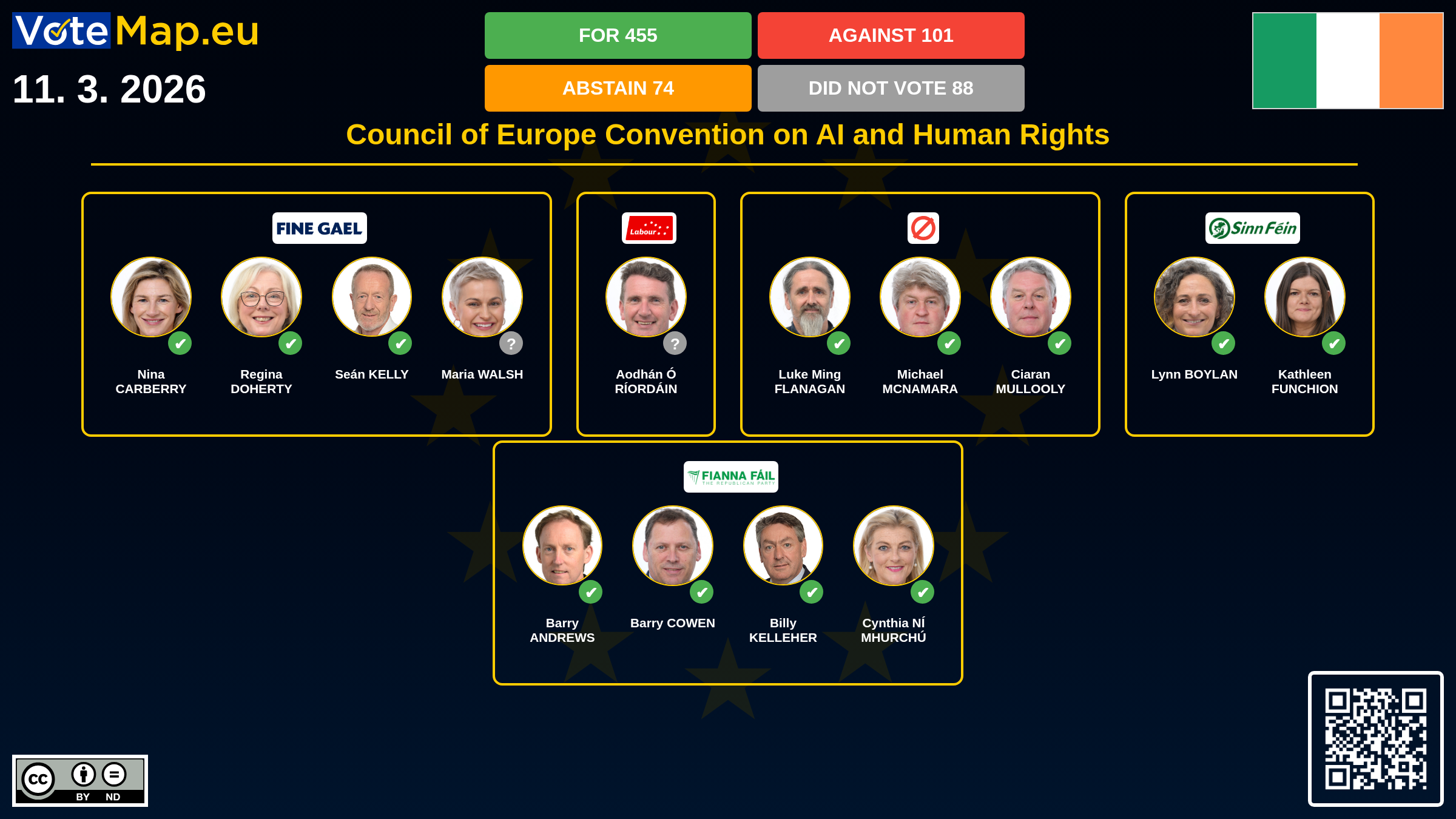
A vote was held on the European Parliament’s consent for the European Union to conclude the Council of Europe Framework Convention on Artificial Intelligence and Human Rights, Democracy and the Rule of Law (CETS 225). This was not a new piece of European legislation. The Convention was negotiated by the Council of Europe, an international organisation which is not an EU body, and its text is finalised. Parliament does not amend it under this procedure: under Article 218 of the Treaty on the Functioning of the EU, it merely decides whether to give its consent to the conclusion of the Convention on behalf of the Union. The resolution adopted is therefore very brief. It grants consent to the conclusion of the Convention and instructs the President of the Parliament to forward the Parliament’s position to the Council, the Commission, the governments and parliaments of the Member States, and the Secretary General of the Council of Europe.
According to the summary in Parliament’s OEIL legislative database, the convention is intended to ensure that all stages of the life cycle of artificial intelligence systems respect human rights, democracy and the rule of law. It explicitly mentions the protection of children from manipulative design and from dangerous interactions with AI, namely conversational systems and applications targeting minors.
The report was drawn up jointly by two committees: the Committee on the Internal Market and Consumer Protection (IMCO), with José Cepeda (S&D) as rapporteur, and the Committee on Civil Liberties, Justice and Home Affairs (LIBE), with Paulo Cunha (EPP) as rapporteur. The Committee on Culture and Education (CULT) sent a letter; the rapporteur was Nela Riehl (Greens/EFA). The shadow rapporteurs were from all four groups of the pro-European majority: Dimitris Tsiodras (EPP), Ana Catarina Mendes (S&D), Sophie Wilmès (Renew) and Hannah Neumann (Greens/EFA).
The motion was passed: 455 MEPs voted in favour, 101 against, and 74 abstained. The result was secured by the pro-European majority. The EPP cast 165 votes in favour, with one of its MEPs abstaining. The S&D group cast 116 votes in favour, Renew 68 and Greens/EFA 47. None of these four groups cast a single vote against, and together they contributed 396 votes in favour. We have no documented separate statement on this vote from any of them; their position is therefore a unanimous vote in favour. The far-left group The Left also supported the motion (42 in favour, 1 abstention).
The far right did not vote as a bloc. PfE voted against (56 against, 7 abstentions), whilst ESN voted against with all 24 of its votes. The majority of the ECR abstained: 63 of its MEPs abstained, 11 voted against and 1 voted in favour. The EPP did not vote alongside the far right on this issue, and the result was decided by a pro-European majority.
We collect and visually present data publicly available at the page of European Parliament. Votemap.eu denies any responsibility for possible inconsistencies of the data or its changes after the publication.
Descriptions are created using DeepL Translate machine translation. We apologize for any possible imperfections or inconvenience.