The European Union’s Enlargement Strategy
2026-03-11
The European Parliament adopted the report on the EU’s enlargement strategy by 385 votes in favour, 147 against and 98 abstentions. It received unanimous support from all four groups of the pro-European majority – the EPP, S&D, Renew and Greens/EFA. The PfE and ESN voted against it, whilst the ECR largely abstained. The resolution commends the progress made by Montenegro and Albania, views developments in Serbia, Georgia and Turkey as the most worrying, and openly condemns Russian hybrid operations and interference in elections.
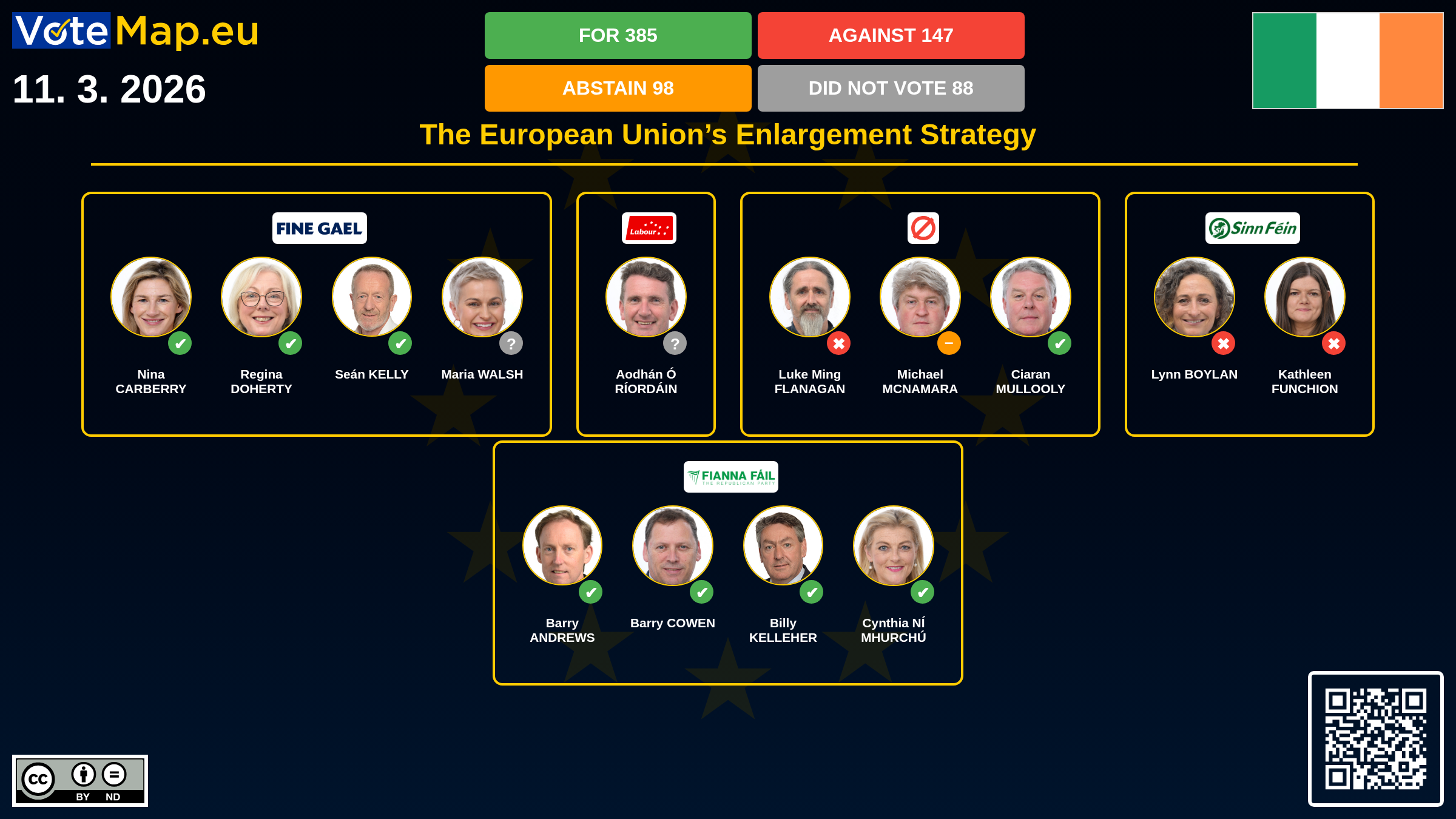
The report by the Committee on Foreign Affairs (A10-0016/2026) was drawn up by the rapporteur, Petras Auštrevičius (Renew). It does not focus on any one country, but on the enlargement policy as a whole. It notes that “nine out of ten countries currently aspiring to EU membership have candidate country status”, and assesses the individual countries on a sliding scale.
It commends Montenegro and Albania for the progress they have made and notes their ambition to conclude negotiations by the end of 2026 and 2027 respectively. It welcomes the candidate country status granted to Bosnia and Herzegovina. It commends Ukraine’s resilience, praises Moldova for completing its screening process, and calls for the opening of negotiation chapters with both countries. At the same time, it “urgently calls on the Hungarian Government to stop blocking the negotiations” and expresses regret that the Council has not agreed on the use of frozen Russian assets. It sees the most worrying developments and the greatest retreat from democracy in Serbia, Georgia and Turkey in particular.
The text also directly names external actors. It attributes hybrid operations, interference in elections and disinformation campaigns to Russia; it notes that Russia occupies parts of the territory of three candidate countries; and it describes the Russian Orthodox Church as an instrument of soft power. With regard to China, it highlights economic and security dependence, particularly in the Western Balkans and Georgia.
The report was supported by 385 MEPs, with 147 voting against and 98 abstaining. All four groups of the pro-European majority voted unanimously in favour: EPP 146 in favour, 9 against, 12 abstentions; S&D: 107 in favour, 3 against, 8 abstentions; Renew: 67 in favour and 1 abstention; Greens/EFA: all 47 in favour. The report was thus passed by the votes of the pro-European majority; on this occasion, there was no cooperation between the EPP and the far right.
PfE voted against (56 against, 6 abstentions), as did ESN (23 against, 1 abstention). The ECR largely abstained: 54 of its MEPs abstained, 11 voted against and 7 in favour. The far right therefore did not vote as a single bloc. The Left (far left) voted predominantly against: 22 against, 7 in favour and 14 abstentions.
All four groups of the pro-European majority contributed to the text: Renew via its rapporteurs, and the EPP, S&D and Greens/EFA via their shadow rapporteurs Andrey Kovatchev, Tonin Picula and Thomas Waitz. We were unable to find separate press statements from the groups regarding this vote, but their positions were expressed during the debate, where they spoke on behalf of their respective groups.
Andrey Kovatchev, speaking on behalf of the EPP, said that “enlargement is not just one of Europe’s policies, but a long-term investment in the security, stability and prosperity of the entire European Union”. Tonino Picula, speaking on behalf of the S&D, pointed out that “the European Union is not just a single market, an area of free movement or a single currency. The European Union is an area of shared values, but also an area of shared risks.”
Rapporteur Petras Auštrevičius (Renew) stated during the debate: “Russia’s direct military aggression against Ukraine and its hybrid war against Europe are forcing us to rethink our strategies for unification… Without a clear enlargement strategy, the integration process based on legal standards becomes a politically untenable dialogue.”
Thomas Waitz, speaking on behalf of the Greens/EFA, emphasised that membership is conditional: “This is precisely what a merit-based process means: countries must meet these criteria of the rule of law.”
The quotations are taken from the verbatim record of the debate, translated from Bulgarian, Croatian and English.
We collect and visually present data publicly available at the page of European Parliament. Votemap.eu denies any responsibility for possible inconsistencies of the data or its changes after the publication.
Descriptions are created using DeepL Translate machine translation. We apologize for any possible imperfections or inconvenience.