Emissions allowances: the dispute over the future of the ETS market reserve
2026-09-15
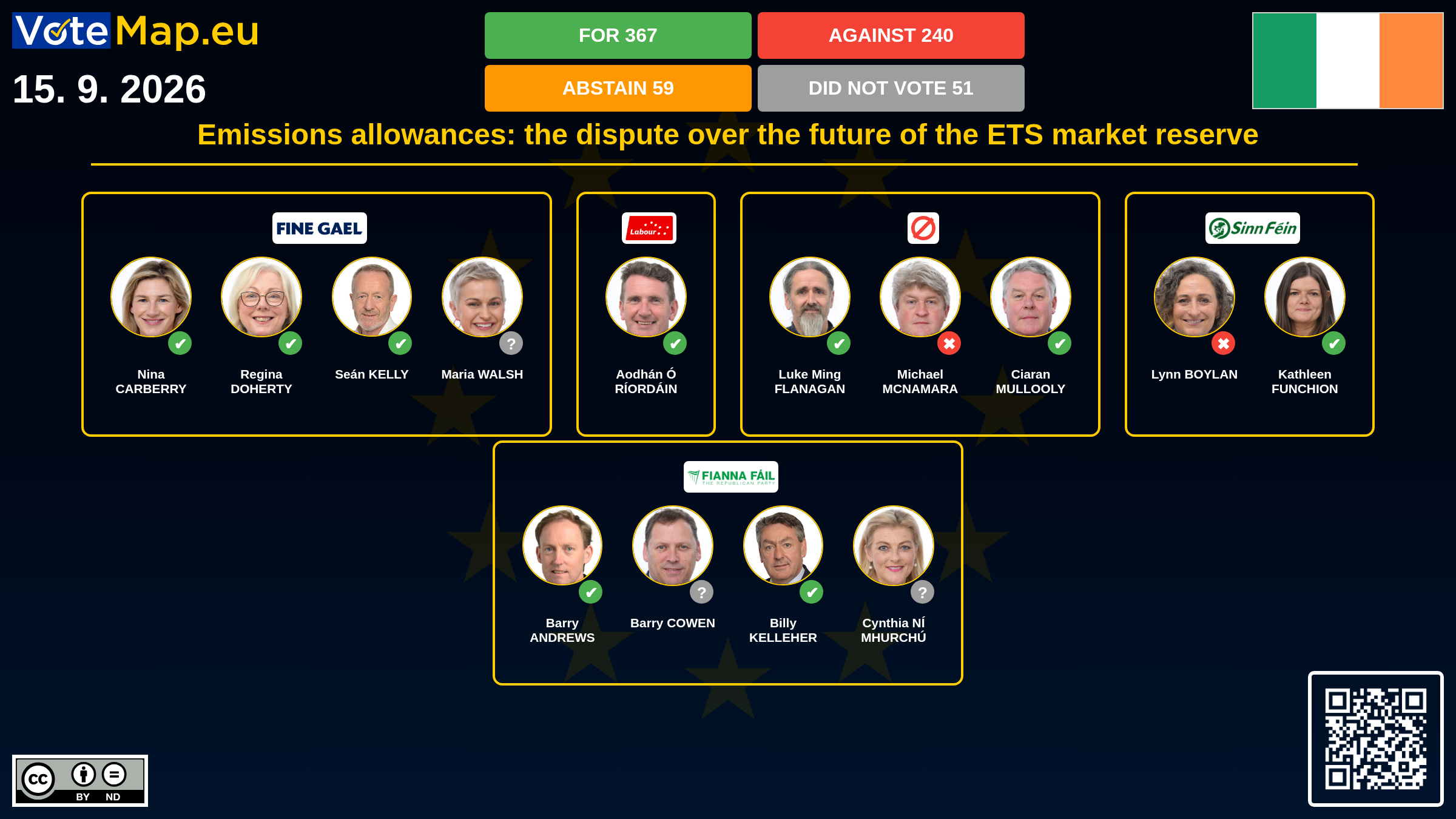
The Parliament in Strasbourg adopted its negotiating position on the revision of the EU ETS market stability reserve by a vote of 367 to 240 (with 59 abstentions). The Commission had proposed completely abolishing the cancellation of surplus allowances in excess of 400 million; MEPs, however, opted for a more moderate approach — raising the threshold to 650 million from March 2027. The EPP, S&D and Renew groups voted in favour, whilst the Greens/EFA were against, although a large proportion of the group chose to abstain.
The European Parliament in Strasbourg has adopted its negotiating position on the revision of the Market Stability Reserve (MSR) under the EU Emissions Trading Scheme (EU ETS). This is a mechanism which, since 2019, has balanced the supply and demand for emission allowances and, from 2023, will also permanently cancel (‘invalidate’) allowances above a specified threshold to prevent a surplus from arising on the market.
In April 2026, the European Commission proposed abolishing this invalidation altogether — according to the Commission, allowances exceeding the current threshold of 400 million should remain in the reserve as a ‘liquidity buffer’ for future market fluctuations after the mid-2030s. Both the Committee on the Environment (ENVI) and subsequently the plenary session moved away from this proposal and opted for a middle ground: the cancellation mechanism remains in place, but the threshold above which allowances are cancelled will increase from 400 million to 650 million units from 1 March 2027.
The plenary approved its position at first reading by 367 votes to 240, with 59 MEPs abstaining. This constitutes a negotiating mandate for the trilogue with the Council, not the final adoption of the legislation.
There was consensus across the centre of Parliament: the EPP voted in favour (139 to 36), the S&D (114 to 14) and Renew (64 to 9) — the S&D and Renew groups voted very cohesively, whilst support within the EPP was somewhat less unanimous. The Greens/EFA were the only one of the four democratic groups to vote against (8 : 13), with a significant number of MEPs abstaining — more on this below. The rapporteur for the report is Pierfrancesco Maran (S&D); all four democratic groups had shadow rapporteurs.
The Greens/EFA’s position is interesting in contrast to the vote a week earlier in the ENVI Committee, where all Verts/ALE members present supported the same compromise text. In plenary, the group as a whole did not manage to reach a clear ‘yes’ vote.
All three far-right groups — ECR (17 : 58), PfE (6 : 66) and ESN (2 : 23) — also voted against, acting in a united and coordinated manner. Nevertheless, they ended up on the losing side: the proposal was passed thanks to the alliance of the EPP, S&D and Renew, not thanks to an alliance with the far right.
Overall turnout for the vote reached 92.9 per cent (666 out of 717 occupied seats), which is in line with the usual Tuesday attendance at plenary sessions. The behaviour of the Greens/EFA and The Left was noteworthy: in both groups (turnout 92.5 per cent, and 88.6 per cent respectively) a large proportion of the members present — 57 per cent for the Greens/EFA and 59 per cent for The Left — chose to abstain rather than cast a clear vote for or against. For no other group did the proportion of abstentions exceed 12 per cent.)
We collect and visually present data publicly available at the page of European Parliament. Votemap.eu denies any responsibility for possible inconsistencies of the data or its changes after the publication.
Descriptions are created using DeepL Translate machine translation. We apologize for any possible imperfections or inconvenience.