EU–Switzerland Agreement on Passenger Name Record (PNR) Data: consensus across the political spectrum, division within the Greens
2026-09-16
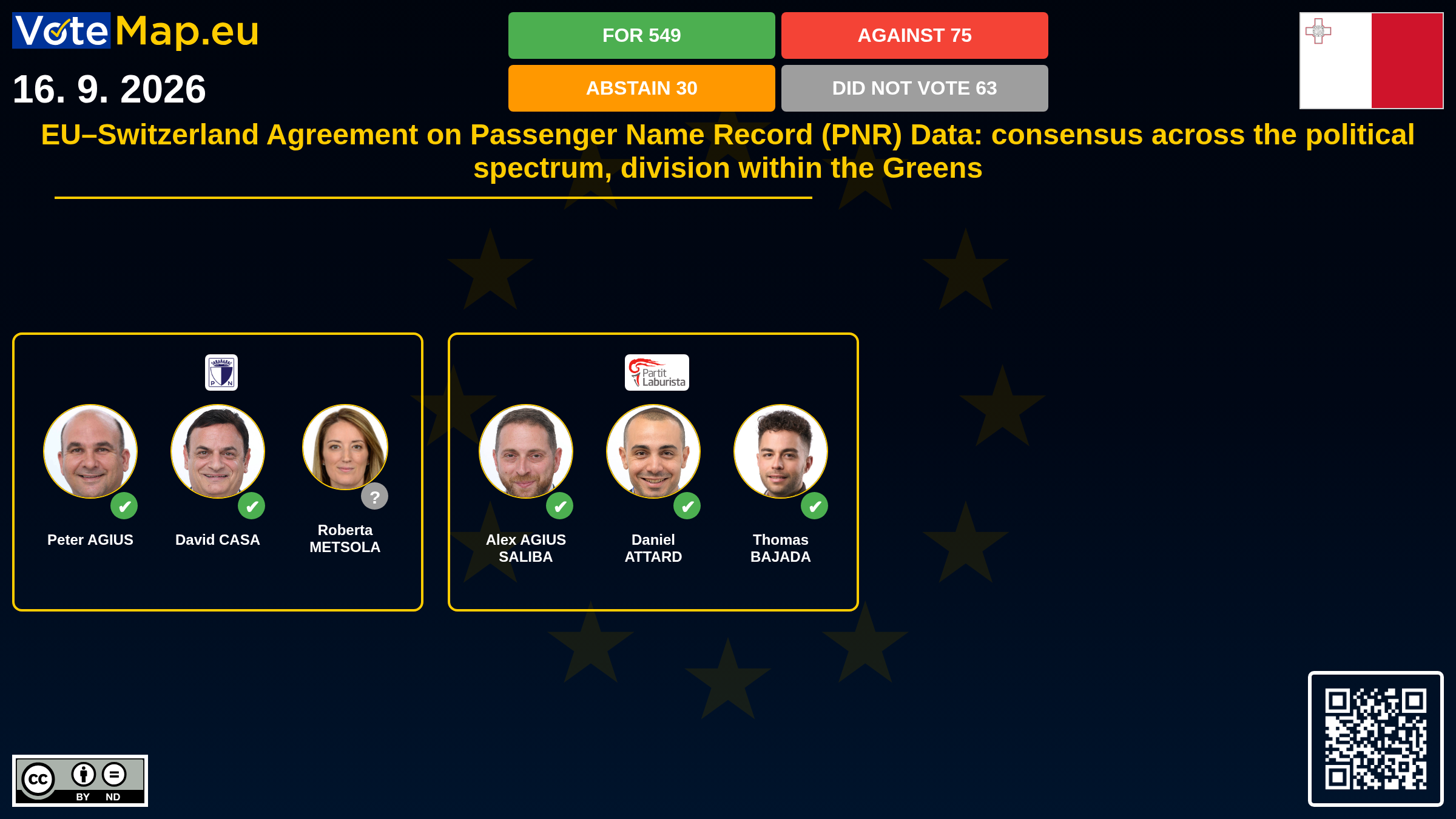
Parliament has given its consent to the agreement between the EU and Switzerland on the transfer of air passenger name record (PNR) data to combat terrorism and serious crime. This is a consent procedure (NLE) — Parliament could only approve or reject the agreement in its entirety; it could not amend it in any way. The vote was 549 in favour, 75 against, with 30 abstentions, and a turnout of 91.2 per cent of MEPs. Three out of four centre-right and centre-left groups (EPP, S&D, Renew) voted almost unanimously in favour, whilst Greens/EFA were the only group to vote against.
The Parliament in Strasbourg has approved an agreement between the European Union and Switzerland on the transfer of Passenger Name Record (PNR) data between air carriers and the Swiss authorities. The agreement is intended to prevent, detect, investigate and prosecute terrorist offences and serious crime.
This is a procedure whereby Parliament (NLE) gives its consent to an international agreement negotiated by the European Commission and signed by the Council. Parliament has no right to propose amendments to such an agreement — it may either approve or reject it in its entirety, but cannot amend the text negotiated by the Commission and Switzerland in any way. The Council may only adopt a decision to conclude the agreement if Parliament gives its consent.
The agreement addresses a gap arising from the fact that, whilst Switzerland is part of the Schengen area, the EU Directive on PNR data (2016/681) is not part of the Schengen acquis — without a specific agreement, Switzerland would not be permitted to legally receive and process PNR data from flights between the EU and Switzerland.
Specifically, the agreement stipulates that airlines themselves send the data (the so-called ‘push’ method) to the Swiss passenger information unit. This includes the travel itinerary, contact details, baggage information, method of payment and other booking details; sensitive categories of data, such as racial or ethnic origin, political opinions or religious beliefs, must not be processed at all. Data may be retained for a maximum of five years and must be depersonalised no later than six months after receipt. Any further disclosure of data within Switzerland or outside Switzerland and the EU requires prior authorisation from a judicial or other independent body.
Parliament gave its approval by a vote of 549 in favour, 75 against and 30 abstentions, with a turnout of 91.2 per cent of MEPs. Three of the four major pro-European groups — the EPP, S&D and Renew — voted almost unanimously in favour (the EPP unanimously, the S&D with no votes against and only a few abstentions, and Renew with just one vote against). The only group to vote against it was the Greens/EFA: the overwhelming majority of its MEPs voted against the agreement, with only a few voting in favour or abstaining. The Greens/EFA are also the only one of the four groups that did not have their own shadow rapporteur for this report in the LIBE Committee – their opposition in plenary is therefore not supported by any position expressed during the negotiations on the text.
It is noteworthy that, on this occasion, the split did not occur between the democratic groups and the far right. The ECR, PfE and ESN all voted overwhelmingly in favour of the agreement, alongside the EPP, S&D and Renew – not against them. The Left was divided on the agreement, with a majority voting against it.
The rapporteur for the report was Jaroslav Bžoch (PfE), who also held the same role for similar EU agreements with Norway and Iceland, approved by Parliament earlier this year. The agreement with Switzerland is thus the third in the same family of bilateral PNR agreements with Schengen-associated states outside the EU.
We collect and visually present data publicly available at the page of European Parliament. Votemap.eu denies any responsibility for possible inconsistencies of the data or its changes after the publication.
Descriptions are created using DeepL Translate machine translation. We apologize for any possible imperfections or inconvenience.