Health resilience in partner countries: the EPP, S&D, Renew and Greens/EFA voted in favour, whilst the far right voted unanimously against (319:142)
2026-09-17
On Thursday 17 September, MEPs adopted a resolution on strengthening health resilience in partner countries by 319 votes to 142 (with 19 abstentions). It responds to the European Commission’s communication on the sharp decline in global health aid. All four pro-democracy groups – the EPP, S&D, Renew and Greens/EFA – voted unanimously in favour. The ECR, PfE and ESN all voted against. Turnout was the lowest of all eight votes held that day, with the EPP recording a turnout of just 54.9 per cent.
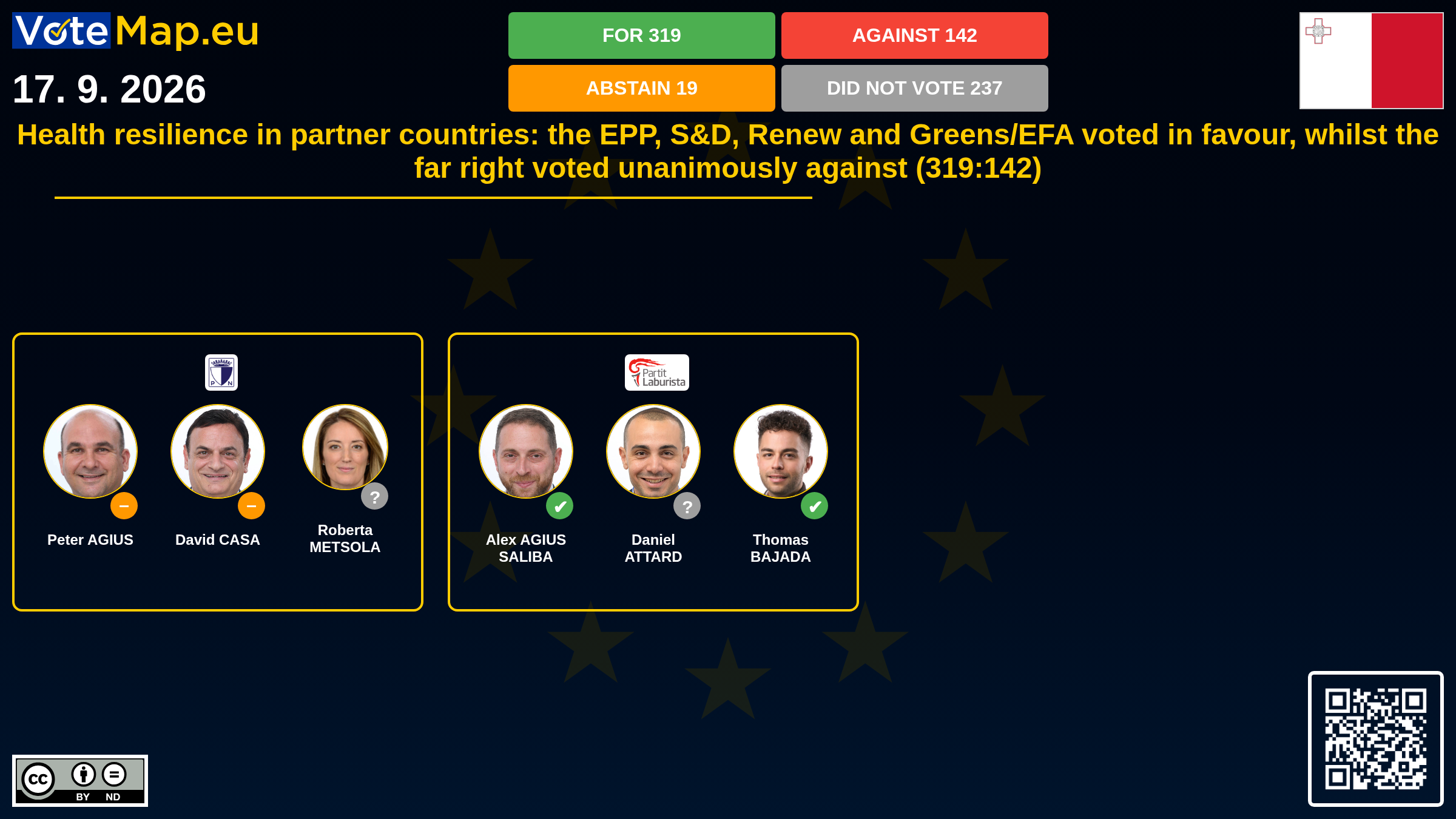
On Thursday 17 September 2026, at a plenary session in Strasbourg, MEPs adopted a resolution on strengthening global health resilience in partner countries (document B10-0385/2026). The result of the vote was 319 in favour, 142 against, with 19 MEPs abstaining. This is a resolution under Rule 142 of the Rules of Procedure, which follows on from an oral question to the European Commission – it is not a legislative act, but a political statement by Parliament on a topic raised by the Commission.
All four democratic political groups – the EPP, S&D, Renew and Greens/EFA – voted unanimously in favour of the resolution. The S&D and Greens/EFA voted without a single vote against or abstention, whilst the EPP and Renew voted almost as unanimously, with only a few isolated exceptions. The Left group, which lies outside the circle of the four democratic groups as defined by editorial policy, also voted unanimously in favour; however, its vote is a fact that is worth noting. The rapporteur for the resolution in the Committee on Development (DEVE) was Barry Andrews of the Renew group. None of the four democratic groups appointed a shadow rapporteur for the resolution – this is a feature of this specific procedure under Rule 142 of the Rules of Procedure, not a sign of disinterest.
Three far-right groups – the ECR, PfE and ESN – voted against the resolution with a high degree of internal unity. The PfE and ESN voted against it without a single vote in favour, whilst the ECR voted almost as unanimously against it.
Turnout was the lowest of all eight final votes held that day: 480 out of 717 seats were filled, representing 66.9 per cent. The EPP had by far the lowest turnout – only 101 of its 184 MEPs voted, or 54.9 per cent, the lowest of all nine political groups and significantly lower than the EPP’s turnout in the other seven votes held on the same Thursday (79.3 to 85.3 per cent). This is a recorded fact; the reason for the low turnout could not be ascertained.
The resolution responds to the European Commission’s communication COM(2026) 197 final of 13 May 2026, entitled ‘Reinforcing global health resilience amidst geopolitical change’. In it, the Commission points out that global health aid is falling sharply – from approximately 45.8 billion euros in 2024 to 36.1 billion euros in 2025, representing a 21 per cent decline, with a further decline expected by 2030. It describes global health cooperation as increasingly geopolitically charged, with a shift from multilateral cooperation towards transactional bilateral relations, and proposes five priority areas and nine measures for 2026 and 2027 – including, amongst other things, support for greater ‘health sovereignty’ of partner countries, that is, their own financial and political responsibility for their health systems.
The text of the Parliament’s resolution itself was not available at the time of writing. It is therefore not possible to quote the specific demands that Parliament made of the Commission in this resolution – the context described relates to the issue to which the resolution responds, not to the content of the resolution itself.
We collect and visually present data publicly available at the page of European Parliament. Votemap.eu denies any responsibility for possible inconsistencies of the data or its changes after the publication.
Descriptions are created using DeepL Translate machine translation. We apologize for any possible imperfections or inconvenience.