Emissions credits for heavy goods vehicles
2026-03-12
Manufacturers of heavy goods vehicles will find it easier to obtain emission credits for the period 2025–2029. The Commission’s proposal was adopted by a vote of 473 to 81, with 9 abstentions (in favour : against : abstentions). The EPP, S&D and Renew voted in favour; the Greens/EFA were the only one of the four pro-European majority groups to vote against. The EPP voted alongside the ECR, PfE and ESN, but the votes of the far right did not determine the outcome. The far-left group, The Left, voted predominantly against. The vote took place under the urgent procedure, without a committee report.
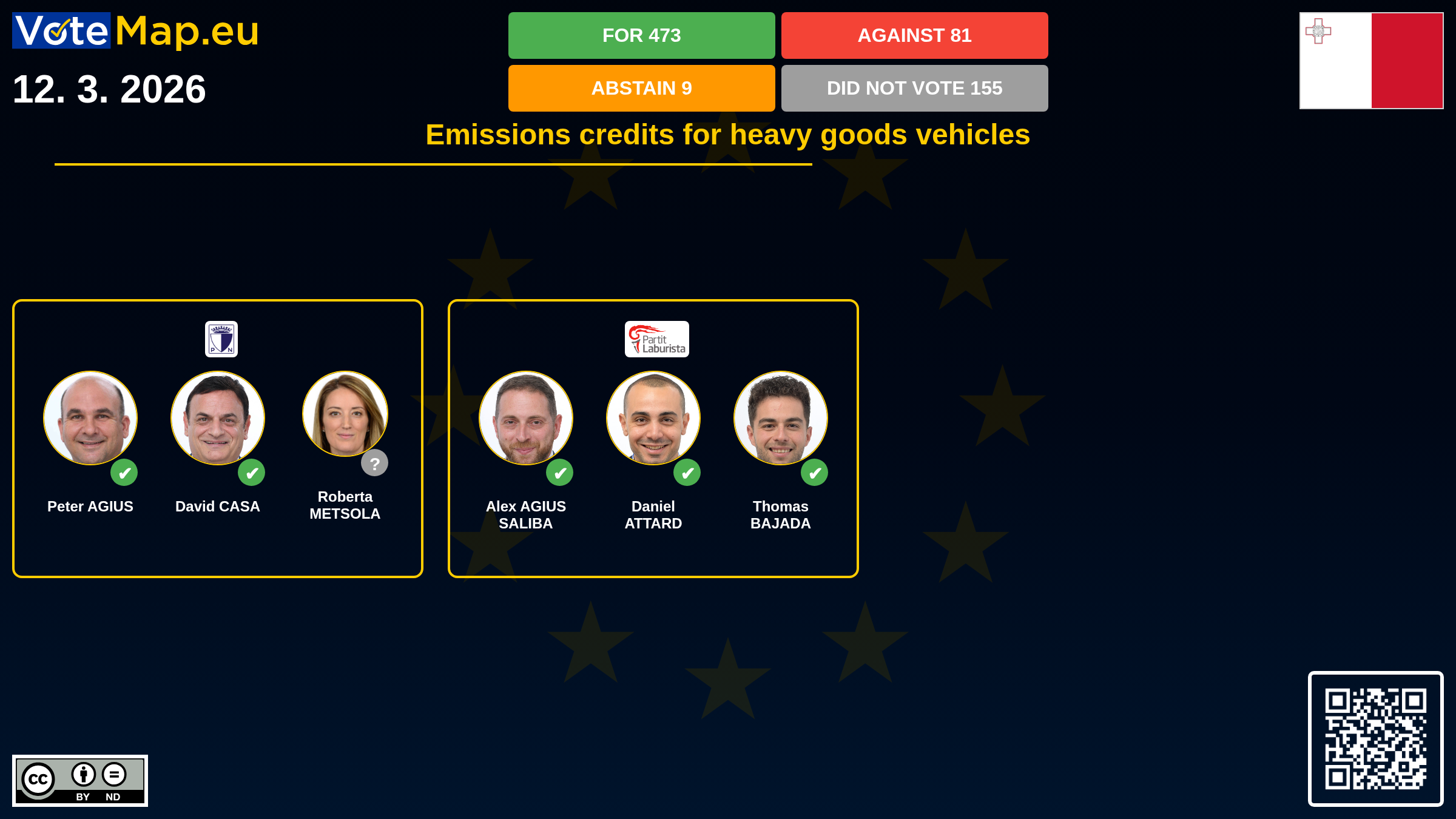
Regulation (EU) 2019/1242 sets standards for CO₂ emissions from new heavy goods vehicles. Manufacturers whose vehicles emit less than the target may receive emission credits for doing so. Until now, credits for years prior to 2030 were only counted if the manufacturer’s emissions were below the so-called linear reduction trajectory. The amendment proposed by the European Commission changes this for the years 2025–2029: a manufacturer will receive a credit whenever its emissions are below the target for that year. This gives manufacturers more leeway before 2030. The targets for 2030 and subsequent years remain unchanged. The amendment does not explicitly apply to city buses.
The Commission published the proposal on 16 December 2025. The EPP Group and the Committee on the Environment (ENVI) requested an urgent procedure, and Parliament approved the request on 10 March 2026. The proposal therefore did not go through the standard committee procedure: no committee report was drawn up, and it has neither a rapporteur nor a shadow rapporteur. The plenary voted directly on the Commission’s text, and no debate took place on it.
Before the final vote, MEPs voted on amendments. The far-left group The Left proposed rejecting the Commission’s proposal in its entirety. Their motion was rejected by a vote of 81 to 473 with 5 abstentions. All 45 Greens/EFA MEPs and 31 MEPs from The Left voted in favour of rejection. None of the three amendments put to the vote were adopted either. Parliament thus adopted the Commission’s text without amendment.
In the final vote, the pro-European majority groups were divided. The EPP (145 in favour, 1 abstention), the S&D (107 in favour, 1 abstention) and Renew (61 in favour) voted unanimously in favour, with not a single vote against. The S&D and Renew groups did not comment on the proposal separately; their position is therefore indicated solely by their vote. Greens/EFA voted unanimously against (45 votes) and was the only one of the four groups to reject the proposal. Greens/EFA did not comment on this amendment separately either, so we do not state the reasons for their vote.
Speaking on behalf of the EPP, Jens Gieseke (EPP), the group’s spokesperson on transport and tourism, commented on the proposal in the group’s press release of 10 March 2026. The press release was published on the day the Parliament approved the urgent procedure and relates to this step, not the final vote. In it, Gieseke stated that the EPP Group supports the Commission’s legislative proposal without any amendments.
The EPP voted alongside the far right: the ECR (55 in favour, 1 against, 2 abstentions), the PfE (60 in favour) and the ESN (21 in favour, 1 against). However, the votes of the far right did not determine the outcome. The EPP, S&D and Renew groups alone had 313 votes in favour, which would have been sufficient for adoption even without them. The far-left group, The Left, voted predominantly against: 31 against, 1 in favour and 4 abstentions.
The Parliament’s position corresponds to the final text of the act. The Council adopted the regulation on 30 March 2026, and on 7 May 2026 it was published in the Official Journal of the EU as Regulation (EU) 2026/1046.
We collect and visually present data publicly available at the page of European Parliament. Votemap.eu denies any responsibility for possible inconsistencies of the data or its changes after the publication.
Descriptions are created using DeepL Translate machine translation. We apologize for any possible imperfections or inconvenience.