Strengthening the role of the euro in the global economy
2026-09-15
MEPs in Strasbourg approved the ECON Committee’s report on strengthening the international role of the euro (rapporteur: Rasmus Andresen, Greens/EFA) by 405 votes to 146, with 60 abstentions. Four democratic groups — the EPP, S&D, Renew and Greens/EFA — voted unanimously in favour, whilst the ECR, PfE and ESN voted together against. Turnout was noticeably lower than for other Tuesday votes: 85.2 per cent of seats were occupied.
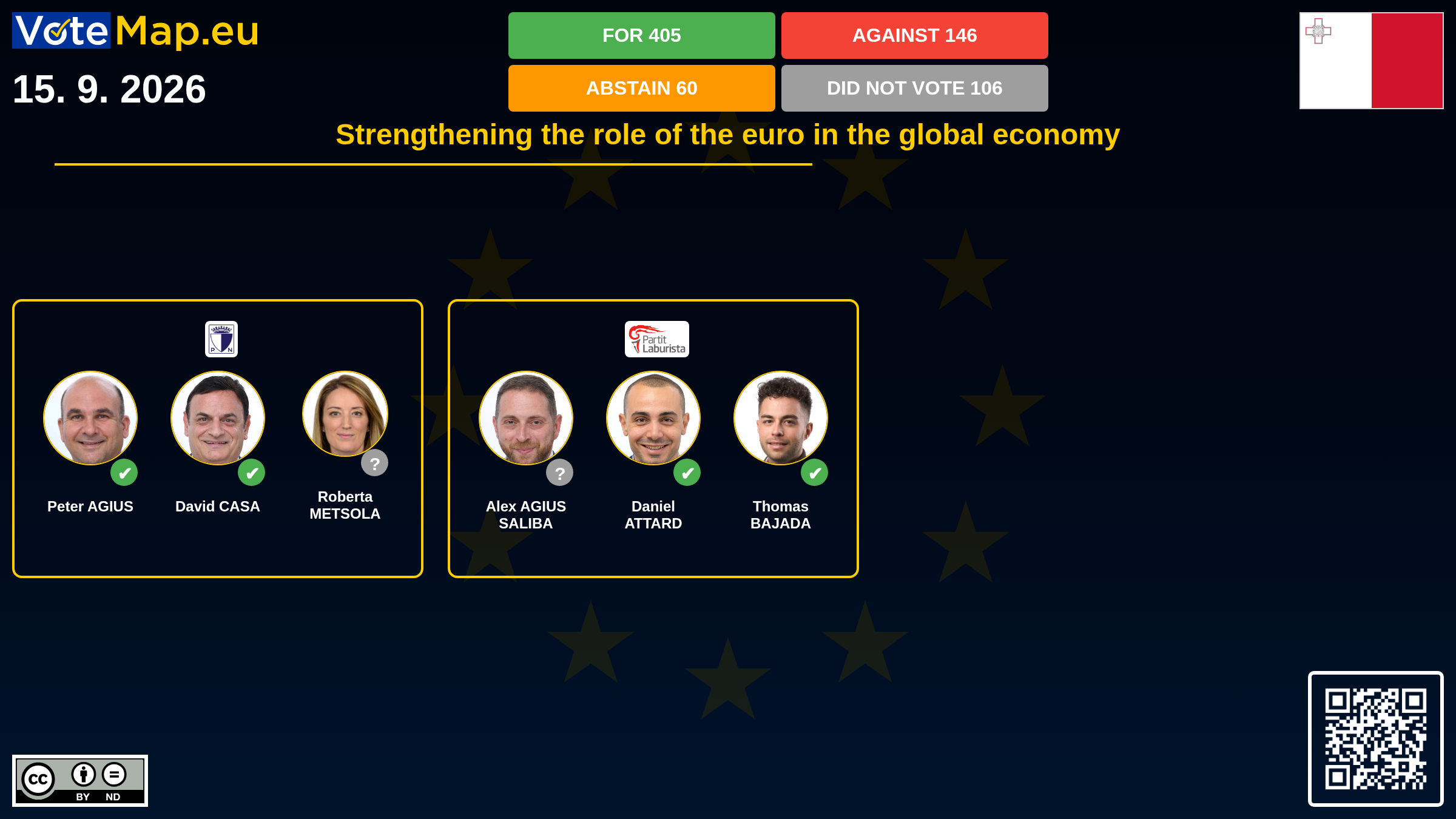
In its final vote, the European Parliament in Strasbourg adopted a report on strengthening the international role of the euro, by 405 votes in favour, 146 against, with 60 abstentions. This was an own-initiative report by the ECON Committee (document A10-0214/2026), for which Rasmus Andresen (Greens/EFA) was the rapporteur. Three of the four democratic groups – the EPP, S&D and Renew – appointed shadow rapporteurs on the subject (the Greens/EFA did not appoint a shadow rapporteur of their own, as the rapporteur himself comes from that group), alongside the ECR, PfE and The Left, meaning that the negotiations on the report covered a broad political spectrum.
The four democratic groups voted unanimously in favour of the report: the EPP supported it by an overwhelming majority, the S&D and Greens/EFA unanimously, and Renew also clearly in favour. By contrast, the ECR, PfE and ESN voted against it as a cohesive, coordinated bloc – the PfE and ESN entirely unanimously, and the ECR by an overwhelming majority. This was not an isolated dissent by a single delegation, but a coordinated move by the entire far right. The voting pattern was thus clear: consensus amongst the democratic centre against the united opposition of the far-right groups.
The report builds on the long-standing debate on how to strengthen the euro’s position in the global economy vis-à-vis the dollar and other currencies. Topics that regularly feature in this debate include the introduction of a digital euro, the completion of the capital markets union, and the idea of a common European safe-haven asset – a bond backed across Member States that could serve as a safe investment comparable to US Treasury bonds.
According to the European Central Bank’s annual report on the international role of the euro from June 2026, the composite index of the euro’s international use rose by 0.2 percentage points in 2025; the euro maintains a share of around one-fifth across indicators of international currency use and remains the second most important currency in the global monetary system, after the dollar. Issuance of international bonds denominated in euros reached a record high of more than $1.1 trillion in 2025, and the euro became the leading currency for green and sustainable bonds for the first time, overtaking the dollar in this segment. Conversely, the euro’s share of global foreign exchange trading fell by around two percentage points to 28.5 per cent. The ECB sets out three conditions for strengthening the euro’s role: economic resilience (completion of the single market and deepening of capital markets), legal and institutional integrity, and geopolitical credibility.
Voter turnout was noticeably lower than in the other final votes of the same Tuesday session: 611 out of 717 occupied seats voted, i.e. 85.2 per cent, whilst the other final votes on Tuesday recorded turnout figures of between 92.9 and 94.3 per cent. The EPP had the highest turnout (89.1 per cent), whilst the ESN had the lowest (77.8 per cent).
We collect and visually present data publicly available at the page of European Parliament. Votemap.eu denies any responsibility for possible inconsistencies of the data or its changes after the publication.
Descriptions are created using DeepL Translate machine translation. We apologize for any possible imperfections or inconvenience.