

The AGILE programme: faster EU support for defence start-ups and small businesses
2026-10-06
The agreement with the Council on the AGILE programme, which is designed to channel EU funds more quickly to small defence firms and start-ups, was passed by 536 votes in favour, 101 against and 16 abstentions. It was supported by all four groups of the pro-European majority (EPP, S&D, Renew, Greens/EFA) and, for the most part, by the ECR and PfE; the ESN and The Left voted against it. We were unable to verify the final budget figure in the text of the agreement; the Commission has proposed €115 million for 2027.
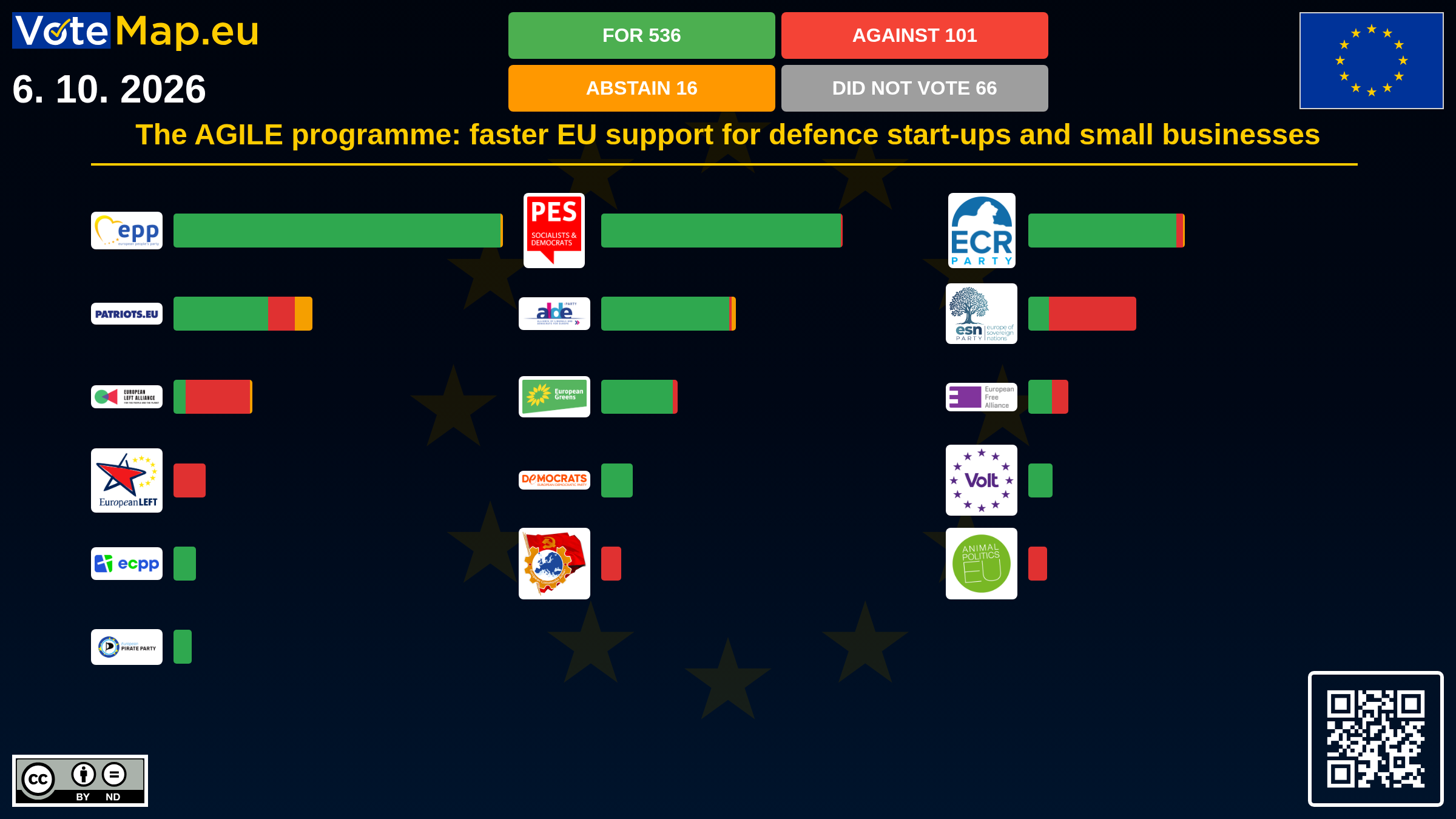
The European Parliament in Strasbourg voted on a provisional agreement with the Council on the regulation establishing the AGILE programme for agile and rapid innovation in defence. The agreement reached in the trilogue is approved by the plenary as a whole; this was therefore the final vote at first reading. It was passed by 536 votes in favour, 101 against and 16 abstentions; a simple majority of the votes cast was sufficient. The rapporteurs were Tonino Picula (S&D) and Ivars Ijabs (Renew).
The programme is aimed at small and medium-sized enterprises and start-ups developing new and groundbreaking defence technologies. It is intended to accelerate the adoption of their products by the armed forces of Member States and major defence contractors. The following figures are taken from the Commission’s March proposal. We did not have access to the final text of the agreement, so please do not regard these figures as definitive. The Commission proposed €115 million for 2027 alone, without any new funding: the amount was to be reallocated from the European Defence Fund, the EDIP programme and the EU space programme. It was intended that the process from application to grant award would take approximately four months, and the support was to cover up to 100 per cent of eligible costs. Companies from Ukraine and EEA/EFTA countries were also to be eligible to apply. The Commission explicitly linked the programme to the challenges facing the armed forces of Member States due to Russia’s war of aggression against Ukraine.
All four groups of the pro-European majority voted in favour. The EPP was united (168 in favour, 1 abstention). Its shadow rapporteur, Jan Farský, stated that AGILE cuts red tape and opens the door to start-ups and small and medium-sized enterprises. The S&D voted in favour by a margin of 122 to 1. Rapporteur Picula had already said, following the July agreement, that Europe “can no longer afford innovations that come too late”. Renew voted in favour (69 in favour, 2 abstentions). We were unable to find a separate statement from the group on the programme. Greens/EFA supported the agreement with 42 votes in favour, whilst 7 of its MEPs voted against; of the four groups, it was the least united in its vote. Shadow rapporteur Sergey Lagodinsky (Greens/EFA) warned that speed must not come at the expense of values.
The difference between the groups is evident in how they describe the safeguard on autonomous weapons. Both the S&D and Greens/EFA state that they secured it during the negotiations, but each describes it differently. According to the S&D, any autonomous weapon systems supported by the programme will be subject to international humanitarian law and meaningful human control. According to the Greens/EFA, the agreement excludes lethal autonomous weapons from funding. The Commission’s March proposal makes no explicit mention of them, and we have been unable to verify the final text. The S&D also takes credit for linking the programme to a loan to support Ukraine and for safeguards against dependence on components from third countries. Greens/EFA take credit for the involvement of Ukrainian innovation companies.
Of the other groups, the ECR voted in favour (75 in favour, 2 against, 1 abstention) and a majority of PfE (50 in favour, 12 against, 10 abstentions). The ESN (2 in favour, 21 against, 1 abstention) and The Left (5 in favour, 36 against, 1 abstention) voted against. The outcome did not depend on the votes of the ECR and PfE: the four groups of the pro-European majority alone gave the agreement 401 votes, whilst a total of 101 MEPs voted against it.
Prior to the vote on the agreement, a motion to reject the Commission’s legislative proposal in its entirety was put to the vote. It was tabled by The Left. It was not passed, with the result standing at 83 in favour, 540 against and 24 abstentions. The ESN voted in favour of rejection (21 in favour, 2 against) as did the majority of The Left (25 in favour, 5 against, 12 abstentions). The EPP, S&D, Renew, Greens/EFA, ECR and PfE were against rejection.