

Protection of workers against carcinogens: limits for cobalt, PAHs, 1,4-dioxane and isoprene, and now also welding fumes
2026-10-06
The European Parliament has approved an agreement with the Council on the sixth revision of the Directive on the protection of workers from carcinogens and mutagens, by 499 votes in favour, 49 against and 104 abstentions. It was supported by all four groups of the pro-European majority (EPP, S&D, Renew and Greens/EFA), although 23 MEPs from the EPP voted against it; the ECR largely abstained. The revision introduces new or stricter limits for cobalt, polycyclic aromatic hydrocarbons, 1,4-dioxane and isoprene, and now includes welding fumes.
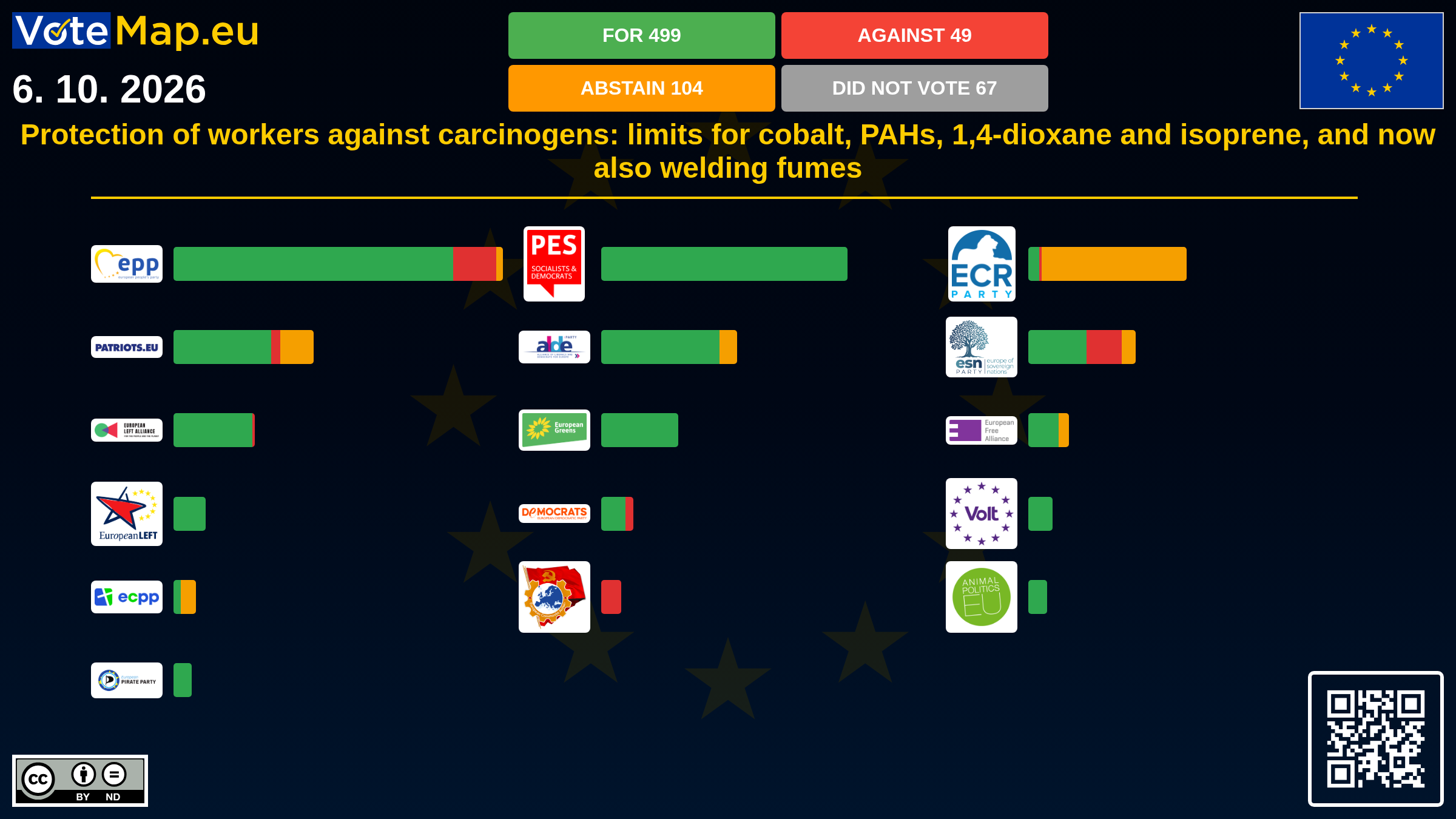
The European Parliament has voted on a provisional agreement with the Council of the EU on the sixth revision of Directive 2004/37/EC. This directive protects workers from carcinogens, mutagens and reprotoxic substances – that is, substances that can cause cancer, damage genetic material or impair reproduction. The agreement was passed by a vote of 499 in favour, 49 against and 104 abstentions.
All four groups of the pro-European majority voted in favour. The S&D (124 votes) and the Greens/EFA (49) voted unanimously in favour, with no votes against or abstentions, whilst Renew voted 61 in favour, 2 against and 8 abstentions. The EPP provided the most votes against: 142 of its MEPs voted in favour, 23 against and 2 abstained. The votes of these four groups alone would have been sufficient for approval. The ECR largely abstained (70 out of 78 MEPs, 7 in favour, 1 against), the PfE voted predominantly in favour (49 in favour, 5 against, 18 abstentions) and the ESN was divided (8 in favour, 13 against, 2 abstentions). The Left supported the agreement with all 43 of its votes.
Rapporteur Liesbet Sommen (EPP) stated in her group’s press release of 23 June 2026 that approximately 120,000 workers in the EU are diagnosed each year with occupational cancer linked to exposure to carcinogens at work. S&D shadow rapporteur Nora Mebarek wrote in her group’s report that the legislation is crucial because it “saves workers’ lives”. Renew and the Greens/EFA voted in favour. We were unable to find a statement from the Greens/EFA on the agreement, and we could not verify the content of Renew’s press release from a direct source.
The figures below are taken from the Council’s general approach of December 2025. This is the negotiating position with which the Council entered into negotiations with the Parliament, not the final text of the agreement. We did not have access to the final text, so the final figures may differ. The limit specifies the maximum permissible average concentration of the substance in the air over an eight-hour shift.
Cobalt and its inorganic compounds: 0.01 mg/m³ for the inhalable fraction and 0.0025 mg/m³ for the respirable (finest) fraction. During a six-year transitional period, the limits are 0.02 and 0.0042 mg/m³.
Polycyclic aromatic hydrocarbons (PAHs), measured as benzo[a]pyrene: 0.00007 mg/m³. For six years, a limit of 0.00014 mg/m³ may apply, but only in nine sectors. These are steel and iron foundries, aluminium production, the manufacture of carbon and graphite electrodes, the manufacture of refractory materials, coking plants, tar distillation, railway track welding, other non-ferrous metallurgy and metal casting.
1,4-dioxane: 7.3 mg/m³ and a short-term limit of 73 mg/m³. For the first time, this directive also introduces a biological limit: 45 mg HEAA per gram of creatinine, measured at the end of the shift.
Isoprene: 8.5 mg/m³. The Commission did not originally propose this; it was included in the Council’s position at the request of the Member States.
Welding fumes: the directive now applies to work involving welding fumes containing carcinogenic, mutagenic or reprotoxic substances. No specific numerical limit has been set for these.
According to secondary sources, the final agreement on PAHs also amended the length of the transition period and the scope of sectors covered. We have not verified this from a primary source, so we do not provide specific figures. In its original proposal from July 2025, the Commission estimated that the new rules would prevent 1,676 cases of lung cancer and 18,912 cases of non-cancerous diseases over 40 years. This estimate relates to the original proposal, not the final agreement.