

Tolls for lorries based on CO2 emissions
2026-10-07
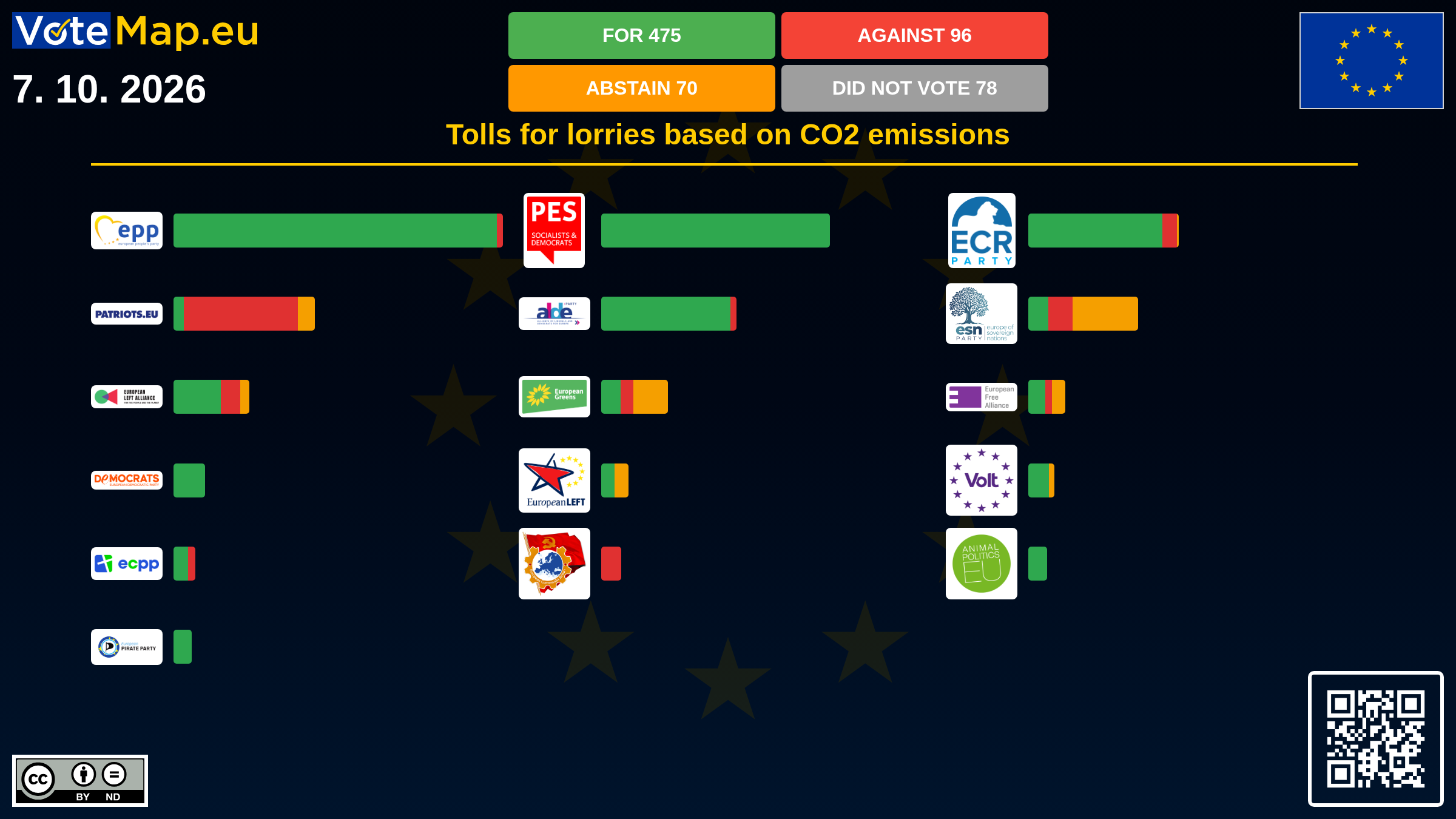
A provisional agreement with the Council, which sets out tolls for heavy goods vehicles based on CO2 emission classes, has been approved: 475 MEPs voted in favour, 96 against and 70 abstained. The EPP, S&D and Renew groups supported it almost unanimously, whilst the Greens/EFA group was divided (15 in favour, 7 against, 23 abstentions). On the far right, the ECR voted predominantly in favour, the PfE predominantly against, and the ESN mostly abstained.
The Eurovignette Directive (1999/62/EC) lays down rules on the charges payable by heavy goods vehicles for the use of roads. Under the Directive, tolls are also differentiated according to the vehicle’s CO₂ emission class. A vote was held on a provisional agreement with the Council. This amends the Directive, together with Directives 1999/37/EC and (EU) 2019/520, in relation to heavy goods vehicles with trailers, and clarifies and simplifies some of its provisions. By adopting the agreement, Parliament approved its position at first reading.
What the agreement changes:
It clarifies when Member States must differentiate tolls according to CO₂ classes for new vehicle sub-categories: 12 months after the publication of reference emissions, with uniform dates of 1 July or 1 January.
It restores the ‘planned emissions reduction’ target to 30 per cent by 2030. This figure was inadvertently tightened to 43 per cent by the adoption of Regulation (EU) 2024/1610, and the agreement rectifies this. Vehicles that have already been classified will be reclassified.
It addresses which CO₂ class vehicles without an emissions profile, special-purpose vehicles, dual-fuel vehicles and retrofitted zero-emission vehicles belong to. Those with a fuel-powered generator belong to CO₂ class 1.
It requires the Commission to assess, by 30 June 2029, whether tolls should also be differentiated according to the characteristics of towed vehicles, i.e. trailers and semi-trailers.
It introduces coordination between Member States regarding the exchange of data on how vehicles are classified.
The agreement was negotiated on behalf of Parliament by the rapporteur, Matteo Ricci (S&D). The shadow rapporteurs for the other groups of the pro-European majority were Markus Ferber (EPP), Jan-Christoph Oetjen (Renew) and Lena Schilling (Greens/EFA).
475 MEPs voted in favour, 96 against and 70 abstained. The S&D supported the agreement unanimously (118 in favour, none against), whilst the EPP (165 in favour, 3 against) and Renew (71 in favour, 3 against) supported it almost unanimously. We do not have any official statements from these three groups regarding the vote; their position is therefore reflected in how they voted.
The Greens/EFA group was divided in its vote: 15 of its MEPs voted in favour, 7 against and 23 abstained. Most of them therefore abstained. We do not know why the group was divided: we found no statement on this vote on its website.
On the far right, the ECR voted predominantly in favour (70 in favour, 8 against), the PfE predominantly against (5 in favour, 56 against, 8 abstained) and the ESN largely abstained (2 in favour, 2 against, 22 abstained). The Left voted 22 in favour, 8 against and 8 abstained.