A multiannual plan for fisheries in the western Mediterranean
2026-11-24
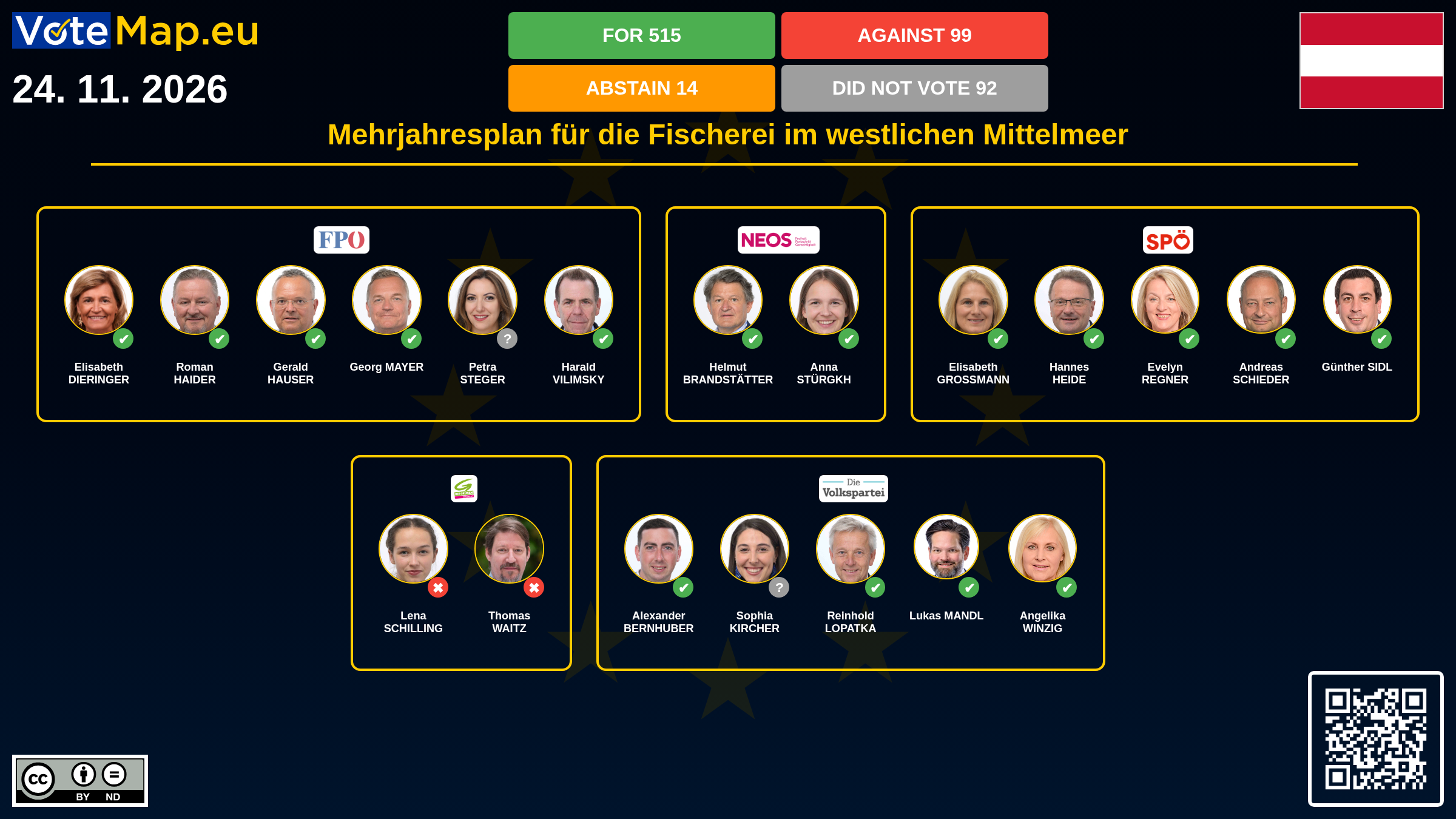
A resolution calling on the Commission to carry out a targeted review of the fisheries plan for demersal stocks in the western Mediterranean was adopted by 515 votes to 99, with 14 MEPs abstaining. The EPP voted alongside the ECR, PfE and ESN, whilst the S&D and Renew also supported the text. The Greens/EFA were the only group within the pro-European majority to vote against it. According to the resolution, once the first five-year phase has ended, the plan is to move from a systematic reduction in fishing days to a phase of consolidation.
The multiannual plan for the western Mediterranean regulates the fishing of demersal stocks, i.e. species that live on or near the seabed. The resolution lists, for example, hake and red shrimp. The plan is set out in Regulation (EU) 2019/1022. The resolution on the report by rapporteur Carmen Crespo Díaz (EPP) of the Committee on Fisheries does not itself amend the regulation: it reiterates the call for a targeted revision and urges the Commission to submit a legislative proposal by 1 December 2026.
The text highlights the high social costs of the plan: according to it, trawling intensity fell by more than 40 per cent between 2020 and 2024. The first five-year phase of reducing fishing effort has ended and, according to the resolution, the framework is to move into a consolidation phase, rather than continuing to systematically reduce fishing days. In the case of red prawns, which are currently subject to both quotas and fishing days, the resolution seeks to retain only fishing days and calls on the Commission to carry out a swift review. The Commission and the Member States are required to consult fisheries organisations, such as the cofradías, prud’homies and Italian cooperatives, and, should they deviate from their opinions, to justify this in writing.
The resolution expresses deep concern over illegal, unreported and unregulated fishing by vessels from non-EU countries; in this context, it mentions Morocco and Algeria and the use of drift gillnets in the Alboran Sea. It calls for better coordination of import controls at EU level, including through the establishment of a European import control agency. It reiterates its call for at least EUR 7.29 billion to be allocated to fisheries and aquaculture under the EMFAF for the period 2028–2034, and calls for greater compensation for the removal of waste from the sea.
The resolution was adopted by 515 votes to 99, with 14 MEPs abstaining. The EPP supported it with the exception of one MEP (159:1), Renew unanimously (71:0) and the S&D by a majority (110:11). The Greens/EFA voted against: 44 of its MEPs voted against, one in favour and one abstained. The dispute within the pro-European majority thus lies between the Greens/EFA and the other three groups. The shadow rapporteurs were Eric Sargiacomo for the S&D, Emma Ytterell for Renew and Mélissa Camara for the Greens/EFA.
The EPP voted alongside the ECR, PfE and ESN. The ECR voted in favour by a margin of 67 to 5, the PfE unanimously (77 to 0) and the ESN by 22 to 1. However, the votes of the far right did not determine the outcome: even without the votes in favour from the ECR, PfE and ESN, the resolution would have received 349 votes to 99. The Left (far left) voted against; 30 of its MEPs voted against, one in favour and five abstained.
Of the amendments put to a roll-call vote, the Greens/EFA tabled four. One of them, Amendment 9 inserted after paragraph 20, was adopted by a narrow margin: 301 to 291, with 73 MEPs abstaining. The remaining three amendments tabled by the Greens/EFA were rejected, as were the five amendments tabled by The Left.
We collect and visually present data publicly available at the page of European Parliament. Votemap.eu denies any responsibility for possible inconsistencies of the data or its changes after the publication.
Descriptions are created using DeepL Translate machine translation. We apologize for any possible imperfections or inconvenience.