The future of livestock farming in the EU
2026-04-30
The resolution on the future of livestock farming in the EU was adopted by 426 votes in favour, 119 against and 40 abstentions. The EPP voted alongside the ECR, PfE and ESN; the S&D and Renew voted split, whilst the Greens/EFA voted against. Among other things, the text calls on the Commission to stop funding non-governmental organisations that engage in targeted lobbying and create a “misleading, militant and ideological portrayal of livestock farming”.
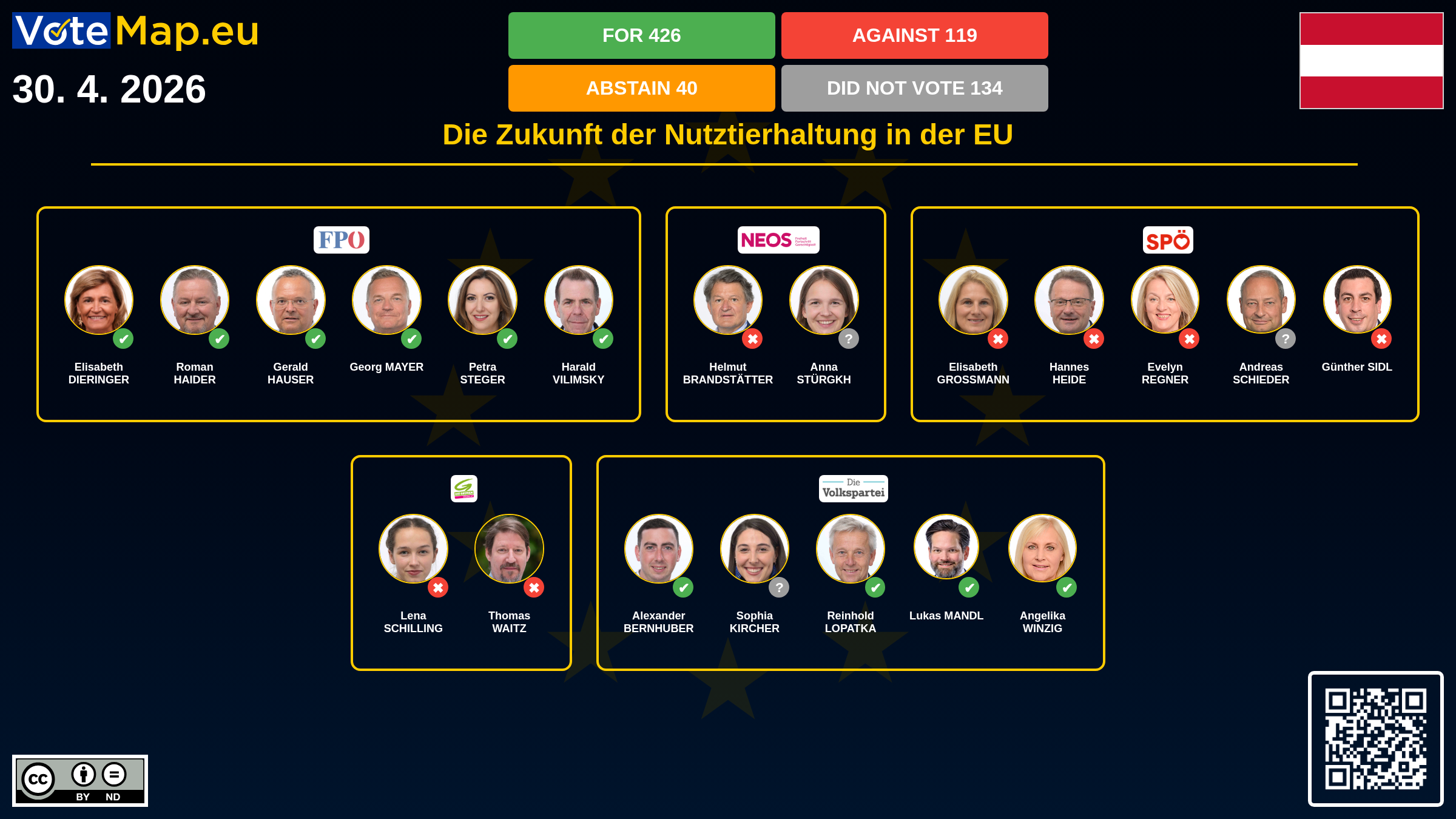
The resolution is based on a report drawn up on the AGRI Committee’s own initiative. Carlo Fidanza (ECR) served as rapporteur for the report. The motion for a resolution was put to the vote as a whole: 426 MEPs voted in favour, 119 against and 40 abstained.
The text welcomes the Commission’s intention to set up a working group on livestock farming and calls for this to be followed by a high-level group. It expresses concern about initiatives and proposals that discourage livestock farming. It also insists that livestock production should not be subject to the same regulatory regime as heavy industry. It warns against one-size-fits-all policies aimed at large-scale reductions in livestock numbers. It calls for a stable and predictable framework for farmers with a lighter regulatory burden, particularly for small and family-run farms.
The resolution welcomes the Commission’s proposal to reopen the issue of meat-based names and to ban their use for products of non-animal origin. According to the text, this should also apply to products derived from cell cultures. It further calls for mandatory origin labelling for all products containing meat. It also expresses deep concern over the promotion of so-called synthetic foods, such as lab-grown proteins, ‘without any convincing scientific evidence of their safety having been presented’.
With regard to wolves, the text emphasises that a targeted amendment to the Habitats Directive is intended to ensure greater flexibility in managing their populations across the EU. The amendment is intended to bring EU law into line with the updated level of protection for wolves under the Bern Convention.
Point 10, concerning non-governmental organisations, forms a separate chapter. It calls for a public register of funds received by non-governmental organisations from the EU. It expresses concern that funds, including those from the LIFE programme, are being received by organisations that lobby EU institutions. It calls on the Commission to stop funding non-governmental organisations that “engage in targeted lobbying and create a misleading, militant and ideological image of livestock farming in Europe”.
The EPP voted overwhelmingly in favour (134 in favour, 1 against, 4 abstentions). It voted alongside all three far-right groups: the ECR (66 in favour, 5 abstentions), PfE (71 in favour) and ESN (24 in favour). However, their votes did not decide the outcome; without them, the resolution would have passed by a margin of 265 to 119. The S&D (72 in favour, 32 against, 4 abstentions) and Renew (44 in favour, 16 against, 5 abstentions) were divided in their voting. The Greens/EFA were against (44 against, 1 abstention). The Left, i.e. the far left, voted against (23) or abstained (12).
The pro-European majority was thus divided. On one side stood the EPP; on the other, the Greens/EFA, whilst the S&D and Renew were split between them. Shadow rapporteur David Cormand (Greens/EFA) said during the debate (in French, translated): “By stringing together falsehoods and seeking scapegoats, it spares the real architects of this crisis. […] By refusing to take a stand, this text is hypocritical and complicit in the crisis in animal husbandry and the suffering of farmers.’ Shadow rapporteur Cristina Maestre (S&D), on the other hand, called (in Spanish, translated): “I therefore call for unanimity and for us to set aside cheap populism.” Her group was nevertheless divided. The text was also supported in the debate by shadow rapporteur Benoit Cassart (Renew), though even Renew did not vote as a bloc.
We collect and visually present data publicly available at the page of European Parliament. Votemap.eu denies any responsibility for possible inconsistencies of the data or its changes after the publication.
Descriptions are created using DeepL Translate machine translation. We apologize for any possible imperfections or inconvenience.