Transboundary water management as a means of conflict prevention
2026-06-17
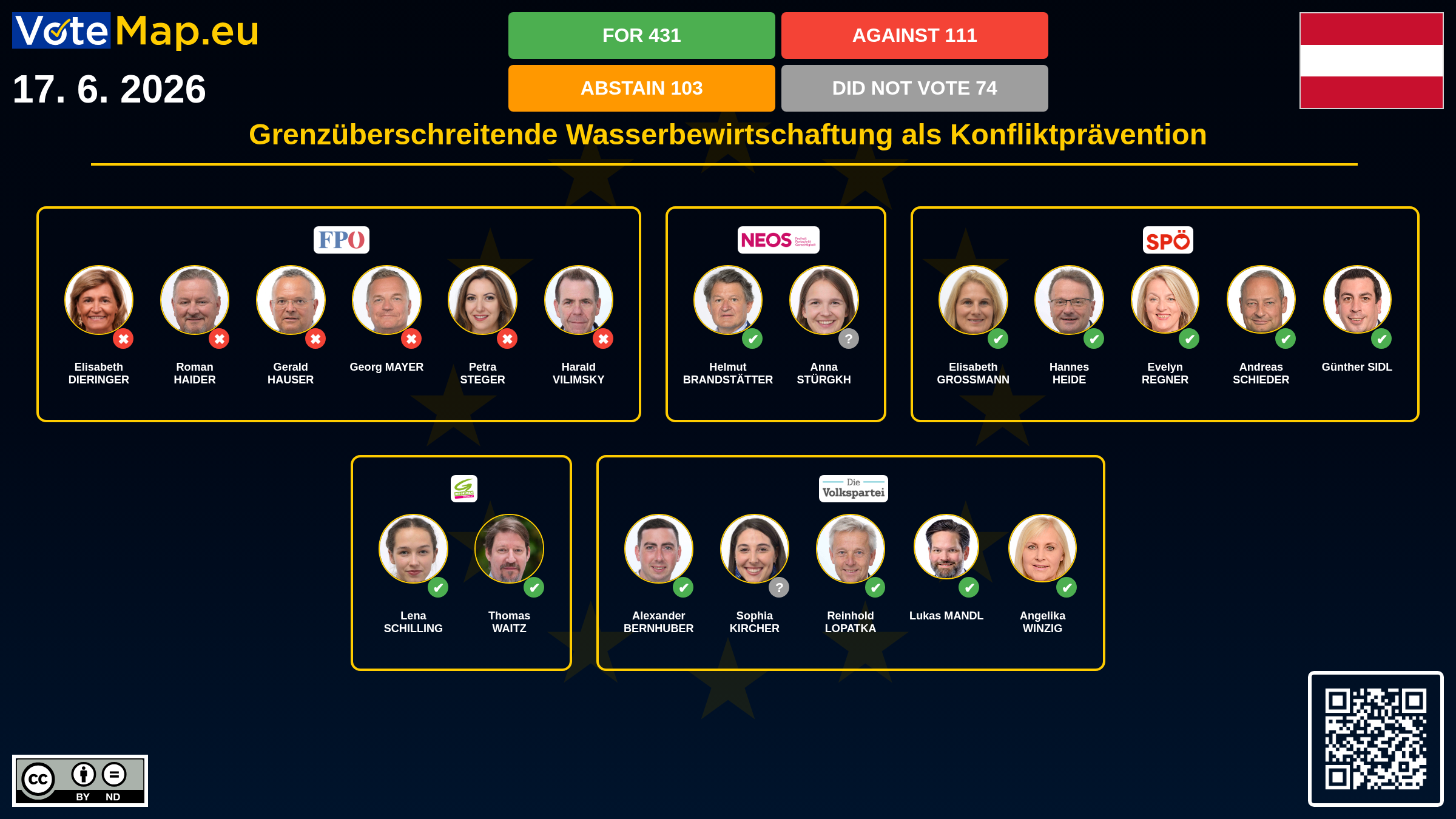
The recommendation that the EU should use transboundary water management to prevent conflicts was adopted by 431 votes in favour, 111 against and 103 abstentions. It was supported by the EPP, S&D, Renew and Greens/EFA – in other words, the entire pro-European majority. The PfE and ESN voted against it, whilst the ECR almost entirely abstained. The text states that the Kakhovka dam was destroyed by Russia and notes that the Israeli authorities exercise effective control over most water resources in the West Bank.
The recommendation was drawn up by the Committee on Foreign Affairs (AFET), with Leoluca Orlando (Greens/EFA) acting as rapporteur. It is addressed to the Council, the Commission and the High Representative of the Union for Foreign Affairs and Security Policy. It calls on the EU to treat shared water resources as a foreign and security policy issue.
The text is based on the fact that 60 per cent of the world’s freshwater flows consist of aquifers, lakes and river basins shared by two or more countries. Of the 153 UN member states that share water resources, only 43 have concluded operational agreements.
Among other things, the recommendation calls for water scarcity to be recognised as a major security, geopolitical and humanitarian risk factor. It aims to fund transboundary water management in the next multiannual financial framework through the Global Europe and Global Gateway instruments. The EU is to assist governments in concluding agreements on shared river basins, whilst fully respecting the sovereignty of partner countries. It should also strengthen monitoring and early warning systems, systematically condemn the use of water as a weapon in conflicts, and ensure that perpetrators are held to account.
The text names specific actors. It states that the Kakhovka Dam in Ukraine was destroyed by Russia in 2023, resulting in loss of life and the mass displacement of civilians. It recalls that the European Parliament has previously strongly condemned Russia for the deliberate destruction of water infrastructure, including dams, which it uses as weapons of war. It also notes that, through these actions, Russia is violating international law. According to the text, as a result of Russia’s war of aggression, approximately 1.7 million children in Ukraine lack reliable access to safe water.
With regard to the West Bank, the text states that, under existing arrangements, the Israeli authorities exercise effective control over most of the inflowing and outflowing water resources in the West Bank. It also mentions the historical and persistent imbalance in water allocations to Palestinian communities. With regard to the Gaza Strip, it states that, as a result of the conflict between Israel and Hamas, water infrastructure has been extensively damaged. According to the Office of the United Nations High Commissioner for Human Rights in July 2025, 89 per cent of the water and sanitation infrastructure in Gaza was damaged or destroyed. The text states that the dams being built by Turkey as part of the South-Eastern Anatolia Project have affected the flow of the Tigris and Euphrates rivers and are contributing to water shortages in Iraq and Syria.
The resolution was adopted by 431 votes in favour, 111 against and 103 abstentions. A simple majority of the votes cast was sufficient. All four groups of the pro-European majority voted in favour: the EPP (164 in favour, 1 against, 1 abstention), the S&D unanimously (120 in favour), Renew (62 in favour, 1 against) and the Greens/EFA unanimously (45 in favour). Shadow rapporteurs Ingeborg Ter Laak (EPP), Matjaž Nemec (S&D) and Petras Auštrevičius (Renew) negotiated the report in committee on behalf of the EPP, S&D and Renew.
PfE voted against (75 against, 2 abstentions), as did ESN (21 against, 4 abstentions). The ECR almost entirely abstained: 71 abstentions, 3 votes against and 2 in favour. The far right was therefore not unanimously opposed. The Left (far left) voted split: 29 in favour, 1 against and 14 abstentions.
We collect and visually present data publicly available at the page of European Parliament. Votemap.eu denies any responsibility for possible inconsistencies of the data or its changes after the publication.
Descriptions are created using DeepL Translate machine translation. We apologize for any possible imperfections or inconvenience.