The EU’s strategy against the influence of the Muslim Brotherhood
2026-10-08
A resolution calling for an EU strategy against Islamist infiltration and the influence of the Muslim Brotherhood network was adopted by 381 votes in favour, 167 against, with 15 MEPs abstaining. The EPP, which tabled the motion, voted alongside the ECR, PfE and ESN; Renew also supported the resolution. The S&D and Greens/EFA were against. Votes from the far right did not decide the outcome – the resolution would have passed even without them. Among other things, the text supports national bans on full-face veiling and criticises the invitation of the FEMYSO forum to the Parliament.
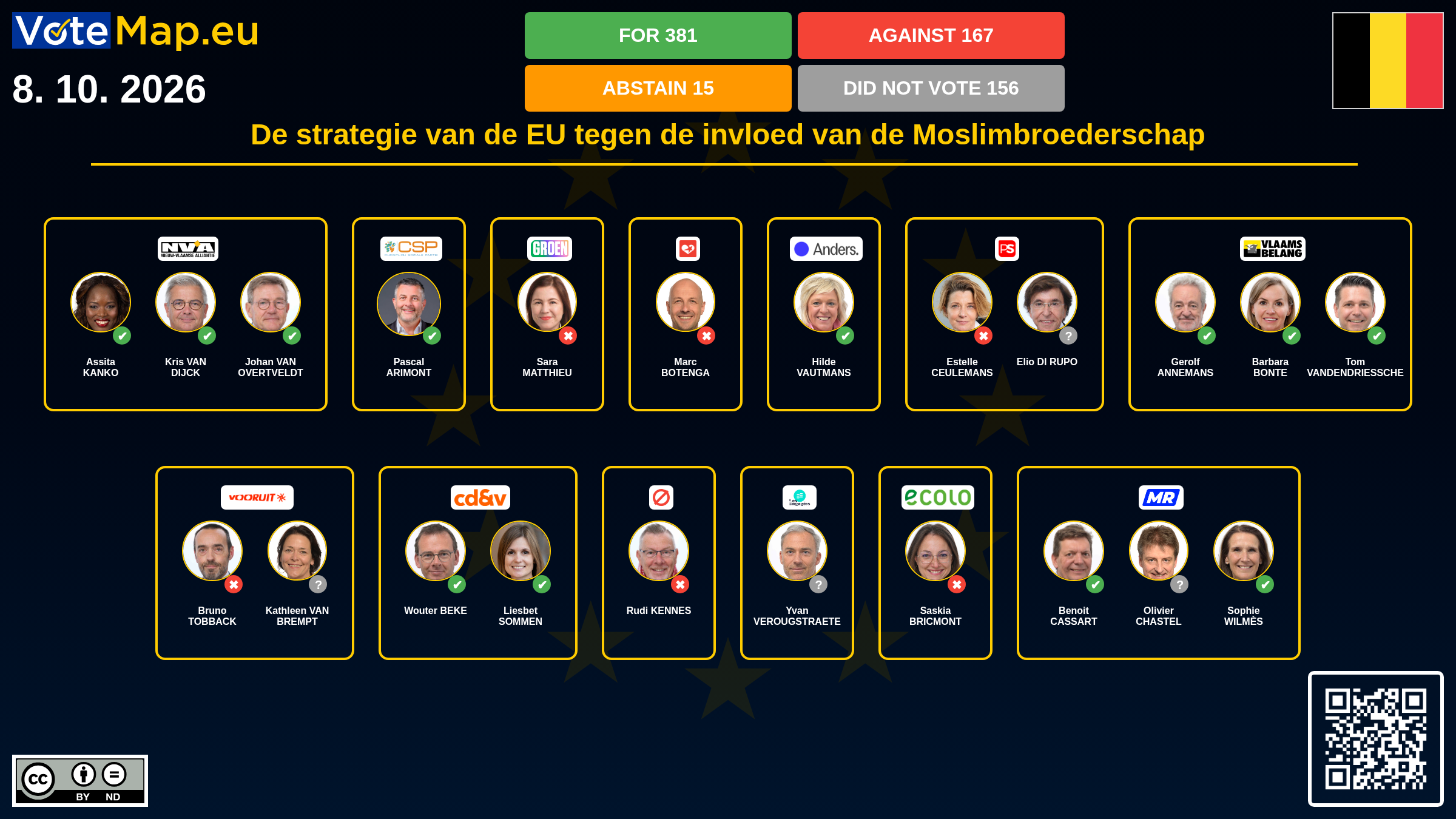
Draft resolution B10-0424/2026 was tabled by French MEP Céline Imart on behalf of the EPP. The resolution defines ‘Islamist entrism’ as a strategy employed by political Islamist networks which, according to the resolution, seek to gain credibility within European institutions, secure invitations and gain access to EU funds. At the same time, it states that Islam as a religion “is neither political nor hostile by its very nature”.
The resolution calls on the Commission to provide an overview of all cases in which EU funds were received by persons and entities suspected of having links to the Muslim Brotherhood or political Islam. It also calls for the entire financial chains to be traced. It calls on the Council to include entities and individuals linked to the Muslim Brotherhood on the EU list of terrorist organisations, provided they meet the criteria set out in Common Position 2001/931/CFSP. It calls on the Commission and the Member States to exercise stricter control over foreign funding, particularly where entities with links to Qatar or Turkey are concerned.
Two points go beyond the scope of funding. In paragraph 8 of the resolution, it ‘therefore supports all national measures aimed at banning the full-face veil (niqab or burqa) in public spaces and places accessible to the public’. In paragraph 12 “regrets that, despite warnings from several parliamentary groups and intellectuals, the FEMYSO forum was once again invited to Parliament on 21 September 2026 by MEPs from the Left and the Greens”. Recital P, however, lists only Members from The Left as the hosts of that event. According to paragraph 12, organisations linked to the European Council of Muslims are to be denied access to European institutions and removed from the EU Transparency Register. The resolution names specific organisations, citing a report by the French Ministry of the Interior, a report by the Belgian State Security Service, and resolutions by the French and Dutch parliaments.
The resolution was passed by 381 votes in favour, 167 against, with 15 MEPs abstaining. The pro-European majority was divided: two groups were in favour, two against. The EPP voted in favour (143 in favour, 1 against) and Renew also supported the resolution (62 in favour, 3 against, 2 abstentions). The S&D voted against (2 in favour, 84 against, 1 abstention), as did the Greens/EFA (1 in favour, 40 against, 1 abstention). The EPP voted alongside the far right: the ECR (72 in favour), PfE (67 in favour) and ESN (25 in favour, 1 abstention) were all unanimously in favour. However, they did not decide the outcome. Without their votes, the resolution would have passed by a margin of 217 to 167. The Left (far left) voted against (1 in favour, 35 against).
Céline Imart (EPP) stated in her group’s press release that Europe must not fund Islamists and that Islam as a faith and political Islam as an ideology must not be confused. The press release was issued on the day of the vote, prior to it taking place. Tomáš Zdechovský (EPP), the group’s spokesperson on budgetary control, stated in the same press release that EU funds must never reach individuals or organisations linked to Islamist networks. Renew voted in favour and did not comment separately on the vote. It tabled its own motion for a resolution (B10-0427/2026) on the same debate, but there is no record of it in the voting data. The S&D and Greens/EFA voted against and did not comment separately on the matter.
Prior to the final vote, 95 amendments and parts of the text were put to the vote: 20 were adopted and 75 were rejected. We do not have details of what the individual amendments contained or who tabled them.
We collect and visually present data publicly available at the page of European Parliament. Votemap.eu denies any responsibility for possible inconsistencies of the data or its changes after the publication.
Descriptions are created using DeepL Translate machine translation. We apologize for any possible imperfections or inconvenience.