The abolition of customs duties on goods from the US and the conditions governing it
2026-03-26
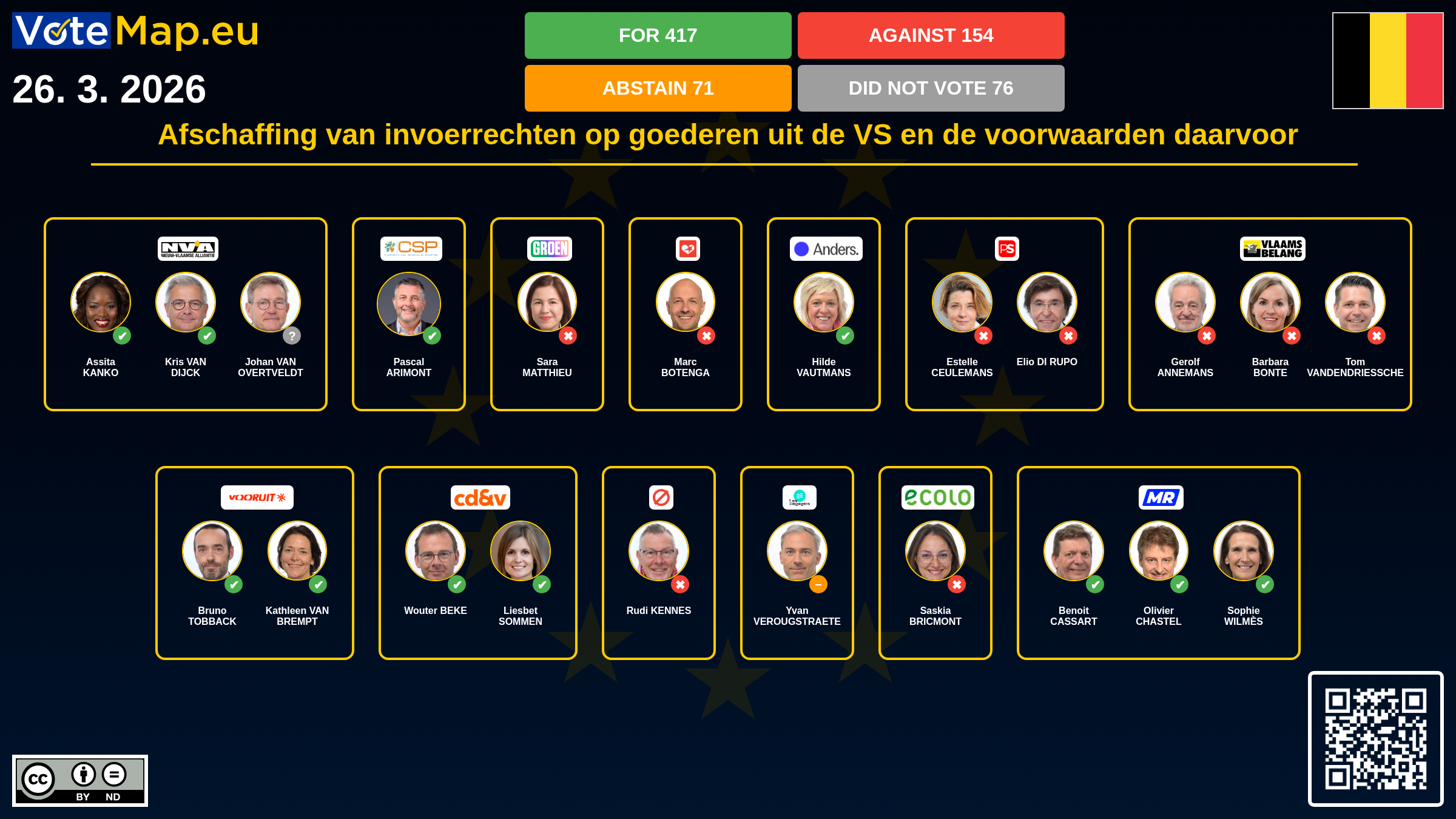
The European Parliament has approved its negotiating position on two regulations implementing the EU–US trade agreement: the removal of tariffs on goods from the US was approved by 417 votes to 154, with 71 abstentions, whilst the tariff-free import of lobsters and crayfish was approved by 437 votes to 144, with 60 abstentions. The EPP, S&D and Renew groups voted in favour, whilst the Greens/EFA were divided. The adopted text allows for the suspension of benefits should the US breach its commitments.
Both regulations implement the EU–US framework agreement set out in the joint statement of 21 August 2025 (known as ‘Turnberry’), in which the US undertook to reduce tariffs on imports from the EU to a maximum of 15 per cent.
The main regulation (A10-0069/2026) removes tariffs on the remaining 34 per cent of imports of industrial goods from the US (the other 66 per cent were already tariff-free in 2024) and opens tariff quotas for selected agricultural and marine products. According to the Commission’s proposal, this will cost the EU budget approximately €3.6 billion a year. A smaller regulation (A10-0070/2026) extends and expands duty-free imports of lobsters and crayfish – now including cooked ones – with a budgetary impact of around €48,000 per year.
This was not a final approval: MEPs voted on Parliament’s position at first reading, and the rapporteur, Bernd Lange (S&D), subsequently requested that the documents be referred back to the committee for further negotiations with the Council. The position includes safeguards in the event that the US fails to comply with the agreement. The Commission is to be able to suspend the benefits if the US imposes tariffs above the agreed 15 per cent ceiling, discriminates against EU companies or undermines the agreement’s objectives, as well as in the event of serious violations of human rights, democracy and the rule of law, or threats to the Union’s security interests. The new EU tariff rates are to take effect only if the US fulfils its commitments. The main regulation is due to expire on 31 March 2028, whilst the regulation on lobsters is to remain in force until 31 December 2028.
The main regulation was adopted by 417 votes in favour, 154 against and 71 abstentions; the regulation on lobsters and crayfish by 437:144:60. The figures below show the votes in favour, against and abstentions, with the main regulation listed first in each case. The EPP voted unanimously in favour (167:0:2 and 169:0:0), the S&D and Renew groups voted predominantly in favour (S&D 90:11:9 and 96:10:3, Renew 51:10:6 and 58:3:5).
Kathleen Van Brempt (S&D) said during the debate that Turnberry was a bad deal and that the group was voting in favour of a strong position for Parliament, not for the deal itself; she stated that the S&D would not give its final approval unless the conditions were fully met. Shadow rapporteur Karin Karlsbro (Renew) spoke of a safeguard against Trump: if the US fails to deliver, it is up to Europeans to protect themselves from chaos through their own safeguards. Shadow rapporteur Željana Zovko (EPP) highlighted the security partnership with the US and economic interdependence: she stated that 16 million jobs depend on the transatlantic economy.
The dispute within the pro-European majority lies with the Greens/EFA. Shadow rapporteur Anna Cavazzini (Greens/EFA) criticised, during the debate, the very existence of tariffs and the EU’s commitments regarding imports of liquefied natural gas from the US, which her group, she said, categorically rejects. At the same time, she acknowledged that Parliament had achieved real improvements and that the mandate gives the EU greater leverage vis-à-vis Trump. The group’s vote was split: 18:25:5 on the main regulation and 19:24:5 on the second.
The ECR voted in favour (70:0:5 and 69:1:5). PfE was predominantly against, with 15:50:17 in both votes. The ESN largely abstained: 22 and 23 out of 28 voters, respectively; 5 and 3 voted against, and 1 and 2 voted in favour, respectively. The Left (far left) voted against (0:35:1 and 0:37:0). Its shadow rapporteur, Martin Schirdewan, proposed postponing the vote and rejecting the Commission’s proposal; neither motion was carried.
The final text of both regulations, agreed with the Council, was approved by Parliament on 16 June 2026.
We collect and visually present data publicly available at the page of European Parliament. Votemap.eu denies any responsibility for possible inconsistencies of the data or its changes after the publication.
Descriptions are created using DeepL Translate machine translation. We apologize for any possible imperfections or inconvenience.