The ECR’s motion for a debate on the unrest among secondary school pupils in France was passed by 217 votes to 198, thanks to votes from the ECR, PfE and ESN; the EPP voted with them
2026-10-05
On 5 October 2026, the European Parliament voted on a motion by the ECR Group to include on that day’s agenda a debate on the violent protests by secondary school pupils in France. The motion was passed by 217 votes to 198, with four MEPs abstaining. The EPP voted unanimously in favour, alongside the ECR, PfE and ESN – without the votes of these three groups, the motion would not have passed. The rest of the pro-European majority – S&D, Renew and Greens/EFA – voted against, as did The Left.
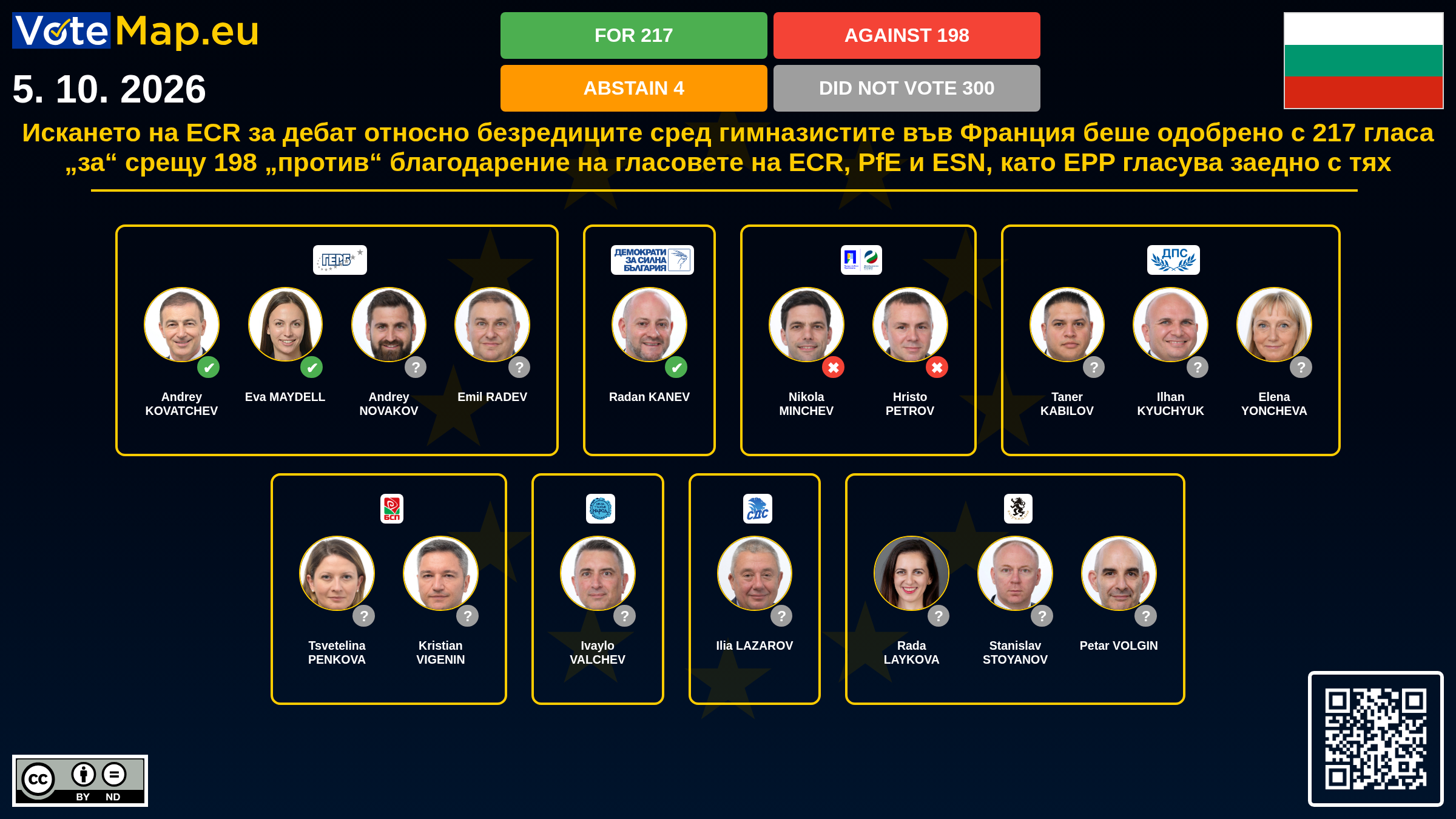
On Monday 5 October 2026, Members of the European Parliament in Strasbourg voted on an amendment to the agenda. The ECR Group requested that a new item be added to that day’s agenda: a debate featuring a statement by the European Commission on the escalation of protests by secondary school pupils in France. This was a vote on the agenda, not on the unrest itself – the decision concerned only whether the topic would be discussed in plenary.
The motion was passed by 217 votes in favour and 198 against, with four MEPs abstaining. The EPP voted unanimously in favour (101 votes, none against), as did the three far-right groups: the ECR (41), PfE (56) and ESN (9). The motion was passed thanks to the votes of the ECR, PfE and ESN – a total of 106 votes; without them, the motion would not have secured a majority. In this vote, the EPP stood alongside the far right, against the other groups of the pro-European majority.
The pro-European majority – the EPP, S&D, Renew and Greens/EFA – was thus divided. Whilst the EPP voted in favour, the remaining three groups voted against: the S&D unanimously (73 against, none in favour), the Greens/EFA also unanimously (46 against) and Renew almost unanimously (41 against, 2 in favour, 2 abstentions). The Left also voted unanimously against (31 votes). None of the four groups in the pro-European majority issued their own statement – that we could find – regarding the ECR’s request or the situation in France. Their position is therefore reflected in how they voted; we do not speculate on their reasons.
According to the draft agenda published by Parliament, the item was scheduled for 5 October 2026 from 19:30 to 21:00. Its title refers to arson attacks on schools and assaults on firefighters, police officers and teachers, including the incident in La Ciotat. We do not yet know whether the debate will be followed by a vote on a resolution: we found no entry relating to this item in the draft agenda for 6–8 October. Nor have we found a Parliament press release regarding the vote.
What is happening in France: According to France 24, protests by secondary school pupils began in late September 2026 in the Île-de-France region over a shortage of teachers, overcrowded classrooms and the poor condition of school buildings, and gradually spread across the whole of France. As of Friday 2 October, France 24 reported around 400 schools closed, at least 65 injured school staff – including 40 headteachers – and 1,747 people detained in a single day. Time magazine reports that around 500 schools have been closed and more than 5,000 people have been arrested since the protests began, 87 per cent of whom were minors. The figures vary because the sources are covering different time periods. In La Ciotat, according to France 24, which cites a spokesperson for the regional education authority, a physics teacher was doused with petrol and attacked on 2 October whilst trying to put out a fire near the school. According to *Time*, Prime Minister Sébastien Lecornu announced a five-point plan aimed, amongst other things, at resuming lessons and repairing school buildings.
We collect and visually present data publicly available at the page of European Parliament. Votemap.eu denies any responsibility for possible inconsistencies of the data or its changes after the publication.
Descriptions are created using DeepL Translate machine translation. We apologize for any possible imperfections or inconvenience.