Tolls for lorries based on CO2 emissions
2026-10-07
A provisional agreement with the Council, which sets out tolls for heavy goods vehicles based on CO2 emission classes, has been approved: 475 MEPs voted in favour, 96 against and 70 abstained. The EPP, S&D and Renew groups supported it almost unanimously, whilst the Greens/EFA group was divided (15 in favour, 7 against, 23 abstentions). On the far right, the ECR voted predominantly in favour, the PfE predominantly against, and the ESN mostly abstained.
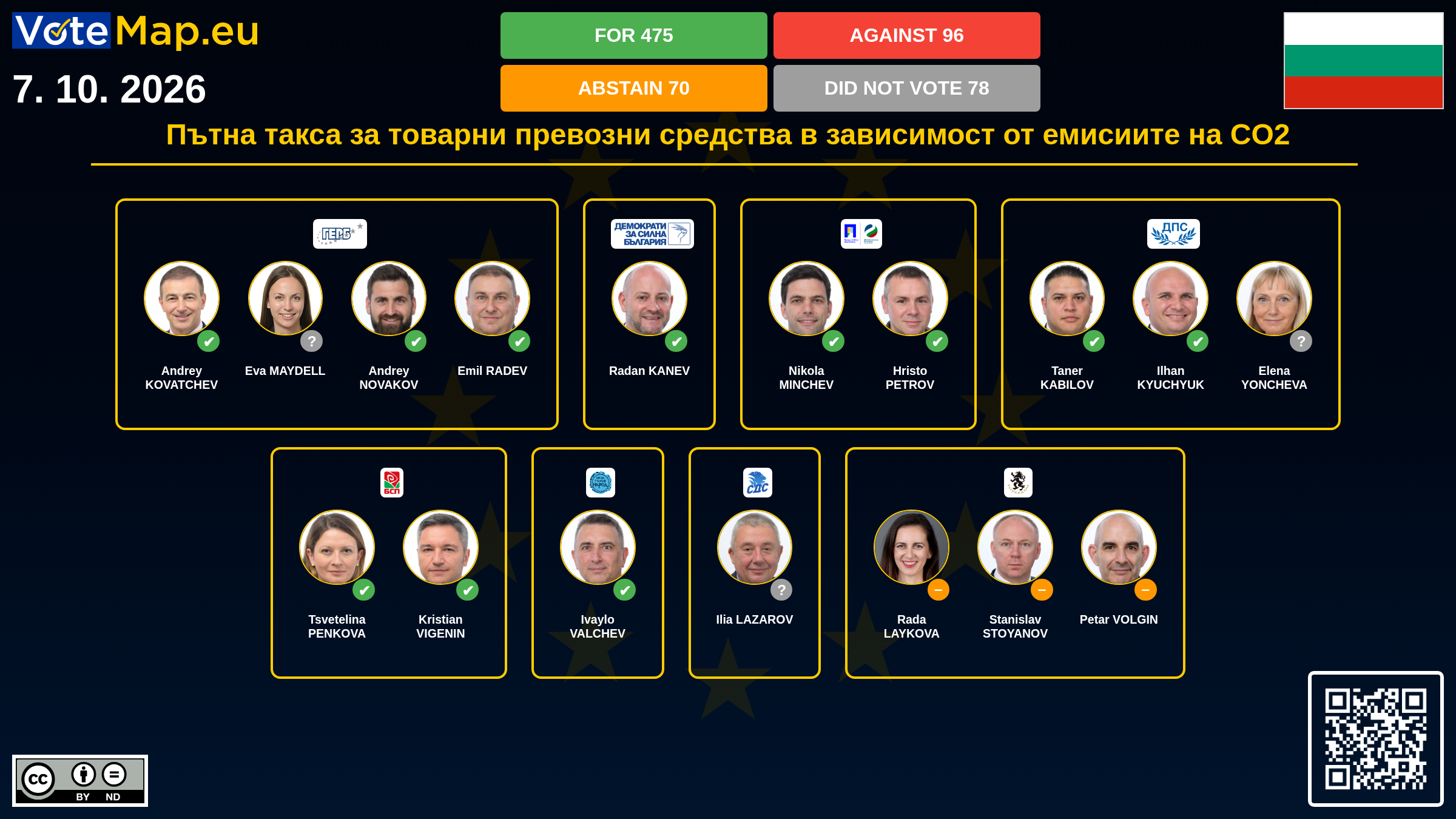
The Eurovignette Directive (1999/62/EC) lays down rules on the charges payable by heavy goods vehicles for the use of roads. Under the Directive, tolls are also differentiated according to the vehicle’s CO₂ emission class. A vote was held on a provisional agreement with the Council. This amends the Directive, together with Directives 1999/37/EC and (EU) 2019/520, in relation to heavy goods vehicles with trailers, and clarifies and simplifies some of its provisions. By adopting the agreement, Parliament approved its position at first reading.
What the agreement changes:
It clarifies when Member States must differentiate tolls according to CO₂ classes for new vehicle sub-categories: 12 months after the publication of reference emissions, with uniform dates of 1 July or 1 January.
It restores the ‘planned emissions reduction’ target to 30 per cent by 2030. This figure was inadvertently tightened to 43 per cent by the adoption of Regulation (EU) 2024/1610, and the agreement rectifies this. Vehicles that have already been classified will be reclassified.
It addresses which CO₂ class vehicles without an emissions profile, special-purpose vehicles, dual-fuel vehicles and retrofitted zero-emission vehicles belong to. Those with a fuel-powered generator belong to CO₂ class 1.
It requires the Commission to assess, by 30 June 2029, whether tolls should also be differentiated according to the characteristics of towed vehicles, i.e. trailers and semi-trailers.
It introduces coordination between Member States regarding the exchange of data on how vehicles are classified.
The agreement was negotiated on behalf of Parliament by the rapporteur, Matteo Ricci (S&D). The shadow rapporteurs for the other groups of the pro-European majority were Markus Ferber (EPP), Jan-Christoph Oetjen (Renew) and Lena Schilling (Greens/EFA).
475 MEPs voted in favour, 96 against and 70 abstained. The S&D supported the agreement unanimously (118 in favour, none against), whilst the EPP (165 in favour, 3 against) and Renew (71 in favour, 3 against) supported it almost unanimously. We do not have any official statements from these three groups regarding the vote; their position is therefore reflected in how they voted.
The Greens/EFA group was divided in its vote: 15 of its MEPs voted in favour, 7 against and 23 abstained. Most of them therefore abstained. We do not know why the group was divided: we found no statement on this vote on its website.
On the far right, the ECR voted predominantly in favour (70 in favour, 8 against), the PfE predominantly against (5 in favour, 56 against, 8 abstained) and the ESN largely abstained (2 in favour, 2 against, 22 abstained). The Left voted 22 in favour, 8 against and 8 abstained.
We collect and visually present data publicly available at the page of European Parliament. Votemap.eu denies any responsibility for possible inconsistencies of the data or its changes after the publication.
Descriptions are created using DeepL Translate machine translation. We apologize for any possible imperfections or inconvenience.