Ukrainian children forcibly deported to Russia
2026-11-12
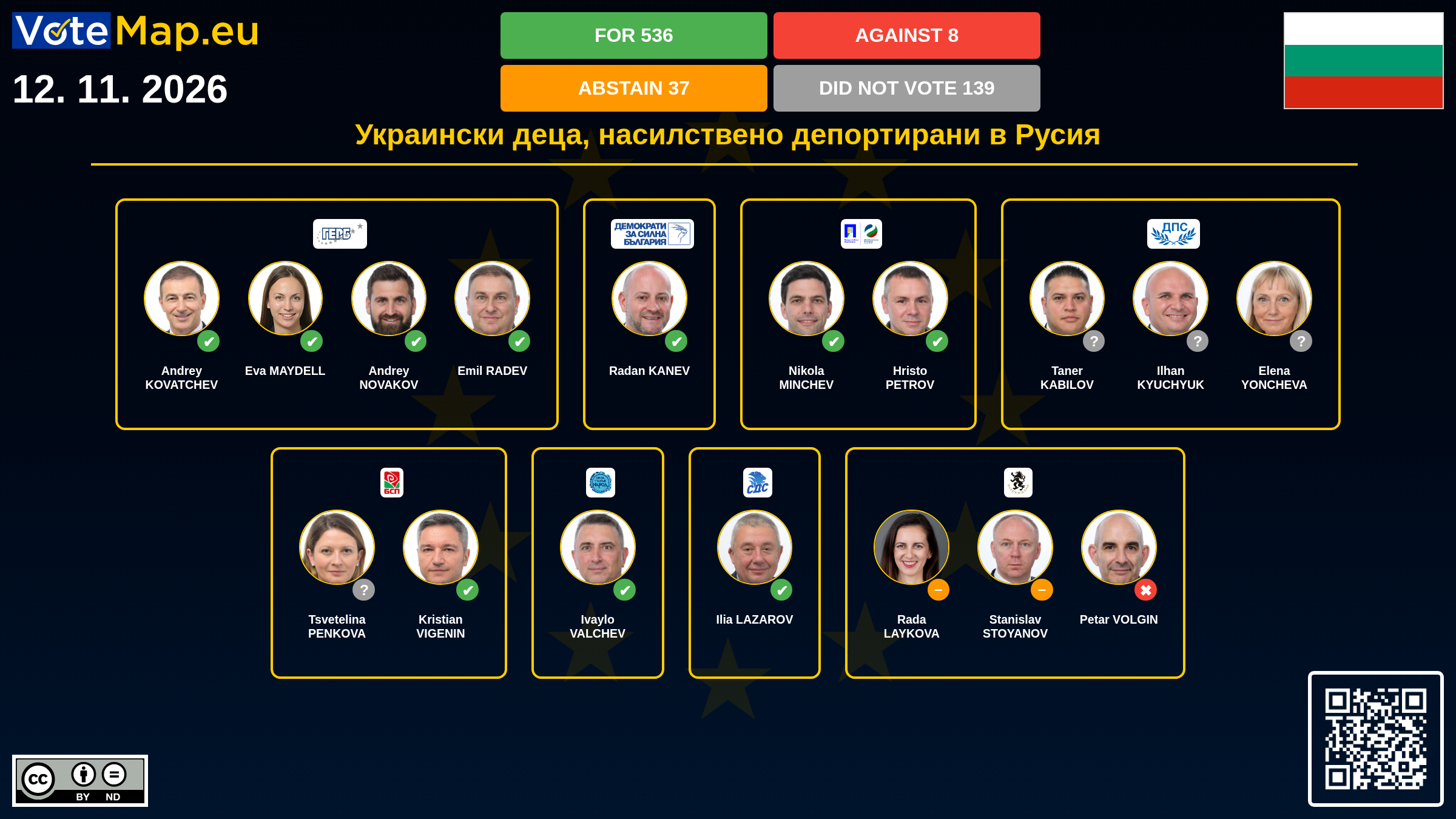
The resolution, which calls on Russia to return all deported and forcibly displaced Ukrainian children immediately, safely and unconditionally, was adopted by 536 votes in favour, 8 against and 37 abstentions. The joint motion was signed by the EPP, S&D, Renew and Greens/EFA, together with the ECR. The text states that Russia’s actions towards Ukrainian children meet the legal definition of genocide and calls on EU Member States to officially recognise this.
The resolution concerns Ukrainian children whom Russia has deported to its territory or forcibly displaced, and children living in Russian-occupied territories of Ukraine. The text refers to figures from the Ukrainian authorities: by September 2026, they had verified 20,651 cases of deportation or forced displacement of children, and by 28 October 2026, 2,752 children had been successfully returned. According to the resolution, approximately 1.6 million children remain under Russian occupation, of whom around 600,000 are of school age. Since the start of Russia’s full-scale war of aggression, approximately 770 Ukrainian children have been killed and 3,000 injured, according to the Ukrainian authorities.
The resolution “demands that Russia immediately, safely and unconditionally return all deported and forcibly displaced Ukrainian children”. It emphasises that their return is an obligation under international law, not a matter for negotiation. It strongly condemns the systematic deportations, forced displacement, illegal adoptions, forced Russification, indoctrination and militarisation of Ukrainian children, which Russia is carrying out with the involvement of Belarus and North Korea. It explicitly states that Russia’s actions towards Ukrainian children meet the legal definition of genocide. It bases this on the UN Convention on Genocide, which includes the forcible transfer of children from one national or ethnic group to another amongst acts of genocide. It calls on EU Member States to officially recognise this.
The text also calls for specific measures. Children are to have their identities restored, and unlawful adoptions and the granting of Russian citizenship are to be reversed. Third countries must not recognise unlawful adoptions or Russian documents, and databases offering Ukrainian children for adoption must be shut down immediately. The resolution condemns the military training of children, including training in the operation of drones, as well as their involvement in the Yunarmiya organisation. It calls on the Hungarian Government, as the only Member State that has not yet done so, to join the International Coalition for the Return of Ukrainian Children without delay. It seeks to extend sanctions to the entire network of individuals and entities that enable the Russian system, specifically Gazprom and Rosneft. In doing so, it refers to a Yale University investigation from March 2026 into the financing of the transport and re-education of approximately 2,158 children.
The resolution further supports the International Criminal Court and its arrest warrants for Vladimir Putin and Maria Lvova-Belova. It expresses “deep concern over US sanctions against the International Criminal Court, its prosecutors, judges and staff”. A call on the Commission to protect the Court from these extraterritorial sanctions by activating the so-called blocking regulation was put to a separate vote and passed by a margin of 411 to 111, with 62 abstentions.
The joint motion was signed by the EPP, S&D, Renew and Greens/EFA – that is, the entire pro-European majority – along with the ECR. The EPP (153 votes), S&D (109) and Greens/EFA (42) voted unanimously in favour. Within Renew, 66 MEPs voted in favour and one abstained. The ECR supported the resolution with 65 votes, whilst three of its MEPs abstained; PfE voted in favour with 60 votes, whilst five of its MEPs abstained. In the ESN, the majority of MEPs abstained (15), five voted in favour and one against. The ECR, PfE and ESN – that is, the far right – did not therefore oppose the resolution: abstaining does not mean voting against. Of the eight votes against, only one came from a political group, namely from an ESN MEP.
The Left, i.e. the far left, did not endorse the joint motion as a group and tabled its own motion for a resolution; three of its MEPs signed the joint text as individuals. The group tabled three amendments to it, none of which were adopted (140:385:62, 142:436:5 and 103:398:86). The Left then supported the resolution as a whole with 30 votes, whilst three of its MPs abstained.
We collect and visually present data publicly available at the page of European Parliament. Votemap.eu denies any responsibility for possible inconsistencies of the data or its changes after the publication.
Descriptions are created using DeepL Translate machine translation. We apologize for any possible imperfections or inconvenience.