Audit of the European Investment Bank’s financial management
2026-04-28
The European Parliament adopted the annual report on the audit of the European Investment Bank’s (EIB) financial activities for 2024 by 377 votes in favour, 254 against and 31 abstentions. The EPP voted alongside the ECR and PfE, whilst Renew also supported the report; the S&D and Greens/EFA were against. The rapporteur was Dick Erixon of the ECR. The resolution calls for a more thorough external audit of the bank, defence as a permanent objective, and, for loans outside the EU, for cooperation on repatriation agreements to be taken into account.
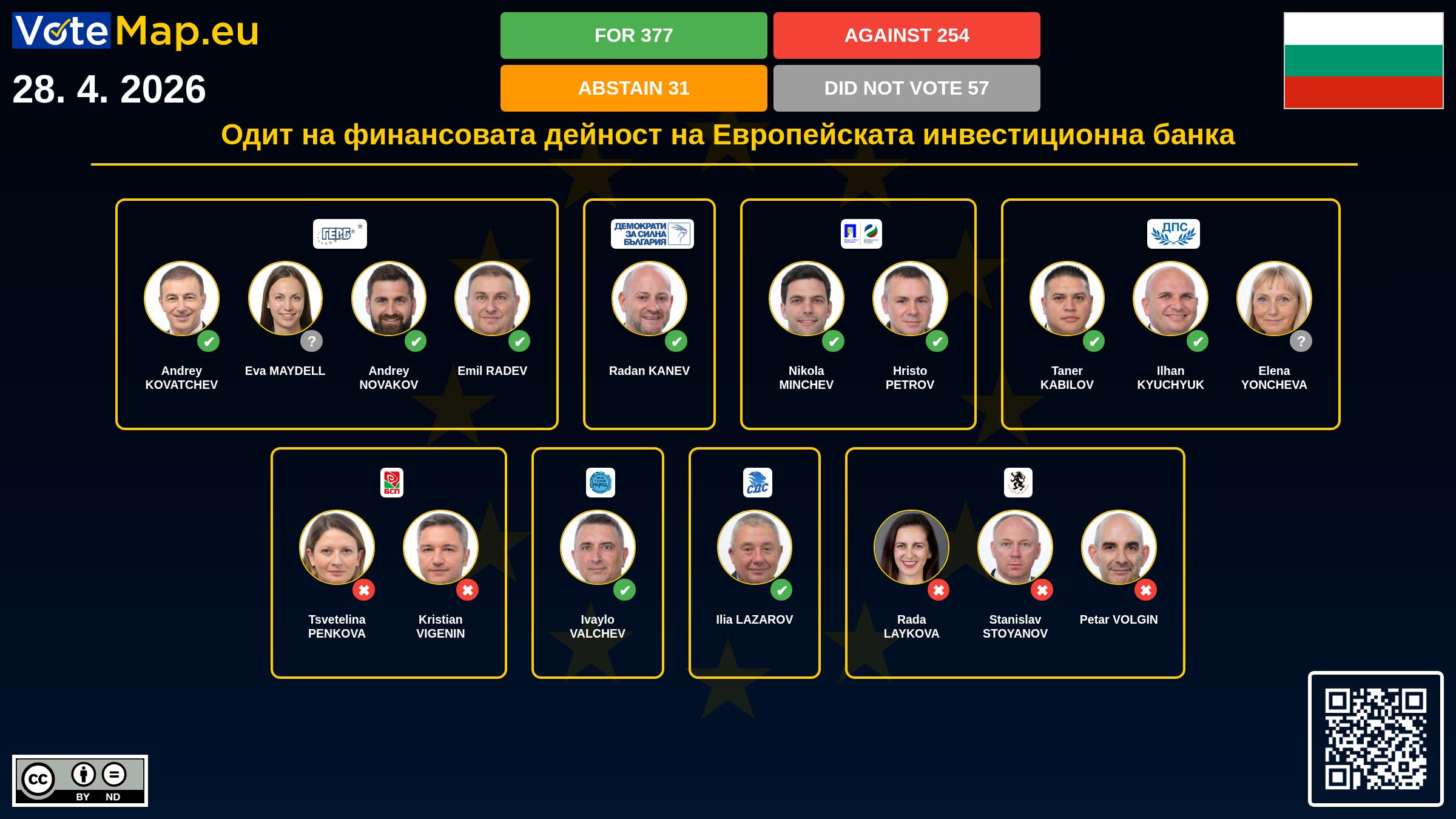
The European Investment Bank (EIB) finances projects in Member States and outside the EU. The Committee on Budgetary Control (CONT) assesses its financial management annually; this non-legislative report covers the year 2024. The rapporteur was Dick Erixon (ECR).
The resolution notes that the EIB’s payments more than 90 days past due more than tripled, rising from €82.4 million in 2023 to €281.3 million at the end of 2024. Funding for security and defence rose from EUR 0.5 billion to EUR 1.04 billion between 2023 and 2024, and the EIB’s EUR 8 billion European Strategic Security Initiative is set to become a permanent objective of the bank. According to the text, operations funded from the EIB’s own resources – which account for over three-quarters of all operations – are largely outside the scope of systematic external audit, and the resolution therefore calls for a stronger role for the European Court of Auditors. It cites the bankruptcy of Northvolt (a loan of over EUR 942.6 million) as an example of risk. For loans outside the EU, it calls for guarantees of transparency, human rights and the rule of law; in paragraph 30, it also calls for consideration to be given to cooperation on migrant return agreements.
The resolution was adopted by 377 votes to 254, with 31 MEPs abstaining. The EPP voted alongside the ECR and PfE, whilst Renew also supported the report. The EPP voted almost unanimously in favour (163:1:4 – in favour, against, abstentions), whilst Renew voted unanimously in favour (71:0:0). On the far right, the ECR voted in favour (71:2:3) as did the majority of PfE (59:6:12), whilst the ESN was predominantly against (1:24:2). The S&D (5:121:0) and the Greens/EFA (2:41:3) voted against, as did the far-left group The Left (1:42:0). The votes from the far right did not decide the outcome: without the ECR, PfE and ESN, the ratio would have been 246:222 and the resolution would still have passed.
The pro-European majority was therefore split: the EPP and Renew in favour, the S&D and Greens/EFA against. The closest result was in the separate vote on point 30, relating to readmission agreements: the amendment was rejected by a vote of 256:380:17 and the point remained in the text. Amendment 24, proposing an addition to point 37 in the section on the EIB’s activities outside the EU, was rejected by a vote of 156:405:58. We do not have the wording of the amendments available, and therefore cannot state exactly what they would have changed.
During the debate, the EPP shadow rapporteur, Dirk Gotink, noted that migration had been discussed at length in the report and called on colleagues on the left of the Chamber not to turn it into a divisive issue. The S&D shadow rapporteur, Carla Tavares, objected that the report underestimates the EIB’s role as a driver of balanced development and overlooks social and territorial priorities. Heléne Fritzon (S&D) criticised the rapporteur and his party, the Sweden Democrats, for attempting to include as much criticism as possible of Northvolt and other green investments in Sweden in the text, describing this as a ‘culture war’. Billy Kelleher (Renew) described the increase in defence funding as understandable, but warned against neglecting other long-term priorities. Virginijus Sinkevičius (Greens/EFA) called for the actual impact of investments to be measured, not just their volume. We were unable to find any statements from the Greens/EFA or other groups regarding the vote. The speeches by Tavares, Fritzon and Sinkevičius are paraphrased from the original.
On the same day, MEPs rejected the report by the same committee on the protection of the EU’s financial interests, drafted by Julien Sanchez (PfE), by 231 votes to 389.
We collect and visually present data publicly available at the page of European Parliament. Votemap.eu denies any responsibility for possible inconsistencies of the data or its changes after the publication.
Descriptions are created using DeepL Translate machine translation. We apologize for any possible imperfections or inconvenience.