The EU’s consent-based definition of rape
2026-04-28
The resolution calls on the European Commission to propose, without delay, an EU-wide definition of rape based on freely given consent. It was adopted by 447 votes in favour, 160 against and 43 abstentions. It was supported by all four groups of the pro-European majority (EPP, S&D, Renew and Greens/EFA) as well as The Left. The majority of MEPs from the ECR, PfE and ESN voted against it; some MEPs from the ECR and PfE abstained. In some of the individual votes, however, the EPP broke ranks with the other three groups.
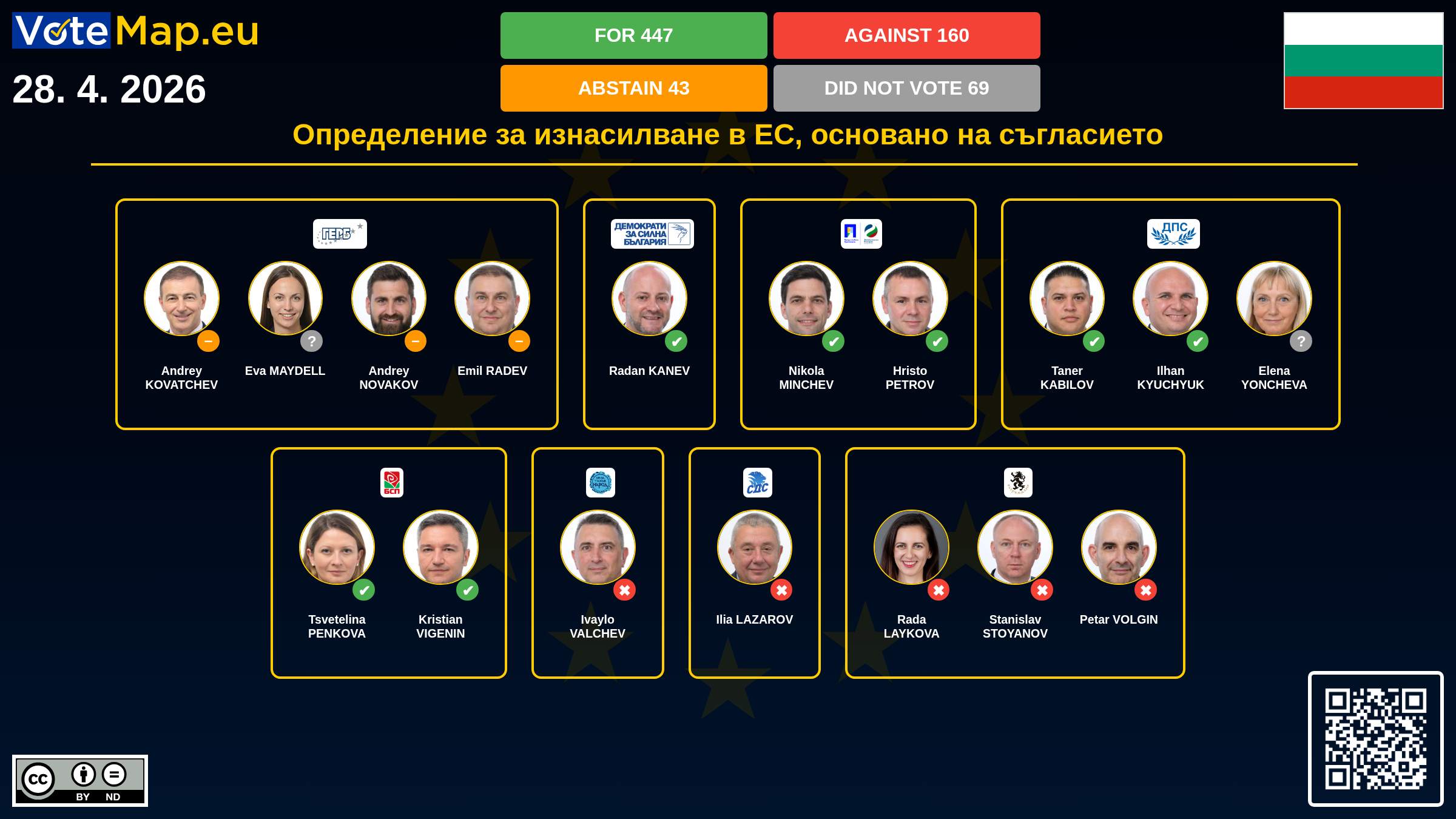
The resolution was drawn up jointly by the LIBE (Civil Liberties) and FEMM (Women’s Rights and Gender Equality) committees, with Evin Incir and Joanna Scheuring-Wielgus (both S&D) acting as rapporteurs. Key demand: The Commission is to propose, without delay, legislation introducing an EU-wide definition of rape based on freely given, informed and revocable consent, in accordance with Article 36 of the Istanbul Convention.
The resolution explicitly states that silence, a lack of resistance or the absence of a ‘no’ do not constitute consent. It also emphasises the need to recognise trauma responses such as ‘freezing’, that is, involuntary paralysis caused by fear, or attempts to appease the perpetrator to prevent the violence from escalating, and that this must be reflected in legislation and judicial practice. The Commission is also to propose the inclusion of gender-based violence among the areas of criminal activity at EU level under Article 83 of the TFEU and to issue guidelines on sex education and consent-based relationships by 2026. The resolution calls on Member States to amend limitation periods, as victims are often only able to identify or report the offence after some time has passed.
The resolution was adopted by 447 votes in favour, 160 against, with 43 MEPs abstaining. The EPP voted 146 in favour, 6 against and 11 abstentions; the S&D (125), Renew (70) and Greens/EFA (46) were unanimously in favour. The Left also voted in favour (42 in favour, 1 abstention). The ECR, PfE and ESN were against, though not unanimously: in the ECR, 60 voted against, 10 abstained and 4 voted in favour; in the PfE, 63 voted against and 13 abstained; and in the ESN, 24 voted against and 1 abstained.
The pro-European majority groups agreed on the core of the proposal. Shadow rapporteur Verena Mertens (EPP) stated that the EU needs a clear and comparable definition of rape based on freely given consent, and that a lack of resistance must never be interpreted as consent. Arba Kokalari (EPP) added that protection against rape should not depend on which EU country a woman lives in. “Sex without consent is rape,” said Anna-Maja Henriksson (Renew); Abir Al-Sahlani (Renew) pointed out that most rapes are committed by someone the victim knows, at home and without physical violence. Diana Riba i Giner (Greens/EFA) summed up the position with the slogan ‘Only yes means yes’. According to a Greens/EFA press release, the group secured the inclusion in the text of mandatory training for professionals and a reference to rape culture. The S&D Group, to which both rapporteurs belong, voted unanimously in favour; we do not have their own statement on this vote in the supporting documents.
A series of 29 roll-call votes took place on individual sections of the text and on amendments. An alternative motion for a resolution, intended to replace the committees’ report, was supported by the ECR, PfE and ESN; the EPP, S&D, Renew, Greens/EFA and The Left were against it, and the motion was rejected in two votes (179:457 and 180:455). We do not have details in the supporting documents regarding who formally tabled it or what exactly it contained.
Amendment 6 to paragraph 21 was narrowly rejected by 312 to 321: the EPP (23 in favour, 141 against) voted alongside the ECR, PfE and ESN against it, whilst the S&D, Renew, Greens/EFA and The Left voted in favour. Amendment 4, in support of the AL’s explanatory statement, was, by contrast, adopted by 316 votes to 298, although the majority of the EPP (15 in favour, 147 against) as well as the ECR and PfE voted against it. We do not have the text of the amendments in our supporting documents, so we are not including it here.
We collect and visually present data publicly available at the page of European Parliament. Votemap.eu denies any responsibility for possible inconsistencies of the data or its changes after the publication.
Descriptions are created using DeepL Translate machine translation. We apologize for any possible imperfections or inconvenience.