The position of farmers in the food supply chain
2026-06-16
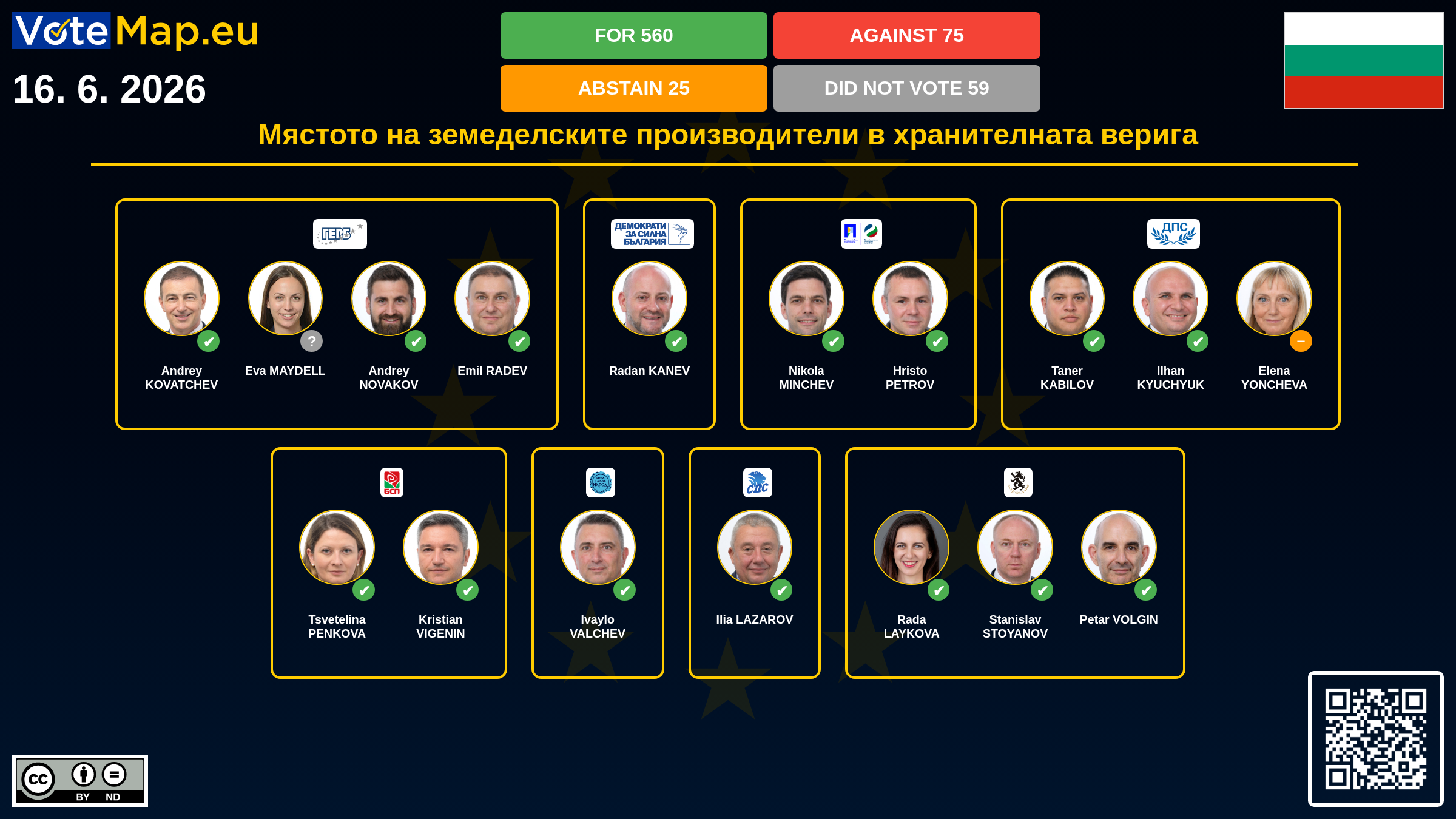
Farmers must, as a matter of principle, supply their produce to buyers on the basis of a written contract, and not only in the dairy sector. The agreement with the Council introducing this measure was supported by 560 MEPs, with 75 voting against and 25 abstaining. The EPP, S&D and Renew voted in favour, whilst the Greens/EFA voted against by an overwhelming majority – meaning the pro-European majority was divided. The EPP voted alongside the ECR, PfE and ESN, i.e. the far right; their votes did not determine the outcome.
Three regulations underpinning the EU’s Common Agricultural Policy are being amended to give farmers a stronger position vis-à-vis buyers. These are the regulation on the common organisation of the markets in agricultural products and two regulations on strategic plans and the financing of the Common Agricultural Policy. The proposal was put forward by the European Commission in 2024. The European Parliament’s rapporteur was Céline Imart (EPP).
The vote concerned the provisional agreement reached by Parliament and Council negotiators on 5 March 2026 during the so-called trilogue, i.e. the final round of negotiations between the two institutions. The agreement was first approved by the Committee on Agriculture (AGRI). The plenary then voted on it as a whole, by a single roll-call vote and without debate. In a letter dated 23 March 2026, the Council undertook to approve the Parliament’s position. It did so on 29 June 2026, and the new rules were published on 29 July 2026 in the Official Journal of the EU as Regulation (EU) 2026/1739.
Written contracts form the core of the agreement. According to the adopted text, the obligation to conclude such contracts applies not only to milk but also to other agricultural sectors. Member States may grant exemptions, for example where the first purchaser is a micro-enterprise or small enterprise, where payment is made immediately upon delivery or within three working days at the latest, or for products where other price transmission mechanisms are already in place. The Commission’s proposal had already provided for contracts lasting longer than six months to include a review clause, enabling a farmer or a producers’ organisation to request a price recalculation.
The agreement does not introduce a fixed minimum price. It emphasises that farmers should receive a price they themselves consider fair and appropriate, and that the calculation of the final price in the contract should be transparent and predictable. For contractual disputes, Member States must ensure mediation or a comparable mechanism, including through mechanisms that already exist. The role of producer organisations is also strengthened. Designations such as ‘beef’, ‘chop’ or ‘bacon’ remain reserved for products that actually contain meat from the specified animals.
The agreement was supported by 560 MEPs, with 75 voting against and 25 abstaining. The EPP (161 in favour, 2 against, 5 abstentions) and the S&D (119 in favour, 8 against, 4 abstentions) voted in favour by an overwhelming majority. Renew supported the agreement by a majority: 52 MEPs voted in favour, 7 against and 9 abstained. An abstention does not count as a vote against. The Greens/EFA voted overwhelmingly against (47 against, 1 abstention, none in favour). All four groups had a shadow rapporteur during the negotiations: Cristina Maestre for the S&D, Barry Cowen for Renew and Anna Strolenberg for the Greens/EFA. Three of the four groups in the pro-European majority thus stood on one side, with the Greens/EFA on the other.
The EPP voted alongside the ECR, PfE and ESN – that is, the far right. The ECR (75 in favour) and PfE (78 in favour) supported the agreement unanimously, whilst the ESN did so by a majority (20 in favour, 2 abstentions). Their votes did not determine the outcome: even without them, the agreement would have received 387 votes in favour against 75 against. The Left, i.e. the far left, voted in favour by a majority (31 in favour, 8 against, 2 abstentions).
We collect and visually present data publicly available at the page of European Parliament. Votemap.eu denies any responsibility for possible inconsistencies of the data or its changes after the publication.
Descriptions are created using DeepL Translate machine translation. We apologize for any possible imperfections or inconvenience.