Ceuta: dispute over the response to hybrid attacks on the EU border
2026-09-17
On 17 September 2026, the European Parliament in Strasbourg adopted, by 339 votes to 225 (with 16 abstentions), a resolution on hybrid attacks and the exploitation of migrants in Ceuta, calling for a coordinated response to protect the EU’s external borders. This was one of seven competing draft resolutions on the subject; the groups were unable to agree on a joint text. The text was pushed through by the EPP, together with the far right (ECR, PfE, ESN), against the S&D and Greens/EFA, whilst Renew was internally divided.
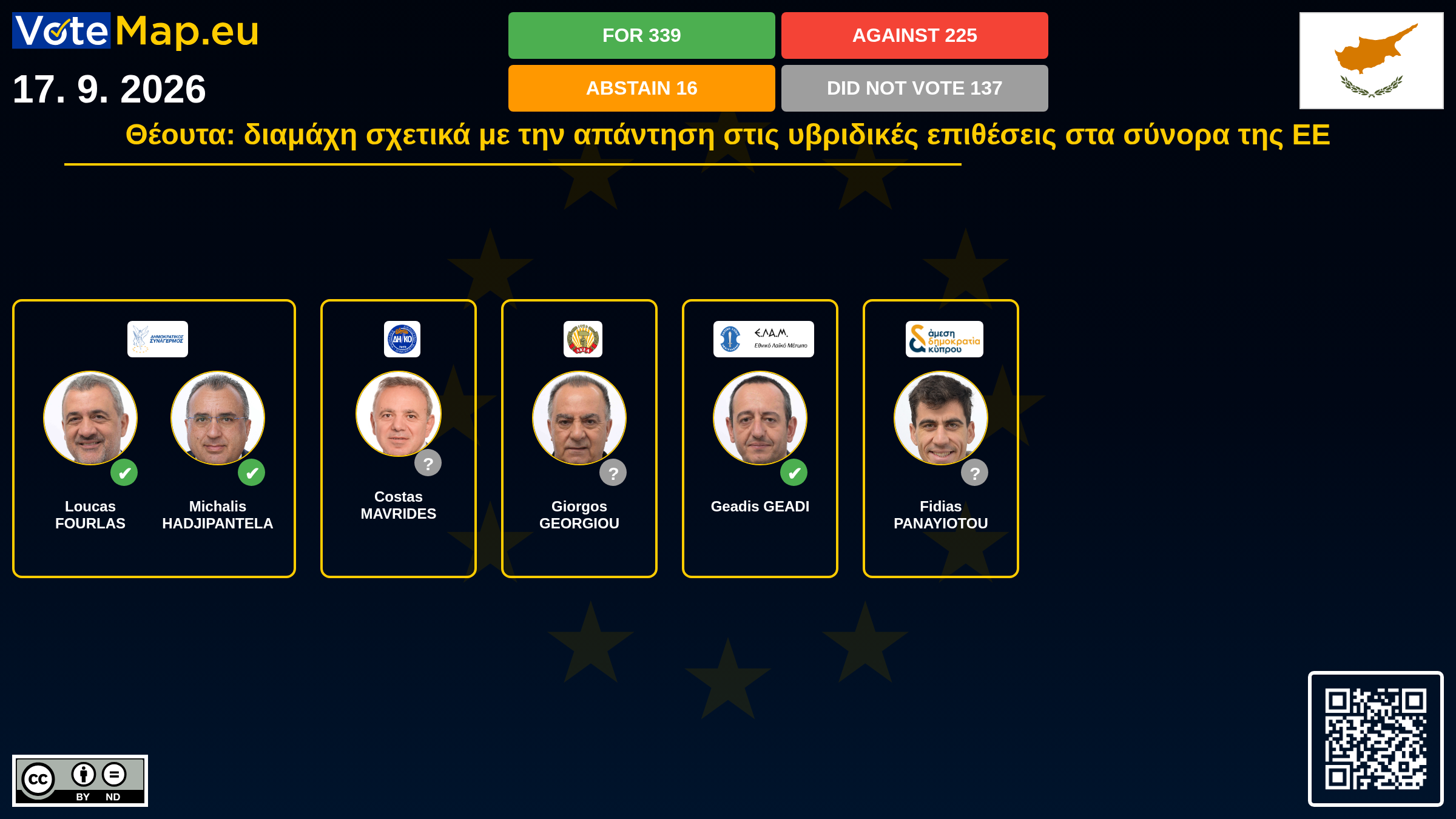
On Thursday 17 September 2026 in Strasbourg, the European Parliament voted on a resolution concerning hybrid attacks and the exploitation of migrants in Ceuta, and on the need for a coordinated response to protect the EU’s external borders. This was a standalone resolution under Rule 136(2) of the Rules of Procedure (the so-called RSP procedure for topical issues), rather than a report from any committee — for this type of text, there is no rapporteur or shadow rapporteurs, as the motion is tabled directly by the political groups. The groups failed to agree on a joint text, and so seven competing motions for resolutions were put to the vote; only one of them, text B10-0406/2026, was adopted, by a vote of 339 in favour, 225 against, and 16 abstentions.
The four democratic groups were divided in their assessment of the text. The EPP voted unanimously in favour, with not a single vote against. The S&D was equally united in the opposite direction — against. The Greens/EFA voted almost unanimously against, with only a few exceptions. Renew Europe was the only one of the four groups to be internally divided, with no clear majority in one direction — which shows that the text provoked disagreement, rather than consensus, within the liberal political camp.
Two days before the vote, the EPP and S&D issued statements on the matter — these were general statements on the situation in Ceuta, not comments specifically on this resolution. EPP Vice-Presidents Tomas Tobé and Dolors Montserrat accused the Spanish government of failing to prevent the border breach in Ceuta and of bearing responsibility for it. S&D Vice-President Ana Catarina Mendes, on the other hand, described Ceuta as the target of a hybrid attack by hostile actors with links to the far right and called for solidarity with Spain. Renew Europe and Greens/EFA have not issued any recent statements on the matter on their websites.
The resolution was passed because the entire far-right joined the EPP — the ECR, PfE and ESN voted as a single bloc, with not a single vote against. The EPP, together with the ECR, PfE and ESN, therefore provided the decisive majority, whilst the S&D and Greens/EFA were against and Renew remained divided.
Turnout was lower than in consensus votes – 580 out of 717 MEPs took part in the vote, or roughly four in five. Among the four democratic groups, the Greens/EFA had the highest turnout, whilst the EPP had the lowest – the very group that effectively pushed the resolution through.
It is not possible to verify with certainty from publicly available sources who formally tabled text B10-0406/2026 – the group responsible for drafting it is not mentioned in the procedural documentation. Contemporary reports and the voting pattern (the EPP aligning with the far right) suggest that the text was associated with the EPP; however, this is an inference, not a verified fact. This vote must be distinguished from another, separate vote held on 16 September 2026 (435:209, 13 abstentions) on an amendment to the report on hybrid threats, which concerned similar wording regarding Ceuta, but involved a different procedure and a different text.
We collect and visually present data publicly available at the page of European Parliament. Votemap.eu denies any responsibility for possible inconsistencies of the data or its changes after the publication.
Descriptions are created using DeepL Translate machine translation. We apologize for any possible imperfections or inconvenience.