Political repression and the humanitarian situation in Cuba
2026-06-18
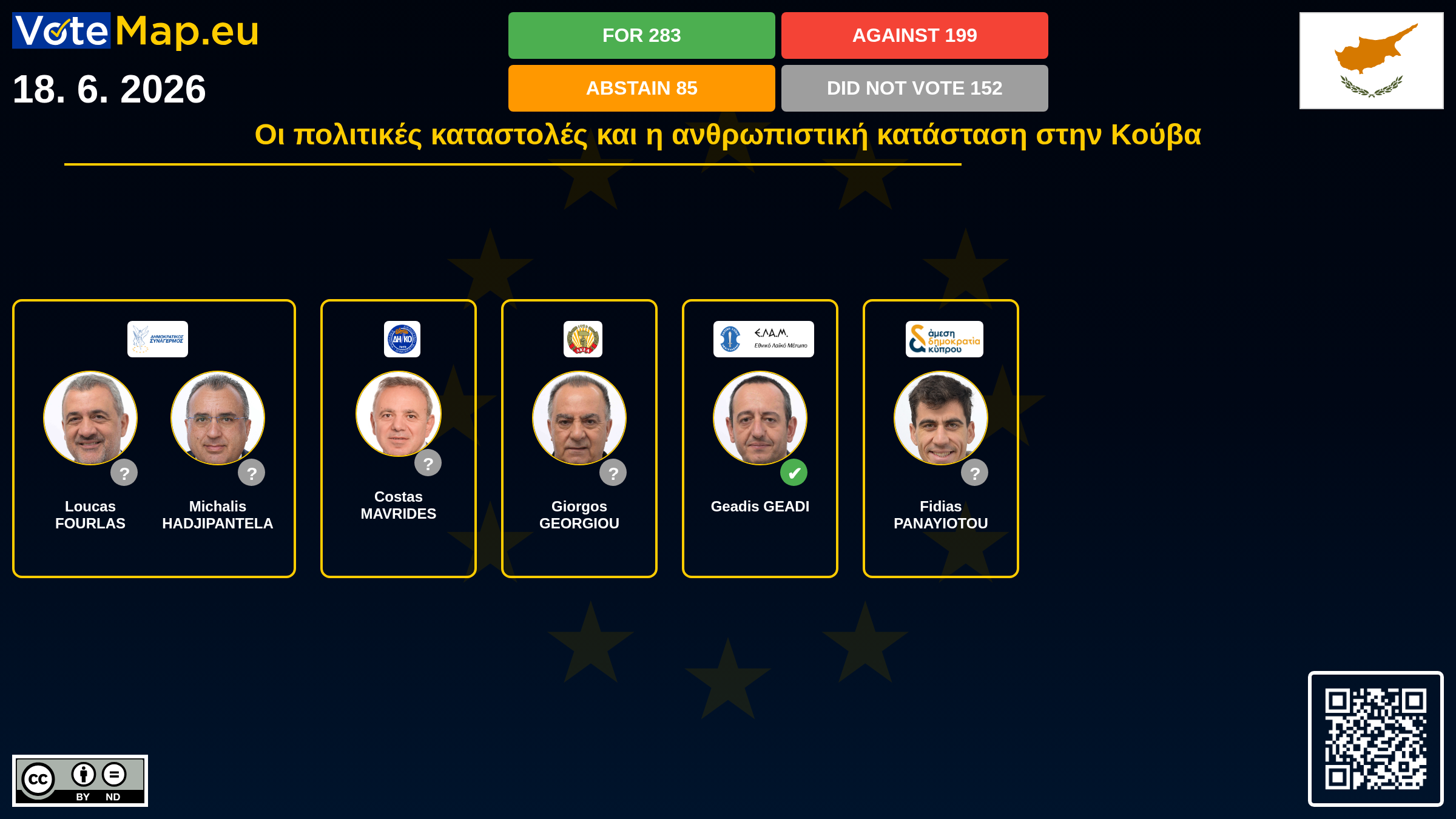
The resolution on Cuba was adopted by 283 votes in favour, 199 against and 85 abstentions. The EPP and Renew voted in favour, whilst the ECR, S&D and Greens/EFA voted against. The pro-European majority was divided mainly over the extent to which the US embargo and sanctions contributed to the crisis, and whether to suspend the EU’s agreement with Cuba. The adopted text attributes the crisis to the Cuban regime, not to the embargo.
The resolution concluded the debate on political repression and the humanitarian situation in Cuba, which had taken place on 19 May 2026. There were seven draft resolutions; the S&D and Greens/EFA groups tabled a joint one. The EPP’s motion was adopted; according to the EP’s Legislative Observatory, the final text was tabled by the EPP, ECR and Renew.
The resolution was passed by 283 votes in favour, 199 against and 85 abstentions. The EPP (140 in favour, 1 against) and Renew (57 in favour, 1 against, 3 abstentions) voted in favour. The S&D (6 in favour, 98 against, 2 abstentions) and the Greens/EFA (41 against, 2 abstentions) voted as a bloc against it, meaning the pro-European majority was split. The ECR also voted in favour (62 in favour, 1 abstention), whilst the PfE (58 out of 64 voters) and the ESN (18 out of 24) largely abstained. Even without the votes of the ECR, PfE and ESN – that is, the far right – the resolution would still have passed, by 211 to 197. The Left, that is, the far left, voted unanimously against (38 votes).
The adopted text “strongly condemns the systematic repression carried out by the Cuban regime”, including, amongst other things, torture, sexual violence, death threats and the imprisonment of children. According to the non-governmental organisation Prisoners Defenders, a record 1,281 political prisoners were being held in Cuba at the end of May 2026. It calls for their immediate and unconditional release and for sanctions under the EU’s Magnitsky Act against those responsible for the repression, starting with the highest-ranking officials, including Miguel Díaz-Canel, and the leadership of the GAESA conglomerate. It also condemns the material support the Cuban regime is providing for Russia’s war of aggression against Ukraine, including the recruitment of Cuban citizens.
According to the text, the Agreement on Political Dialogue and Cooperation between the EU and Cuba has failed to fulfil its purpose. The resolution calls on the High Representative and the Member States to make it clear that if the regime does not take concrete steps in the near future – including, amongst other things, the release of nearly 1,300 political prisoners – the EU must suspend the agreement without delay. It states that humanitarian aid should go directly to the people and to independent businesses, bypassing the Cuban state.
The point of contention lies in paragraph G. The adopted text states that the humanitarian crisis “was not caused by any external embargo” and that it is a direct consequence of the regime’s own actions. The S&D and Greens/EFA, by contrast, argued during the debate that the US also bore some responsibility for the crisis. Leire Pajín (S&D) linked the suffering of the Cuban people to the US blockade and recent sanctions, saying: “The United States must end all pressure on Cuba.” At the same time, she stated that the Cuban government must finally make progress on democratic reforms, and defended the agreement with Cuba as a tool that “serves to exert pressure and drive progress”. Ana Miranda Paz, speaking on behalf of the Greens/EFA, stated that the situation cannot be assessed without the context of decades of the US embargo, adding: “What is happening is collective punishment by Trump, which is suffocating the Cuban people.” Both speeches were delivered in Spanish; the quotations have been translated.
The text refers to US sanctions against regime officials in a matter-of-fact manner and does not criticise the US.
We collect and visually present data publicly available at the page of European Parliament. Votemap.eu denies any responsibility for possible inconsistencies of the data or its changes after the publication.
Descriptions are created using DeepL Translate machine translation. We apologize for any possible imperfections or inconvenience.