Deferral of obligations relating to methane emissions in the energy sector
2026-10-22
The Commission’s proposal to postpone part of the obligations under the Regulation on methane emissions in the energy sector by two to three years was adopted by 341 votes in favour, 225 against, with 6 MEPs abstaining. It was passed thanks to votes from the ECR, PfE and ESN – the far right – alongside the EPP. The S&D and Greens/EFA were against it, whilst Renew was divided: the EPP, S&D, Renew and Greens/EFA – the pro-European majority – were split. The Left (the far left) also voted against it.
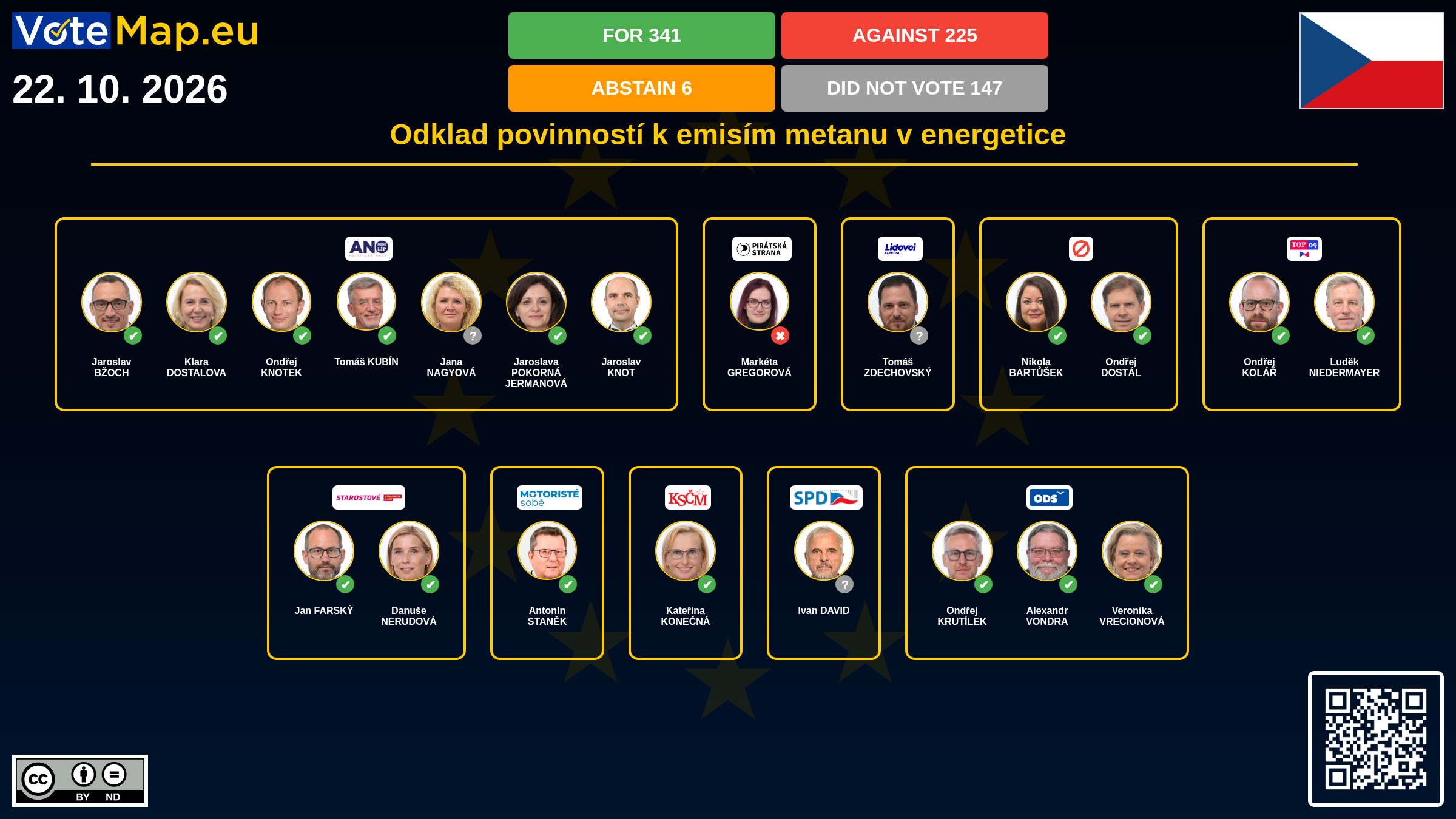
Regulation (EU) 2024/1787 limits methane emissions in the energy sector, specifically during the extraction and transport of oil, natural gas and coal. The Commission’s proposal, which was put to a vote, extends several of its deadlines. Reports on emissions measured directly at source are to be submitted three years later: for active assets by 5 February 2030 instead of 5 February 2027, and for inactive assets by 5 August 2031 instead of 5 August 2028. The deadline the obligation for importers of oil, gas and coal to demonstrate that imported fuels are subject to an equivalent regime for monitoring, reporting and verifying emissions, and to report the results of these efforts, is being postponed. Reports on the methane intensity of production are also postponed by two years, to 5 August 2031, for both producers within the Union and importers.
The full deferral does not apply to oil, gas and coal from third countries subject to EU sanctions. For these, the obligations come into force earlier, in 2028 and 2030 respectively. The adopted text explicitly refers here to Regulation (EU) 2026/261 on the phasing out of Russian gas. The Commission is to submit a report to the Parliament and the Council by 1 July 2029 on how the Regulation is being implemented. The amendment is to enter into force on the day following its publication, rather than on the twentieth day.
The proposal was voted on under the urgent procedure in accordance with Rule 170 of the Rules of Procedure. The Commission published the proposal on 14 October 2026; one day later, one of the political groups requested the urgent procedure, and on 19 October the proposal was referred to the ENVI and ITRE committees. The committees did not draw up a report, and the plenary voted directly on the Commission’s proposal. Consequently, no rapporteur was appointed.
341 MEPs voted in favour, 225 against, and 6 abstained. The EPP voted in favour by a ratio of 140 to 1. The ECR (66 votes), PfE (70) and ESN (21) also voted in favour, all three without a single vote against or abstention. Without the votes of the ECR, PfE and ESN – that is, the far right – the proposal would have received 184 votes against 225 and would not have been adopted. The postponement was therefore adopted thanks to their votes.
The S&D voted mostly against: 91 MEPs against, 7 in favour, and 4 abstained. The Greens/EFA voted against with all 46 votes. Renew was split, with 25 MEPs in favour, 40 against and 2 abstaining. We would like to point out that abstaining does not mean voting against: those who abstained did not support the motion, but neither did they reject it. The EPP, S&D, Renew and Greens/EFA – in other words, the pro-European majority – were divided on this vote. The EPP supported the postponement, whilst part of Renew, the S&D and the Greens/EFA opposed it. All 37 MEPs from The Left (far left) who took part also voted against.
Dimitris Tsiodras (EPP), a member of the ENVI Committee, defended the postponement on behalf of the EPP. In his group’s press release, he described the vote as an important step towards a more realistic and effective implementation of the methane regulation, adding: “We are not suspending the methane regulation; we are ensuring that it can be implemented effectively.”
The Greens/EFA had previously criticised efforts to suspend the Methane Regulation. On 6 October 2026, Jutta Paulus (Greens/EFA) stated that a suspension would neither bring more gas into the EU nor reduce heating costs. In her view, the Commission must not give in to pressure from the oil and gas industries.
We collect and visually present data publicly available at the page of European Parliament. Votemap.eu denies any responsibility for possible inconsistencies of the data or its changes after the publication.
Descriptions are created using DeepL Translate machine translation. We apologize for any possible imperfections or inconvenience.