EU Civil Protection and Health Preparedness
2026-11-12
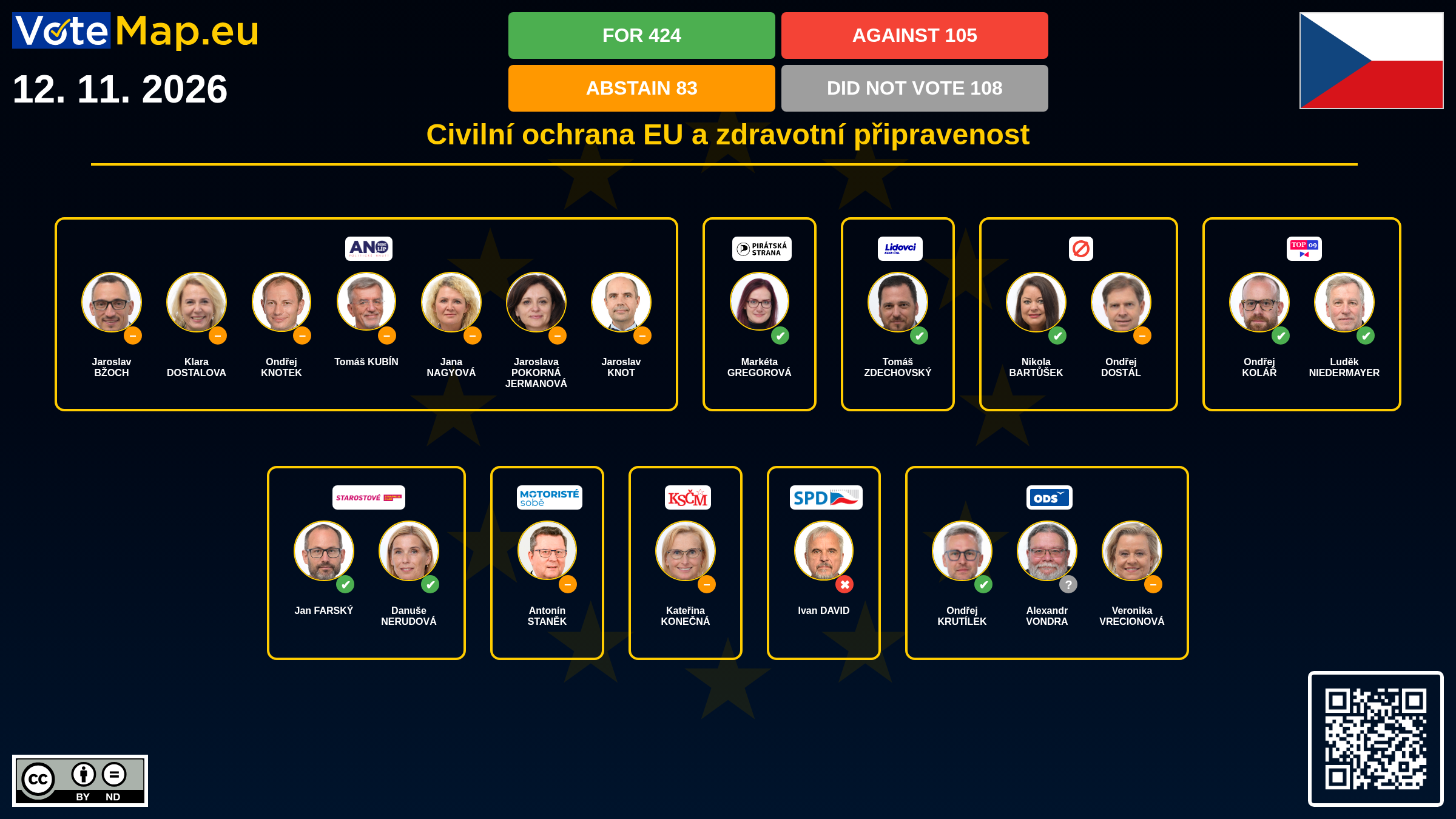
Members of the European Parliament approved, by 424 votes to 105 with 83 abstentions, the negotiating position on the reform of the Union Civil Protection Mechanism for the period 2028–2034, linked to preparedness for health crises. The EPP, S&D, Renew and Greens/EFA voted in favour, whilst PfE and ESN voted against; the ECR, which includes one of the two rapporteurs, split its vote. The final text of the regulation will be determined following negotiations with the Council.
The Union’s civil protection mechanism is a common European framework for responding to natural disasters, industrial accidents and other crises; it also includes the rescEU capabilities. The Commission has proposed its structure for the 2028–2034 budgetary period and linked it to the Union’s support for preparedness and response to health emergencies.
This was not a vote on final approval. MEPs voted on a set of 332 amendments to the Commission’s proposal – in other words, on Parliament’s position – and immediately afterwards decided, by a show of hands, to refer the dossier back to the committees. The committees will use this position to begin negotiations with the Council, known as a trialogue. The final text of the regulation will emerge from these negotiations.
The most significant change compared with the Commission’s proposal concerns funding. The Commission had envisaged an indicative budget of €10.675 billion; Parliament is calling for €12.416 billion at current prices, or €11 billion at 2025 prices. It also wishes to allocate the budget as follows: 40 per cent for prevention, preparedness and civil protection, including rescEU; 40 per cent for prevention, preparedness and response to health emergencies; and the remaining 20 per cent to be set aside as a flexible amount for either of these two objectives. It also introduces stricter monitoring and auditing of expenditure, in which the Commission, the European Court of Auditors, OLAF and the European Public Prosecutor’s Office are to be involved, as well as rules to prevent the same activity from being funded by more than one EU programme at the same time.
Parliament further extends the scope of the mechanism to cover all hazards, explicitly including serious cross-border health threats, and adds the capacity for recovery alongside prevention, preparedness and response. A new article requires the Commission and the Member States to incorporate climate risks and projections into civil protection planning, including rescEU capacities and early warning systems. The proposed coordination centre is to be called the Union Crisis Support Hub, and regional and local authorities will also be able to contribute to the mechanism on a voluntary basis.
The proposal was examined jointly by two committees, the Committee on the Environment (ENVI) and the Committee on Public Health (SANT), and therefore had two rapporteurs: Leire Pajín (S&D, Spain) for ENVI and Aurelijus Veryga (ECR, Lithuania) for SANT. The S&D Group welcomed the vote in its press release. Its shadow rapporteur, Christophe Clergeau, described it as an important step towards creating a culture of preparedness, whilst rapporteur Pajín emphasised that Europe must anticipate risks and be able to protect people when disaster strikes.
The motion was supported by 424 MEPs, with 105 voting against and 83 abstaining. The EPP (160 in favour, 1 against), S&D (116), Renew (69) and Greens/EFA (42) – in other words, the entire pro-European majority – voted in favour; within the latter three groups, no one voted against or abstained. The Left voted mostly in favour (16 in favour, 2 against), whilst 20 of its MEPs abstained.
The PfE (44 against, 25 abstentions) and the ESN (22 against) voted against. The ECR was divided in its vote: 14 in favour, 26 against and 30 abstentions, despite the fact that Co-rapporteur Veryga is a member of their group. The far right therefore did not stand as a united bloc against the motion. We would like to point out that an abstention is not a vote against.
We collect and visually present data publicly available at the page of European Parliament. Votemap.eu denies any responsibility for possible inconsistencies of the data or its changes after the publication.
Descriptions are created using DeepL Translate machine translation. We apologize for any possible imperfections or inconvenience.