Barriers to the single market in the defence sector
2026-03-11
The resolution on removing barriers to the single market in the defence sector was adopted by 393 votes in favour, 169 against, with 67 MEPs abstaining. It was supported by all four groups of the pro-European majority: the EPP, S&D, Renew and Greens/EFA. The ESN and the majority of the PfE voted against it, whilst the ECR was divided – more of its MEPs abstained (37) than voted against (35), with 2 voting in favour. The report was drafted by Tobias Cremer (S&D).
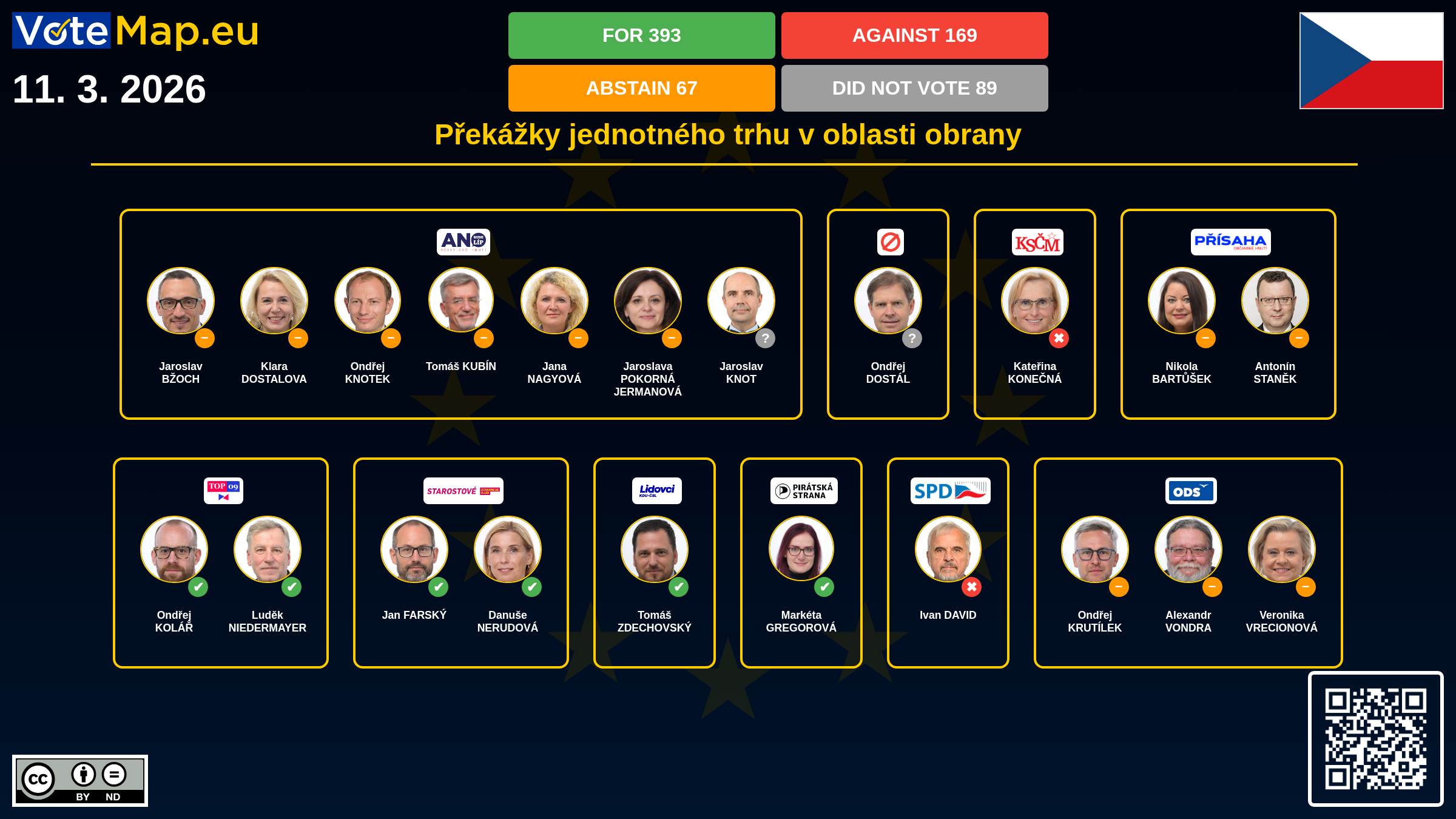
The resolution on the report on ‘Removing barriers to the single market in the field of defence’ (A10-0017/2026) was drawn up by the Committee on Security and Defence (SEDE), with German MEP Tobias Cremer (S&D) acting as rapporteur. Opinions were issued by the ECON and IMCO committees, with Johan Van Overtveldt (ECR) and Kamila Gasiuk-Pihowicz (EPP) acting as rapporteurs.
This is a non-legislative own-initiative resolution: it is not legally binding, but rather a political position addressed to the Council and the Commission. It focuses on the factors preventing the EU defence market from functioning as a single market. It calls on Member States to overcome the “nationalist impulse” to protect their own industries and to purchase more jointly – giving priority to products from the European industrial base, from Ukraine and from EEA/EFTA countries, with other partners coming second. It seeks to treat Ukraine as far as possible as part of the single market in the field of defence, including access to the European Defence Fund.
It calls on the Commission to undertake an ambitious revision of Directive 2009/81/EC on defence procurement and to simplify the movement of defence products between EU Member States, for example by waiving authorisation requirements for components that are already incorporated into a finished product. It also calls for a uniform interpretation of Article 346 TFEU, namely the derogation from internal market rules on grounds of ‘essential security interests’: this should be applied only in exceptional circumstances and assessed on a case-by-case basis. According to the resolution, the Court of Justice of the European Union has already found on several occasions that Member States have abused this provision. It then calls on the Council and the Commission to earmark sufficient funds in the next multiannual financial framework for defence programmes that will lead to joint development and procurement by the Member States.
The resolution also highlights external threats. It justifies the need for closer defence cooperation primarily on the grounds of Russia’s war of aggression against Ukraine and Russian cyber-attacks and provocations directed against the EU. It also warns against the dependence of supply chains on countries outside the EU and cites China, which threatens to restrict exports of raw materials, as an example of coercion.
The resolution was adopted by 393 votes in favour and 169 against, with 67 MEPs abstaining. All four groups of the pro-European majority voted in favour, almost unanimously: EPP 155 in favour, 5 against and 4 abstentions; S&D: 116 in favour, none against, 4 abstentions; Renew: 65 in favour, 1 against, 2 abstentions; Greens/EFA: 46 in favour, none against, 1 abstention.
Only the S&D issued a specific statement directly regarding this vote. Tobias Cremer (S&D) stated on his group’s website (translated from English): “In a new world of great-power politics, a European single market in defence is not an ambitious ideal, but an urgent necessity.” The EPP, Renew and Greens/EFA voted in favour; we could not find a separate statement from them regarding this report, and we therefore describe their position based on how they voted.
The ESN, PfE and ECR (far right) did not support the resolution, but did not vote as a unified bloc. The ESN was entirely against (24 votes). PfE voted predominantly against (48), with 14 of its MEPs abstaining and none in favour. The ECR was divided: 37 MEPs abstained, 35 voted against and 2 in favour. The EPP did not vote alongside the far right on this issue.
The Left (far left) voted predominantly against: 36 of its MEPs voted against, 4 in favour and 2 abstained.
We collect and visually present data publicly available at the page of European Parliament. Votemap.eu denies any responsibility for possible inconsistencies of the data or its changes after the publication.
Descriptions are created using DeepL Translate machine translation. We apologize for any possible imperfections or inconvenience.