Agreement with the Council on duty-free imports of lobsters from the USA
2026-06-16
The European Parliament has approved an agreement with the Council under which no customs duties will be levied on lobsters and crayfish imported from the US, including, for the first time, processed products. There were 444 votes in favour, 152 against and 54 abstentions. Among the EPP, S&D, Renew and Greens/EFA – that is, the pro-European majority – the EPP voted unanimously in favour, the S&D and Renew voted mostly in favour, and the Greens/EFA were divided. The ECR supported the agreement by an overwhelming majority; the PfE was mostly against; the ESN almost entirely abstained; and The Left voted unanimously against.
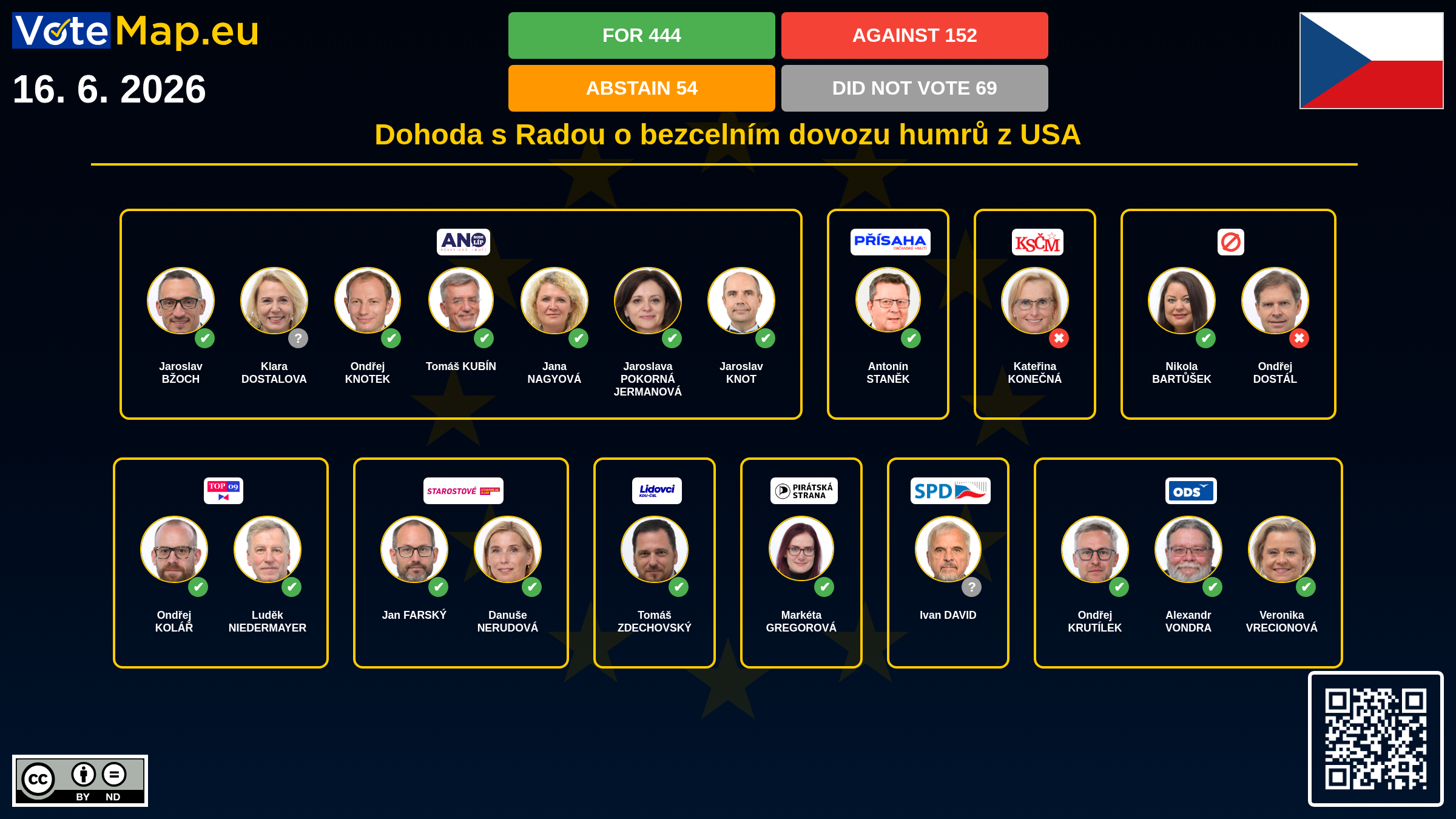
The European Parliament has approved, at first reading, a provisional agreement with the Council on a regulation under which no customs duties will apply to lobsters and crayfish imported from the US. 444 MEPs voted in favour, 152 against, and 54 abstained. A provisional agreement is a text on which Parliament and Council negotiators have reached agreement in a trilogue and which is then formally approved by both institutions. The rapporteur was Bernd Lange (S&D).
Regulation (EU) 2020/2131 introduced duty-free imports of lobsters from the US for a period of five years, until 31 July 2025. The new regulation builds on this and now also covers processed products, such as cooked items. It forms part of a package through which the EU is implementing the joint statement with the US of 21 August 2025. In this declaration, the US pledged a 15 per cent ceiling on customs duties on imports from the EU. The EU pledged to abolish customs duties on industrial goods from the US and to grant preferential access to selected agricultural and marine products. The main regulation in the package was voted on separately on the same day.
The vote follows on from 26 March 2026, when Parliament adopted a mandate for negotiations with the Council; we wrote about this in a previous article. According to the summary in the Parliament’s Legislative Observatory (OEIL), the agreement differs from the mandate in three respects. The duty-free regime may be suspended by a Commission implementing act, rather than a delegated act, over which Parliament has greater control. The mandate explicitly listed human rights, democracy and the rule of law as grounds for suspension, but the summary of the final text does not mention them. One reason for suspension, for example, is that the US is not complying with the joint declaration. And the regime remains in force until 31 July 2030, not until the end of 2028.
Of the EPP, S&D, Renew and Greens/EFA groups – that is, the pro-European majority – the EPP unanimously supported the agreement (168 in favour). Shadow rapporteur Željana Zovko (EPP) called during the debate for its approval “not merely as an economic agreement, but as a strategic decision that protects jobs” (in English). The S&D group was largely in favour (110 in favour, 18 against). Kathleen Van Brempt (S&D) described it as “a temporary and conditional agreement, not a blank cheque” (in English). Renew also voted in favour by a majority (55 in favour, 11 against, 1 abstention).
The division within the pro-European majority lies with the Greens/EFA, who voted split (18 in favour, 25 against, 3 abstentions). Shadow rapporteur Anna Cavazzini (Greens/EFA) said that “Trump’s tariffs are illegal”. However, she added that Parliament had achieved “real improvements” and that it was now important for the Commission to “make full use of these levers” (in German). Catarina Vieira (Greens/EFA) described the agreement as “deeply unequal”. In her view, it is intended “to prevent the worst, even though the US Supreme Court has ruled that the worst is illegal” (in English). The debate on 15 June 2026 covered both regulations in the package.
Of the ECR, PfE and ESN – that is, the far right – the ECR supported the agreement by an overwhelming majority (71 in favour, 1 against, 3 abstentions). The PfE was mostly against (14 in favour, 39 against, 24 abstentions). The ESN almost unanimously abstained (21 out of 22 voters; one MEP was against); an abstention does not count as a vote against. The Left, i.e. the far left, voted unanimously against (40 votes).
The Council adopted the regulation on 25 June 2026, and on 30 June it was published in the Official Journal of the EU as Regulation (EU) 2026/1461. According to the OEIL summary, an evaluation report on its functioning is due by 31 January 2030.
We collect and visually present data publicly available at the page of European Parliament. Votemap.eu denies any responsibility for possible inconsistencies of the data or its changes after the publication.
Descriptions are created using DeepL Translate machine translation. We apologize for any possible imperfections or inconvenience.