Georgian Dream wants to ban opposition parties
2026-10-08
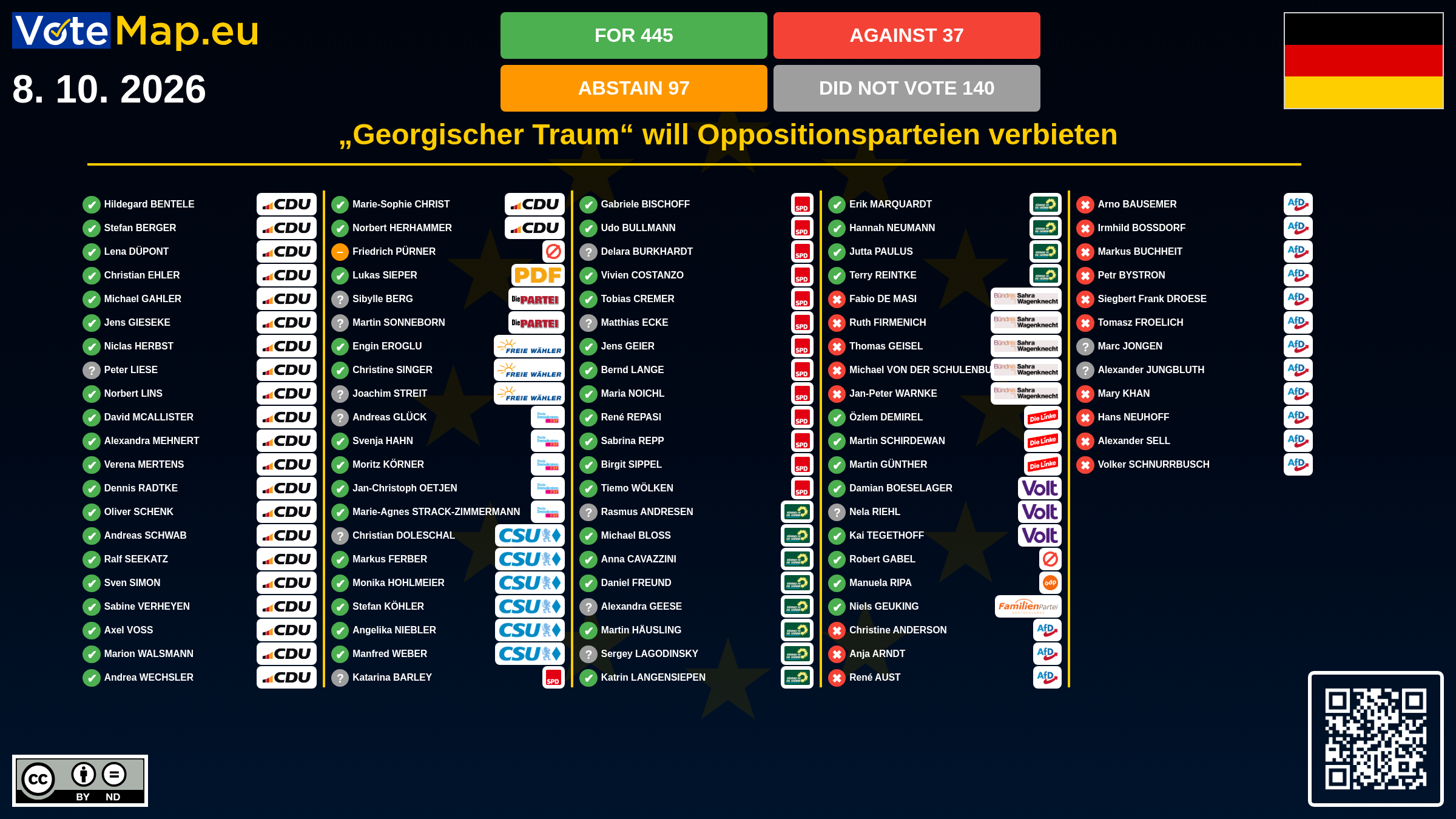
The European Parliament adopted, by 445 votes in favour, 37 against and 97 abstentions, a resolution condemning the Georgian Dream party’s attempts to outlaw opposition parties and calling for sanctions against the regime’s leaders. The text was tabled by the EPP, S&D, Renew and Greens/EFA, together with the ECR; the four pro-European majority groups supported it unanimously. The PfE abstained, with the exception of three MEPs, whilst the ESN voted predominantly against; the far right was thus divided.
The Georgian Parliament, which is controlled by the ruling Georgian Dream party, filed a constitutional complaint in November 2025 seeking to ban the opposition parties: the United National Movement, the Coalition for Change and the Strong Georgia–Lelo coalition. The petition was later expanded to include the Federalists and, in September 2026, For Georgia, the only opposition party currently represented in parliament. In the same month, new constitutional judges were appointed, which, according to the resolution, raises serious doubts about the independence of the proceedings.
The resolution ‘strongly condemns’ these efforts and demands the immediate withdrawal of the petition. It describes the removal of the legitimate opposition through judicial means as incompatible with democracy. It also states who stands to benefit from this: according to the text, the proceedings form part of the Georgian Dream’s strategy “aimed at transforming Georgia into a one-party regime by eliminating political pluralism, following the example of Russia and Belarus, which serves the Kremlin’s intention to keep Georgia outside the European and Euro-Atlantic sphere”.
It further calls for the immediate and unconditional release of all political prisoners, namely Elena Khoshitari, Mzia Amaglobeli, Mikheil Saakashvili, Giorgi Baramidze and Nika Melia. It reiterates its call for targeted sanctions and a visa ban on Bidzina Ivanishvili, Irakli Kobakhidze, Shalva Papuashvili and Kacha Kaladze. It regrets that the EU and most Member States have not yet taken action “in a way that would have tangible consequences”. It points out that two European political foundations, including the Konrad Adenauer Foundation, were forced to close their offices in Tbilisi in September 2026. It warns Georgia that the ban on established parties is driving it further away from the EU and precludes any progress towards accession.
The resolution was adopted by 445 votes in favour, 37 against and 97 abstentions. It was the result of a merger of five motions tabled by the EPP, S&D, Renew, Greens/EFA and ECR. The four pro-European majority groups voted unanimously in favour: the EPP with 151 votes, the S&D with 101, Renew with 69 and the Greens/EFA with 46. None of them voted against or abstained. Together, they accounted for 367 votes in favour, more than the total number of those who voted against or abstained. We were unable to find any separate statements from any of these four groups regarding this vote; their position is therefore indicated by their co-authorship of the text and their voting record.
The ECR, which co-sponsored the resolution, voted overwhelmingly in favour: 45 MEPs in favour, 2 against and 23 abstained, 18 of whom were Italian. The PfE did not table its own motion for a resolution and almost the entire group abstained in the vote: 3 MEPs voted in favour, 56 abstained and none voted against. The entire French delegation of the PfE (Rassemblement National, 26 MEPs) abstained. Eleven Hungarian PACE members did not vote at all. The ESN voted predominantly against (1 in favour, 23 against, 1 abstained). It also tabled its own draft resolution, but this was not included in the joint text. The far right was therefore divided on this vote.
The far left (The Left) voted in favour, with 27 votes in favour and 9 of its MEPs abstaining.
The resolution is not legislative and does not in itself bring about any changes. Parliament will forward it to the Council, the Commission, the High Representative, the Member States and, as the text explicitly states, “the self-proclaimed authorities of Georgia”.
We collect and visually present data publicly available at the page of European Parliament. Votemap.eu denies any responsibility for possible inconsistencies of the data or its changes after the publication.
Descriptions are created using DeepL Translate machine translation. We apologize for any possible imperfections or inconvenience.