Cohesion policy for the EU’s eastern border regions
2026-10-22
The resolution on cohesion policy in EU regions bordering Russia, Belarus and Ukraine was adopted by 414 votes in favour, 79 against and 90 abstentions. It was supported by the EPP, S&D, Renew and Greens/EFA – in other words, the pro-European majority. Of the ECR, PfE and ESN – that is, the far right – the ECR and PfE were divided in their voting: the ECR mostly voted in favour, whilst the majority of the PfE abstained; the ESN voted against, as did The Left (the far left). The resolution calls for special funding for border regions under cohesion policy for the period 2028–2034.
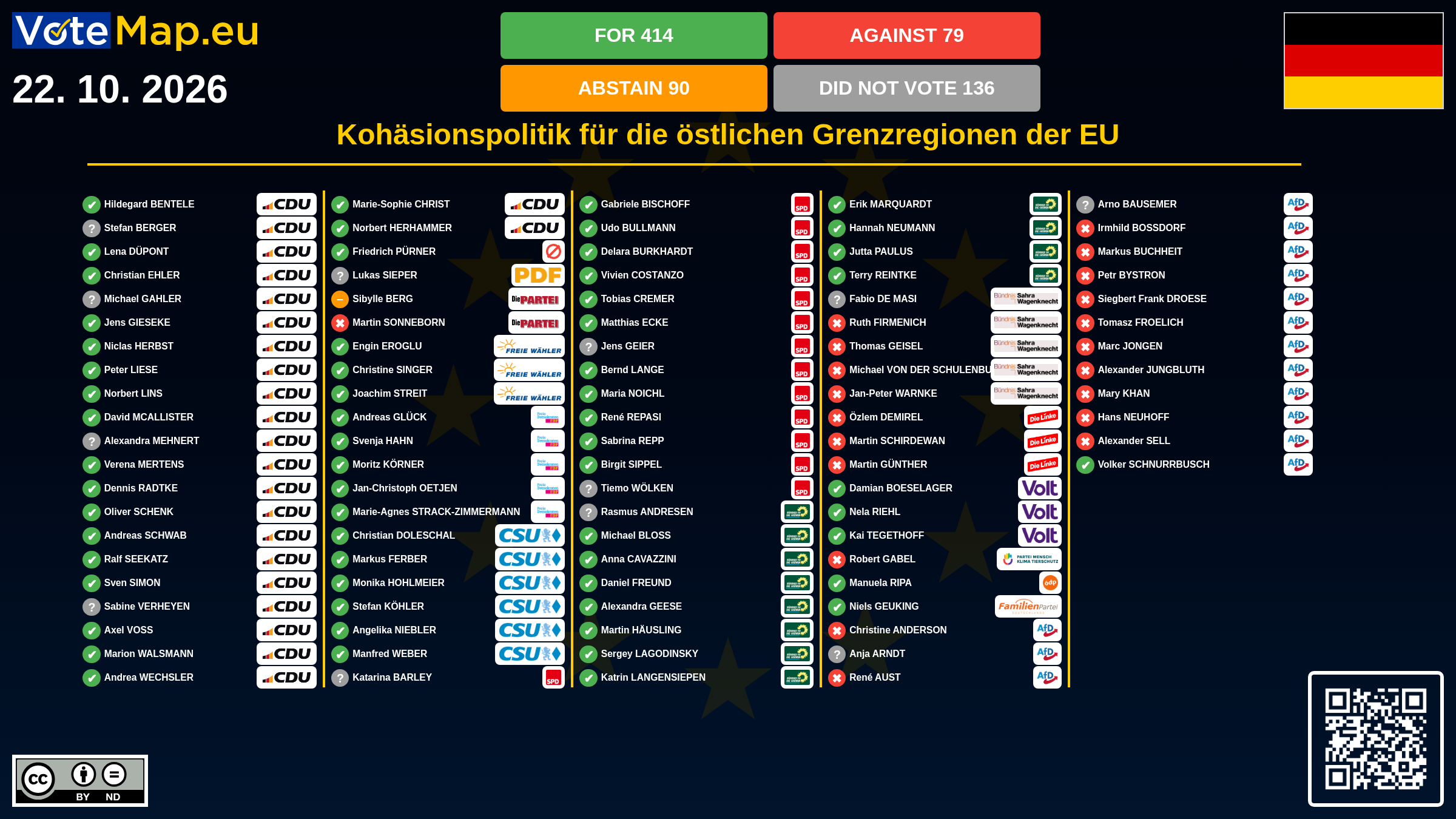
The resolution on cohesion policy in the EU’s eastern border regions – that is, regions bordering Russia, Belarus and Ukraine – was adopted by 414 votes in favour, 79 against and 90 abstentions. This is an own-initiative report by the Committee on Regional Development (REGI), not a legislative proposal. The rapporteur was Jacek Protas (EPP) from Poland.
The resolution was supported by all four political groups – the EPP, S&D, Renew and Greens/EFA – that is, the pro-European majority. Renew (67 MEPs) and Greens/EFA (46) voted unanimously in favour. The EPP voted overwhelmingly in favour (133 out of 142, with nine MEPs abstaining), as did the S&D (105 out of 112, with seven abstentions). None of the members of these four groups voted against. Their 351 votes in favour would have been sufficient for adoption even without the support of the other groups.
The ECR, PfE and ESN – that is, the far right – each voted differently. The ECR voted split, mostly in favour: 41 MEPs in favour, 5 against and 19 abstained. The PfE also voted split. Most of its MEPs abstained (49 out of 72), 15 voted against and 8 in favour. Abstaining does not mean voting against: an MEP who abstains does not support the resolution, but does not oppose it either. The majority of the ESN voted against (18 out of 21, with 3 in favour). The Left (far left) was also largely against: 32 out of 36 of its MEPs voted against, 3 voted in favour and 1 abstained.
The resolution follows on from the Commission’s communication of 18 February 2026 on the eastern regions. It welcomes the communication but emphasises that it should mark the start of the legislative process, not a substitute for it. The main demand concerns the next budgetary period. Under the cohesion policy for 2028–2034, a special additional allocation is to be created for regions on the eastern border, going beyond the current allocations. The resolution further calls for up to 10 per cent of the budgets of the relevant EU instruments to be allocated to these regions. It also supports a higher co-financing rate (up to 95–100 per cent) and higher pre-financing (30 per cent) for projects in these regions.
Much of the text concerns security. The resolution repeatedly names Russia and Belarus as sources of hybrid threats, including disinformation campaigns and the ‘expedient use of migration’. It also expresses concern over incidents involving drones, cyber-attacks and GPS jamming. When cross-border cooperation programmes with Russia and Belarus were suspended, the regions lost around 300 million euros in funding. Only around 150 million was reallocated to other cross-border cooperation programmes, meaning that, according to the resolution, the net loss of 150 million euros has not yet been offset. The resolution therefore calls for a special allocation under the Interreg programme. The Commission is to recognise these regions as strategic areas that are important for the EU’s security, competitiveness and strategic autonomy. Cohesion Fund money is also to be channelled into dual-use infrastructure – for both civilian and military purposes – including anti-drone systems.
The resolution also acknowledges the costs of hosting war refugees from Ukraine. In Poland alone, over 1.3 million had been registered by the start of 2026. It calls for migration pressure to be permanently factored into the assessment of these regions’ financial needs. It also proposes the establishment of a permanent European Forum for Eastern Regions and a uniform definition of ‘regions on the eastern border’ based on their distance from the border.
We collect and visually present data publicly available at the page of European Parliament. Votemap.eu denies any responsibility for possible inconsistencies of the data or its changes after the publication.
Descriptions are created using DeepL Translate machine translation. We apologize for any possible imperfections or inconvenience.