Objection to the calculation of the carbon footprint of new buildings
2026-03-26
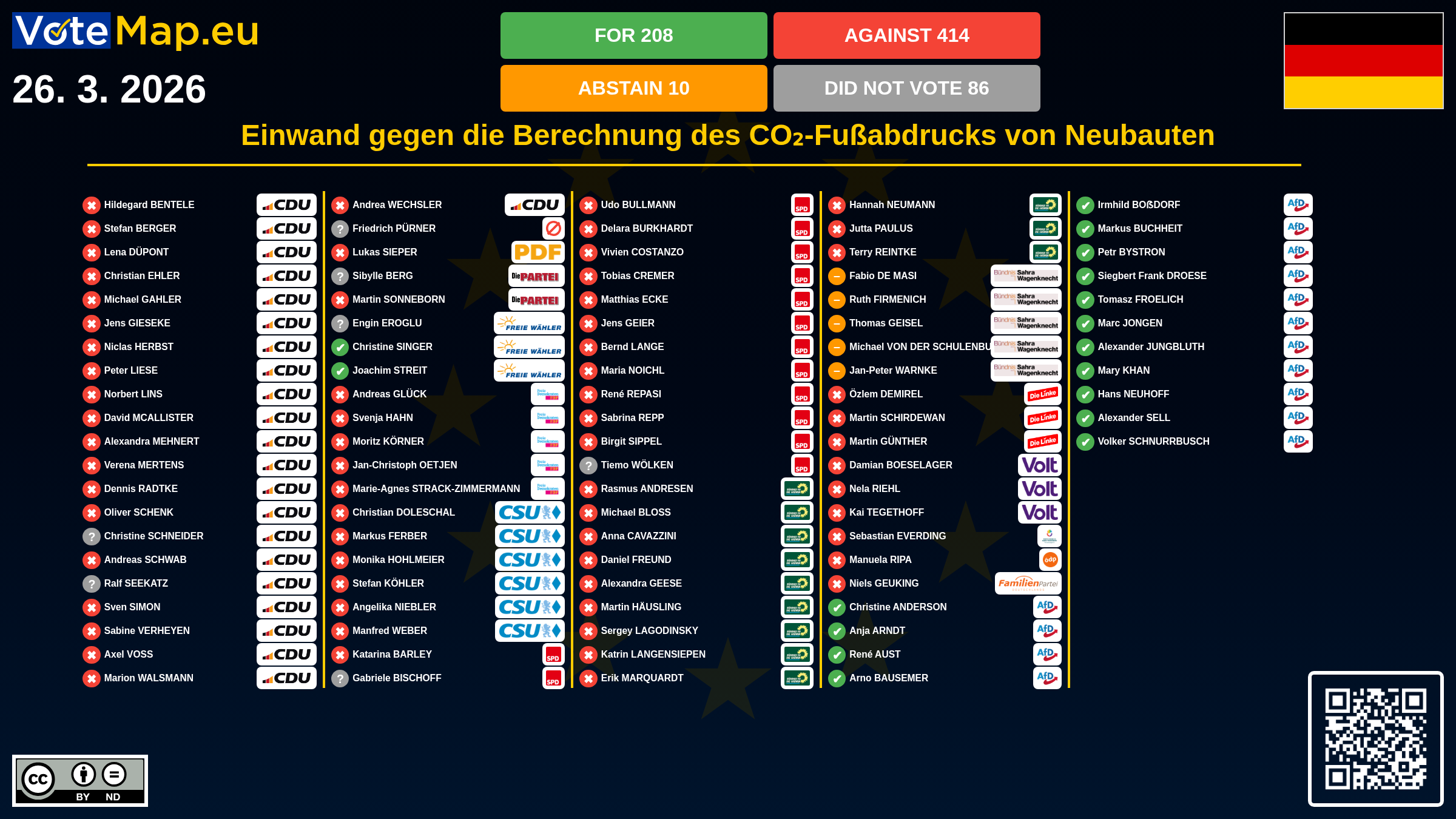
The European Parliament rejected an objection raised by 14 MEPs from the Patriots for Europe (PfE) group against a Commission act standardising the calculation of the carbon footprint of new buildings. 208 MEPs voted in favour of the objection, 414 against, and 10 abstained. It would have needed 361 votes to succeed. All four groups of the pro-European majority – the EPP, S&D, Renew and Greens/EFA – voted against it, as did the far-left group The Left. The far-right groups – PfE, ECR and ESN – voted unanimously in favour. The Commission’s act therefore stands.
The revised Energy Performance of Buildings Directive (EPBD, Directive 2024/1275) provides for the monitoring of the total carbon footprint of new buildings over their entire life cycle. This is technically referred to as global warming potential (GWP). It includes emissions embedded in the building itself as well as emissions from its operation. To ensure that Member States do not each calculate this in their own way, the European Commission has drawn up a common EU framework for national calculations. It presented this on 16 December 2025 as a delegated act amending Annex III to the Directive.
The resulting figures are to appear on buildings’ energy performance certificates: for large new buildings with a floor area of over 1,000 m² from January 2028, and for all new buildings from January 2030.
Delegated acts are technical regulations issued by the Commission on the basis of an authorisation contained in an approved law. Parliament may block them by raising an objection. For an objection to be successful, it must be supported by an absolute majority of all Members, i.e. at least 361 votes, regardless of how many Members are present in the Chamber at the time.
An objection to this act was tabled by 14 MEPs on behalf of the Patriots for Europe (PfE) group from France, the Netherlands, Italy, the Czech Republic, Austria, Spain and Hungary. The sole proposer was PfE. Neither the rapporteur nor the shadow rapporteurs are present, as the motion was tabled directly by the political group. There was no debate on it in plenary, and no Member mentioned the objection in the verbatim record of the sitting.
The motion was defeated: 208 MEPs voted in favour, 414 against and 10 abstained. It fell 153 votes short of the required 361. It would not have passed even if a simple majority had sufficed, as there were almost twice as many opponents as supporters.
All four groups of the pro-European majority voted against the objection, and did so unanimously: the EPP had 155 against and 10 in favour; the S&D had 106 against, 1 in favour and 1 abstention; Renew had 64 against and 2 in favour; Greens/EFA all 46 against. None of them commented on the objection separately; their position is therefore indicated solely by the vote: they supported the Commission’s act remaining in force. The far-left group The Left also voted against the objection, with all 36 MEPs voting against.
The far right voted unanimously in favour of the objection: PfE (82 votes), ECR (72 in favour, 2 abstentions) and ESN (28). Together, they accounted for 182 out of 208 votes in favour. The EPP did not join the far right on this occasion.
As the objection was not passed, Parliament did not block the act and the common European framework for calculating the carbon footprint of new buildings remains in force. Parliament’s Legislative Observatory (OEIL) lists it as an act against which Parliament did not raise an objection.
We collect and visually present data publicly available at the page of European Parliament. Votemap.eu denies any responsibility for possible inconsistencies of the data or its changes after the publication.
Descriptions are created using DeepL Translate machine translation. We apologize for any possible imperfections or inconvenience.