Vehicle MOT tests and odometer tampering
2026-05-21
The European Parliament’s plenary session approved the negotiating mandate for new rules on vehicle roadworthiness tests by 369 votes to 126, with 84 abstentions. The EPP, S&D, Renew and Greens/EFA – the pro-European majority – voted in favour. The PfE voted against it by a majority, whilst the ESN voted unanimously against it; the ECR largely abstained. Rapporteur Jens Gieseke (EPP) emphasised that the mandate does not provide for annual inspections of older cars, as proposed by the Commission. The mandate also targets the tampering of odometers.
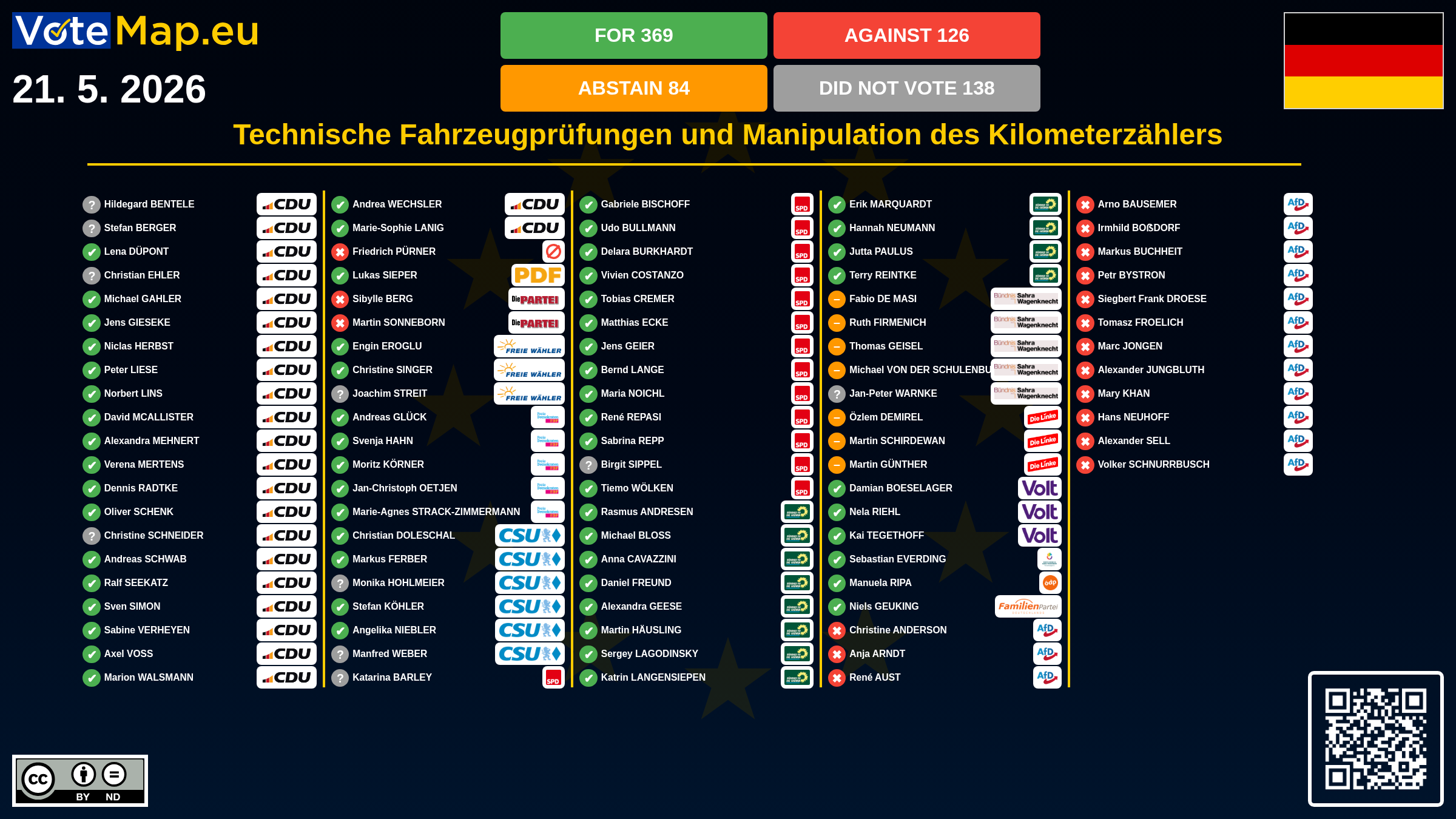
A vote was held on the so-called roadworthiness package. This involves amendments to two directives: one governs regular technical inspections of vehicles, the other roadside checks on commercial vehicles. The Commission tabled the proposal in April 2025. This was not yet the adoption of the legislation, but rather a negotiating mandate. This is the position from which Parliament will enter into negotiations with the Council and the Commission, known as the ‘trilogue’. The mandate was voted through by the TRAN Transport Committee on 5 May 2026 and confirmed by the plenary with 369 votes in favour, 126 against and 84 abstentions. The plenary will vote again on the text agreed upon by the institutions.
Drivers are most concerned about how often they will have to undergo a roadworthiness test. The Commission has proposed that passenger cars and vans over ten years old should undergo a roadworthiness test every year, rather than once every two years as has been the case to date. Before the vote, rapporteur Jens Gieseke (EPP) said in German: “We are making it clear: no annual roadworthiness tests for older vehicles and no additional inspection requirements for light commercial vehicles.” According to him, the compromise strikes a balance between road safety and reduced red tape.
The directive also addresses the tampering of odometers. Garages are required to record the odometer reading for cars and vans, but only when work takes longer than an hour, so as not to burden small workshops. Manufacturers of connected vehicles must submit data to a national database every three months from the date of first registration. The Commission is to set up a multilingual website where buyers of second-hand cars can check the vehicle’s mileage history free of charge, even if the car comes from another EU country. Member States are to introduce effective and dissuasive penalties for proven odometer tampering or for tampering with the vehicle’s emission control system or safety features.
Roadside checks are now to measure emissions from passenger cars, motorbikes, vans, lorries and coaches using remote sensing directly on the road. Vehicles with high emissions will be sent for a further technical inspection, and Member States may also use the same system to monitor noise levels. Checks are being extended to include vans. The existing EU-wide target of inspecting 5 per cent of buses and lorries will be replaced by a national target. Motorcycles with an engine capacity of over 125 cm³ will no longer be eligible for exemption from compulsory inspections. A vehicle with only a minor fault will pass the test, and the repair will only be verified at the next regular test. Roadworthiness certificates are to be issued electronically and shared between Member States.
The mandate was supported by the EPP, S&D, Renew and Greens/EFA – in other words, the pro-European majority. The S&D (106 votes), Renew (65) and Greens/EFA (43) voted unanimously, whilst the EPP voted by an overwhelming majority (137 in favour, one MEP abstained). Sérgio Gonçalves (S&D) described remote emissions monitoring as a crucial measure against air pollution, which, he said, causes the deaths of over 150,000 Europeans every year. Asger Christensen (Renew) highlighted digitalisation, the fight against vehicle fraud and simplification for drivers. Speaking on behalf of the Greens/EFA, Kai Tegethoff said that whilst the mandate fell short of the group’s ambitions, it did bring concrete improvements: mandatory remote emissions monitoring, stricter penalties for odometer tampering and better protection for buyers of second-hand cars.
The ECR, PfE and ESN – that is, the far right – did not vote as a single bloc. The ESN voted unanimously against (24 votes) and the PfE voted mostly against (66 against, 6 in favour, 6 abstentions). Within the ECR, 43 MEPs abstained, 21 voted against and 2 in favour. Abstaining does not mean voting against. The Left, i.e. the far left, also largely abstained (26 MEPs), whilst 10 of its MEPs voted in favour and 2 against.
We collect and visually present data publicly available at the page of European Parliament. Votemap.eu denies any responsibility for possible inconsistencies of the data or its changes after the publication.
Descriptions are created using DeepL Translate machine translation. We apologize for any possible imperfections or inconvenience.