Taxes in the financial sector and VAT on financial services
2026-07-07
The resolution calls on the Commission to establish a comprehensive tax framework for the EU financial sector and to review the VAT exemption for financial services. It was adopted by 418 votes in favour, 152 against and 85 abstentions. It was supported by the EPP, S&D, Renew and Greens/EFA – in other words, the entire pro-European majority. The PfE and ESN voted against it; the ECR voted against (41), whilst 32 of its MEPs abstained. The Left mostly abstained.
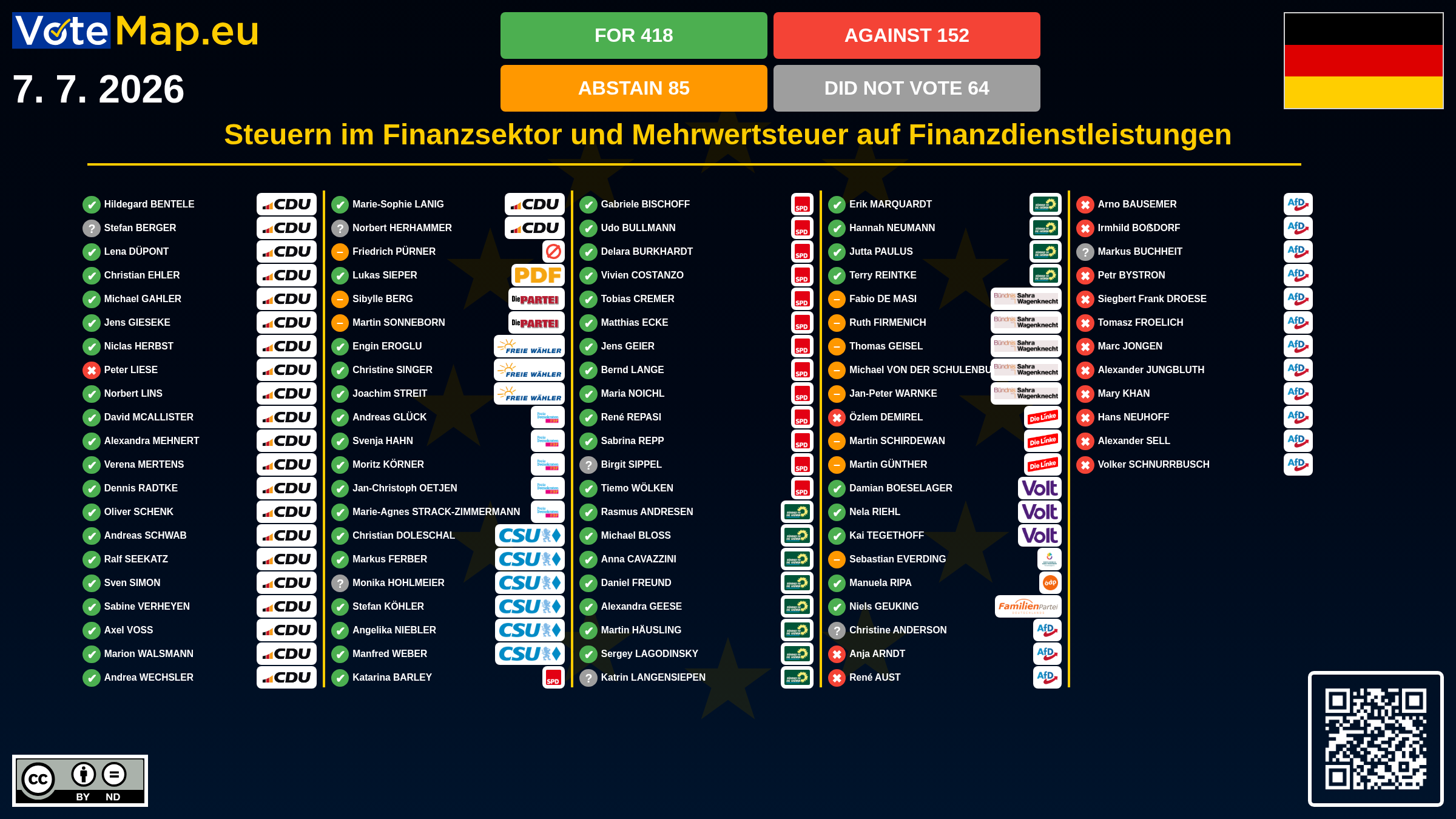
The resolution is based on the report by Matthias Ecke (S&D) on behalf of the Committee on Economic and Monetary Affairs (ECON). It is a non-legislative own-initiative report: it neither amends nor introduces any legislation, but calls on the Commission to take further action.
According to the resolution, following the major financial crisis, Member States introduced 91 sector-specific taxes on the financial sector. This has created a highly fragmented tax environment which increases operational and administrative costs, hinders the cross-border expansion of financial service providers and undermines the Union’s savings and investment objectives. The resolution calls on the Commission to fulfil its commitment to propose innovative solutions for the taxation of the sector, whilst warning that simplification must not lead to deregulation or a race to the bottom in tax standards.
Financial services have been exempt from VAT since 1977; according to the resolution, technological progress could now resolve the original technical obstacles to their taxation. This exemption has a downside: financial institutions cannot deduct the VAT they themselves pay on inputs, resulting in so-called ‘non-recoverable VAT’. The resolution takes the view that the current situation leads to persistent market distortions, may reduce transparency and increases costs for customers. It calls on the Commission to review the impacts of the regime, publish the analysis and consider possible solutions. Any change must carefully assess the impact on small consumers, particularly low- and middle-income households, and prevent any additional overall costs.
The resolution also recalls the 2020 agreement between the Parliament, the Council and the Commission from 2020 on new own resources, including a financial transaction tax, and notes that the Commission announced in its 2026 work programme that it was withdrawing its proposal for this tax, as insufficient progress had been made in the Council.
There was no separate debate on the item in plenary; the rapporteur, Matthias Ecke (S&D), spoke briefly before the vote. He stated (translated from English): “We cannot carry on like this. It is not sustainable. Our system of financial sector taxation needs reform. (…) The VAT exemption for financial services dates back to 1977. That is almost 50 years ago, and it was designed for a completely different financial system. Today, it creates distortions and undermines our single market. (…) I expect the Commission to assess the role that a financial transaction tax and windfall taxes might play within such a framework.”
The resolution was adopted by 418 votes in favour, 152 against and 85 abstentions. It was supported by the EPP (157 in favour, 10 against, 7 abstentions), the S&D (123 in favour, 4 abstentions), Renew (74 in favour) and the Greens/EFA (48 in favour) – that is, all four groups of the pro-European majority.
PfE voted predominantly against (62 against, 12 in favour), whilst the ESN voted unanimously against (25 votes). The ECR voted against: 41 MEPs voted against, 32 abstained and none voted in favour. However, not the entire far right opposed the resolution; 12 PfE MEPs voted in favour. The EPP did not vote alongside the far right. The Left, i.e. the far left, mostly abstained (25 abstentions, 4 against, 2 in favour).
We collect and visually present data publicly available at the page of European Parliament. Votemap.eu denies any responsibility for possible inconsistencies of the data or its changes after the publication.
Descriptions are created using DeepL Translate machine translation. We apologize for any possible imperfections or inconvenience.