

The European Parliament has approved a resolution on combating poverty (385:141): the aim is to eradicate poverty by 2035, with €20 billion earmarked for children; the far right is opposed
2026-02-12
In a non-binding resolution, the European Parliament calls on the Commission to adopt an ambitious anti-poverty strategy aimed at eradicating poverty in the EU by 2035 and to earmark at least €20 billion in the multiannual budget for the European Child Guarantee. The resolution was adopted by 385 votes to 141 (with 53 abstentions) — the EPP, S&D, Renew and Greens/EFA voted in favour almost unanimously, whilst the ECR, PfE and ESN voted against.
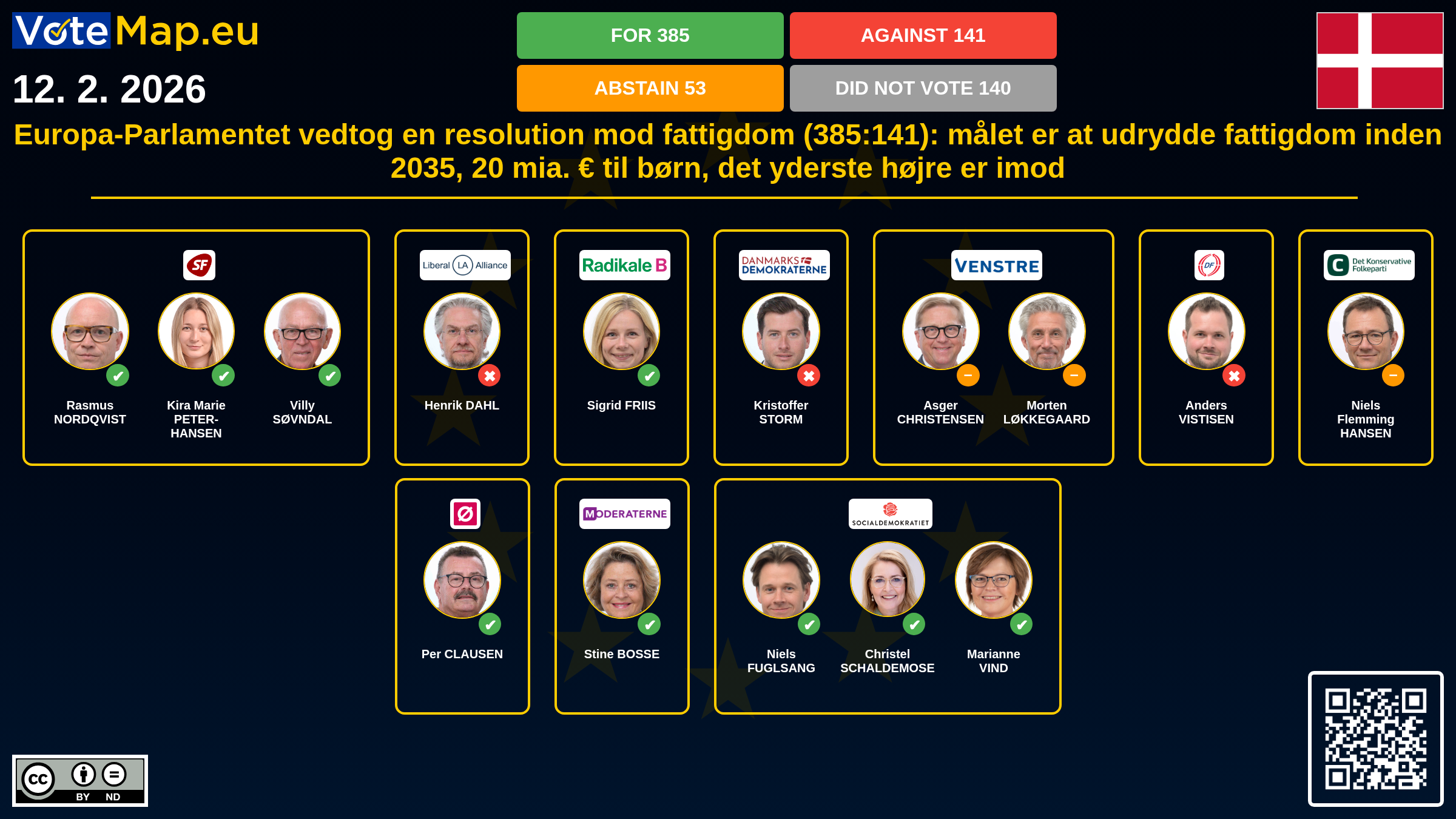
On Thursday 12 February 2026, the European Parliament adopted a resolution on the EU’s new anti-poverty strategy (A10-0260/2025) by 385 votes to 141, with 53 MEPs abstaining. This is a non-binding resolution initiated by the Parliament itself, which sets out recommendations to the European Commission on the shape of its forthcoming anti-poverty strategy.
The resolution is based on data from 2024: 93.3 million people in the EU were at risk of poverty or social exclusion, including 20 million children — roughly one in four children in the EU. Twenty-seven million people suffered from acute material and social deprivation. Under the European Pillar of Social Rights, the EU has committed to reducing the number of people at risk of poverty by at least 15 million by 2030, including at least 5 million children.
The text calls for the eradication of poverty in the EU by 2035, the recognition of poverty as a violation of human dignity, and a so-called ‘life-cycle’ approach, which combines universal and targeted measures from childhood through to old age. A key point is the demand to earmark at least €20 billion in the multiannual budget for the period 2028–2034 for the European Child Guarantee, to be funded through the European Social Fund Plus. The resolution also calls for ‘Housing First’ programmes to tackle homelessness, as well as more affordable housing, food, water, energy and transport, and for the principle of equal pay for equal work.
All four major democratic groups voted almost unanimously in favour of the resolution. The S&D (109 votes in favour, none against) and the Greens/EFA (43 in favour, none against) voted unanimously in favour; the EPP voted in favour by 129 to 10, with 6 abstentions, and Renew by 48 to 3, with 12 abstentions — the highest proportion of abstentions among the four groups.
All three far-right groups voted unanimously against: the ECR (1 in favour, 58 against, 3 abstentions), the PfE (none in favour, 39 against, 30 abstentions) and the ESN (none in favour, 24 against, 1 abstention).
The rapporteur for the resolution in the Committee on Employment and Social Affairs (EMPL) is João Oliveira of The Left group. In the Parliament’s press release on the vote, he stated: “The anti-poverty strategy must be ambitious. It must address the structural causes of poverty, promote a fairer distribution of wealth, improve working conditions, ensure robust investment in public services, and guarantee access to decent housing for all.” (The anti-poverty strategy must be ambitious. It must tackle the structural causes of poverty, promote a fairer distribution of wealth, improve working conditions, ensure robust investment in public services, and guarantee access to decent housing for all.) Shadow rapporteur Aodhán Ó Ríordáin negotiated the report on behalf of the S&D Group in the EMPL Committee; following the vote, he said: “Today, the EU can make history by finally taking poverty seriously. Poverty is one of those words that should haunt every politician in the EU, because the very existence of poverty does violence – to humanity, democracy, and our political credibility.” (Today, the EU can make history by finally taking poverty seriously. Poverty is one of those words that should haunt every politician in the EU, because the very existence of poverty is an act of violence – against humanity, democracy and our political credibility.) The rapporteur for the opinion of the Committee on Women’s Rights (FEMM) was Lina Gálvez (S&D).
We collect and visually present data publicly available at the page of European Parliament. Votemap.eu denies any responsibility for possible inconsistencies of the data or its changes after the publication.
Descriptions are created using DeepL Translate machine translation. We apologize for any possible imperfections or inconvenience.
