

Media literacy and digital learning
2026-07-07
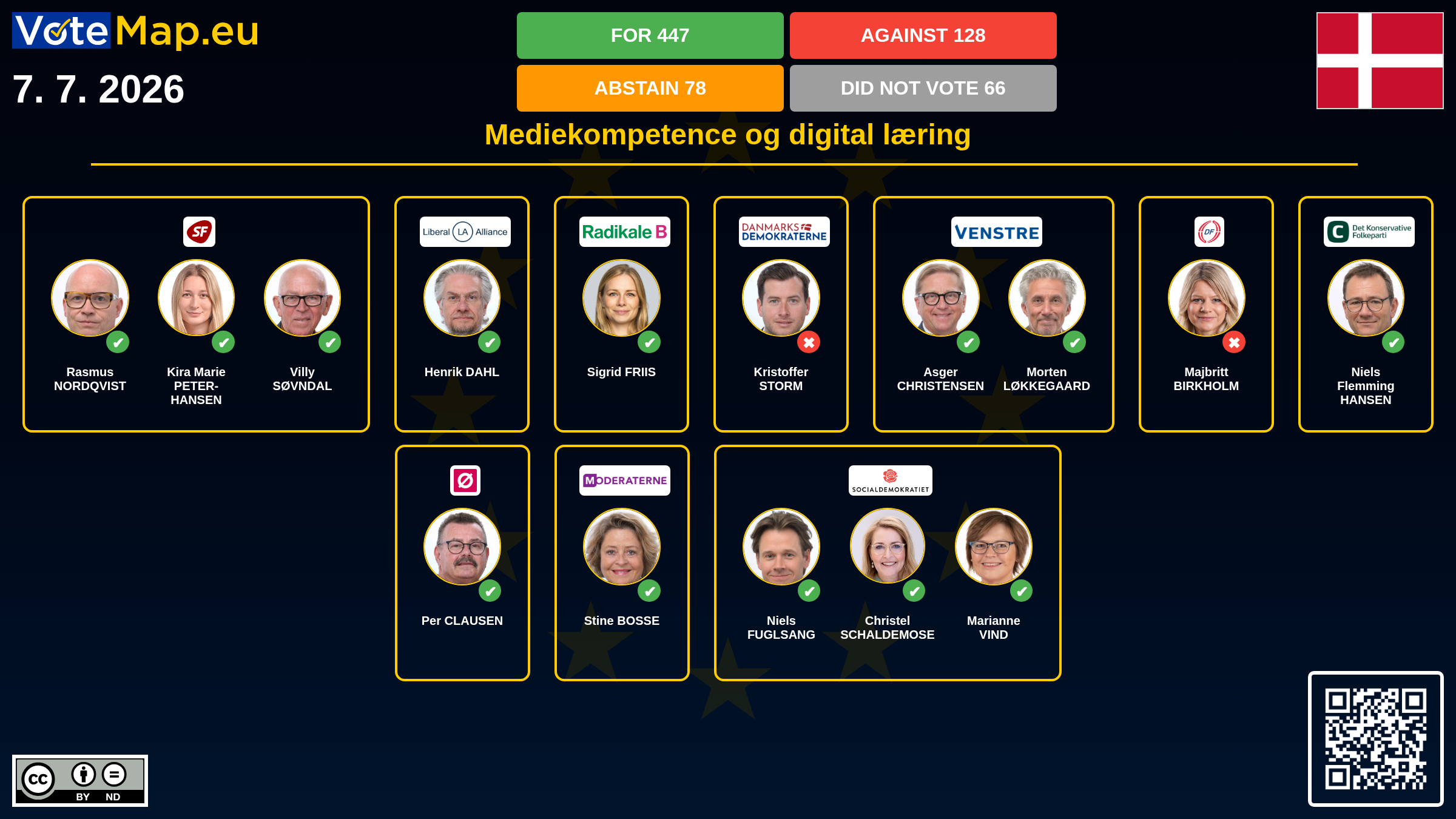
The resolution on a new strategy for media literacy and digital learning was adopted by 447 votes to 128, with 78 abstentions. It was supported by the EPP, S&D, Renew and Greens/EFA – that is, all four groups of the pro-European majority – as well as The Left. The ESN voted against, the PfE largely against, and the ECR mostly abstained. The text calls for media literacy to be taught across the entire education system, for an assessment of a unified EU approach to the age-appropriate use of social media, and urgently calls on very large online platforms to take measures in line with the Digital Services Act (DSA).
The resolution is not legally binding. It was drawn up on the European Parliament’s own initiative (procedure 2025/2181(INI)) on the basis of a report by the Committee on Culture and Education, prepared by the rapporteur Marcos Ros Sempere (S&D). It sets out what the European Commission, Member States and online platforms should do.
The text is based on the fact that 97 per cent of young people in the EU use the internet daily and that, for those aged 15–24, social media is becoming the main source of information. However, media literacy education varies considerably across Member States, both in terms of school curricula and funding. The resolution links this to resilience against disinformation and foreign interference in information, particularly in the run-up to elections.
It calls on the Commission to assess and, where appropriate, propose a unified EU approach to the age-appropriate use of online platforms, particularly social media, whilst fully respecting fundamental rights. It is also to propose amendments to the Audiovisual Media Services Directive that would extend the rules on media content to influencers and content creators and ensure the effective labelling of content created or modified by artificial intelligence, as well as commercially sponsored content. Furthermore, it is to assess the impact of digital devices and AI tools in schools and, where necessary, propose measures which could include targeted restrictions or bans, particularly in pre-school education. Stable EU funding is to be allocated to media literacy, including from the forthcoming AgoraEU programme.
It calls on Member States to integrate media literacy into educational programmes for different age groups and to effectively monitor whether video-sharing platforms are fulfilling their obligations in this area; it also encourages them to provide ongoing training for teachers and librarians. According to the text, media literacy policies must fully respect freedom of expression and media pluralism.
The resolution addresses very large online platforms most emphatically. It urges them to put in place reasonable, proportionate and effective mitigating measures against systemic risks arising from the exploitation of users’ low media literacy, particularly that of minors, as required by the Digital Services Act (DSA). It insists that they carry out impact assessments to determine how the design of their services affects users’ ability to engage with content; these assessments must be independent and publicly accessible. The text does not name any specific platform or country.
The resolution was adopted by 447 votes in favour, 128 against and 78 abstentions. The EPP (169 in favour, 4 abstentions), S&D (127 in favour), Renew (71 in favour, 3 abstentions) and Greens/EFA (48 in favour, 1 abstention) voted in favour, meaning the resolution was backed by a broad pro-European majority. There was no separate debate on the item in plenary.
The Left (29 in favour, 2 abstentions), i.e. the far left, also voted in favour. The ESN voted unanimously against (25 votes), the PfE largely against (58 against, 17 abstentions) and the ECR mostly abstained (41 abstentions, 29 against). The far right thus did not act in unison. The EPP did not vote with them on this occasion.
We collect and visually present data publicly available at the page of European Parliament. Votemap.eu denies any responsibility for possible inconsistencies of the data or its changes after the publication.
Descriptions are created using DeepL Translate machine translation. We apologize for any possible imperfections or inconvenience.
