

Where should the European Investment Bank invest?
2026-07-07
The resolution on the annual report on the European Investment Bank (EIB) was adopted by 316 votes to 281, with 39 MEPs abstaining. The EPP and Renew, whose MEP Joachim Streit drafted the report, voted in favour, whilst the S&D and Greens/EFA voted against – the pro-European majority was divided. A majority of the ECR also voted in favour, and without their votes the resolution would not have passed. Among other things, the resolution calls on Member States to allow the EIB to finance arms and ammunition, and on the bank to take into account countries’ cooperation on the return of migrants when granting loans outside the EU.
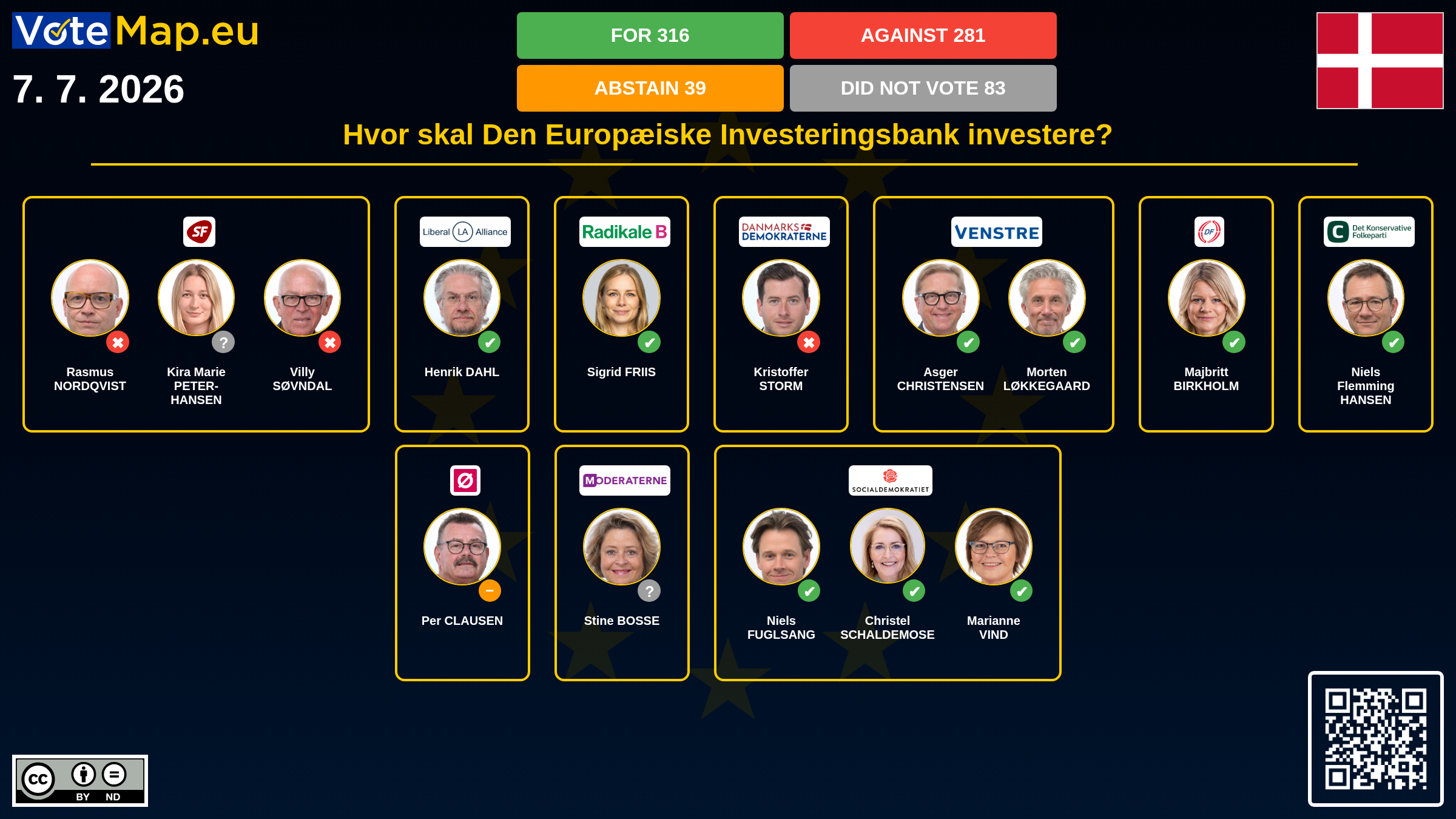
The European Investment Bank (EIB) is a bank of the European Union owned by the Member States. It lends and invests where this serves the Union’s objectives. The report on its financial activities for 2025 was prepared for the Committee on Budgets by rapporteur Joachim Streit (Renew).
The resolution was adopted by 316 votes in favour and 281 against, with 39 MEPs abstaining. The EPP voted unanimously in favour (167 votes), as did almost the entire Renew group (70 in favour, 1 against). The S&D (4 in favour, 120 against, 1 abstention) and the Greens/EFA (2 in favour, 46 against) voted against. The pro-European majority was thus split into two camps.
The ECR voted mostly in favour (54 in favour, 11 against, 6 abstentions) and their votes proved decisive: without them, the result would have been 262 in favour and 270 against. The PfE voted mostly against (15 in favour, 41 against, 17 abstentions) and the ESN voted unanimously against (23 votes). The Left, i.e. the far left, voted against (23 against, 7 abstentions).
According to EIB figures, its investments reached a record €100 billion in 2025, up from €89 billion the previous year. The resolution supports the bank continuing to expand its defence funding. It welcomes the new defence funding of €4 billion, representing almost 5 per cent of the EIB’s investments in the EU, and calls on Member States to amend the list of what the EIB is prohibited from financing, thereby enabling it to support weapons and ammunition as well, not just dual-use technologies. At the same time, it calls on the bank to monitor the impact of defence activities on its AAA credit rating, and states that defence spending should not undermine social and environmental spending.
In the energy sector, the text notes that almost 60 per cent of the EIB’s funds in 2025 were allocated to the transition to a low-carbon economy, and calls on the bank to assess low-carbon projects, including nuclear energy, using technology-neutral criteria. For loans outside the EU, one of the criteria should be partner countries’ cooperation in managing migration, including the readmission and return of migrants who do not have the right to reside in the EU. The resolution also calls for stronger parliamentary oversight of the bank and expresses concern over the ongoing corruption investigation into the former EIB president.
During the debate, shadow rapporteur Karlo Ressler (EPP) congratulated the bank on its record-breaking mobilisation of funds, whilst rapporteur Streit defended the text, emphasising competitiveness and defence. Shadow rapporteur Carla Tavares (S&D) stated that the expansion of the EIB’s mandate, including defence, must be balanced and must not jeopardise the bank’s credibility or financial stability, and that the new priorities must not overshadow cohesion, small and medium-sized enterprises, external cooperation or the climate transition. Shadow rapporteur Damian Boeselager (Greens/EFA) spoke about venture capital for start-ups.
A separate resolution dated 28 April 2026 was devoted to the EIB’s financial management; Votemap wrote about this in an earlier article.
We collect and visually present data publicly available at the page of European Parliament. Votemap.eu denies any responsibility for possible inconsistencies of the data or its changes after the publication.
Descriptions are created using DeepL Translate machine translation. We apologize for any possible imperfections or inconvenience.
