Deferral of obligations under the Methane Emissions Regulation
2026-11-26
The European Parliament approved, by 341 votes to 224 (with 31 MEPs abstaining), an agreement with the Council that postpones the deadlines for several obligations under the regulation on reducing methane emissions in the energy sector. These obligations apply to importers and producers of oil, natural gas and coal. The agreement was passed thanks to the votes of the ECR, PfE and ESN groups, alongside the EPP; it would not have passed without the support of the far right. The S&D and Greens/EFA groups voted against, whilst Renew was split in its voting.
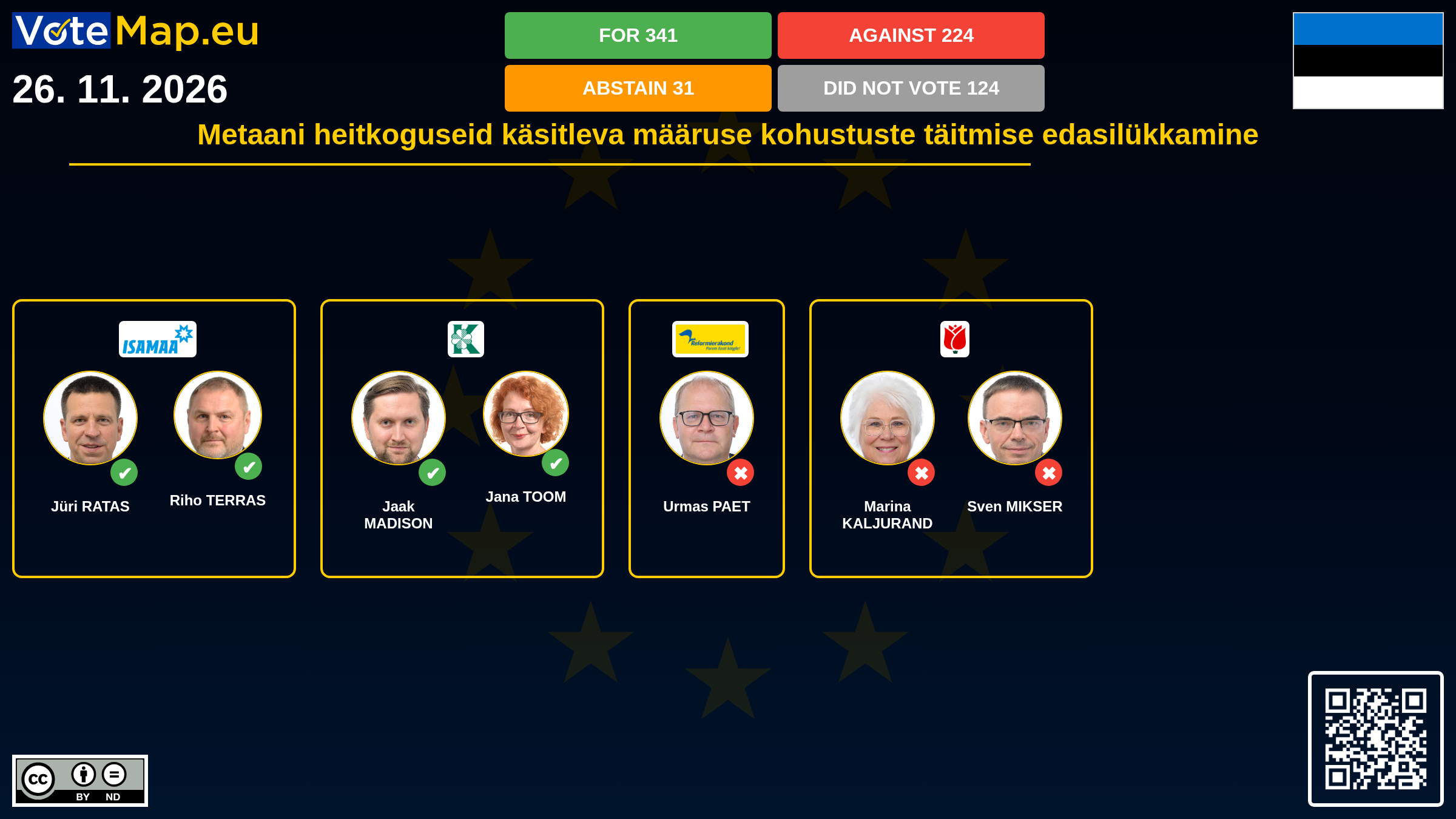
Regulation (EU) 2024/1787 on reducing methane emissions in the energy sector imposes a number of obligations on importers and producers of oil, natural gas and coal. The provisional agreement with the Council, which had previously been approved by the ENVI and ITRE parliamentary committees, postpones the deadlines for several of these obligations. There are three main ones.
Importers must demonstrate that the imported oil, gas and coal are subject to monitoring, reporting and verification measures equivalent to those of the EU. This deadline is being moved from 1 January 2027 to 31 May 2030 (Article 28). EU producers and importers are to report the methane intensity of their production; this deadline is being postponed from 5 August 2028 to 5 August 2030 (Article 29(1)). It will be necessary to demonstrate that the intensity does not exceed the maximum value by 5 August 2031 instead of 5 August 2030 (Article 29(2)). Each of the deadlines is therefore being postponed by a different period. The new Article 29a expressly states that the Regulation does not affect EU sanctions or Regulation (EU) 2026/261 on the phasing out of Russian natural gas.
The agreement was adopted by 341 votes in favour, 224 against, with 31 MEPs abstaining. The EPP supported it by an overwhelming majority (144 in favour, 4 against, 1 abstention). The ECR (71 in favour, 1 abstention), PfE (67 in favour, 5 against) and ESN (19 in favour, 2 against, 1 abstention) – that is, the far right – also voted in favour. These three groups together provided 157 votes for the agreement. Without them, the result would have been 184 votes in favour and 224 against; the agreement therefore passed thanks to the votes of the ECR, PfE and ESN.
The EPP, S&D, Renew and Greens/EFA – that is, the pro-European majority – were divided in the vote. The S&D voted mostly against (6 in favour, 98 against, 4 abstentions), whilst the Greens/EFA voted against with all 45 of their votes. Renew was split: 24 MEPs voted in favour, 21 against and a further 21 abstained. The Left, the far left, also voted against (38 votes against).
In its overview of the plenary week of 23–27 November 2026, the EPP stated that the postponement is intended to help safeguard energy supplies to Europe and keep prices affordable, whilst maintaining commitments to reduce methane emissions. Shadow rapporteur Jutta Paulus (Greens/EFA) wrote in her group’s press release of 19 November 2026 regarding the agreement: “The EU is bowing to the fossil fuel lobby and the Trump administration.”
Before the final vote, the S&D and Greens/EFA groups requested that the plenary vote on the amendments individually, rather than just on the agreement as a whole. The request was rejected by 240 votes to 346 (with 9 abstentions). The EPP, ECR, PfE and ESN voted against; without the votes of the ECR, PfE and ESN, the motion would have passed. A motion by The Left to reject the Commission’s proposal also failed (136 to 398, with 61 abstentions).
The rapporteurs are Dimitris Tsiodras for the ENVI Committee and Borys Budka for the ITRE Committee, both from the EPP.
We collect and visually present data publicly available at the page of European Parliament. Votemap.eu denies any responsibility for possible inconsistencies of the data or its changes after the publication.
Descriptions are created using DeepL Translate machine translation. We apologize for any possible imperfections or inconvenience.