Objections to the authorisation of GM maize and soya
2026-07-08
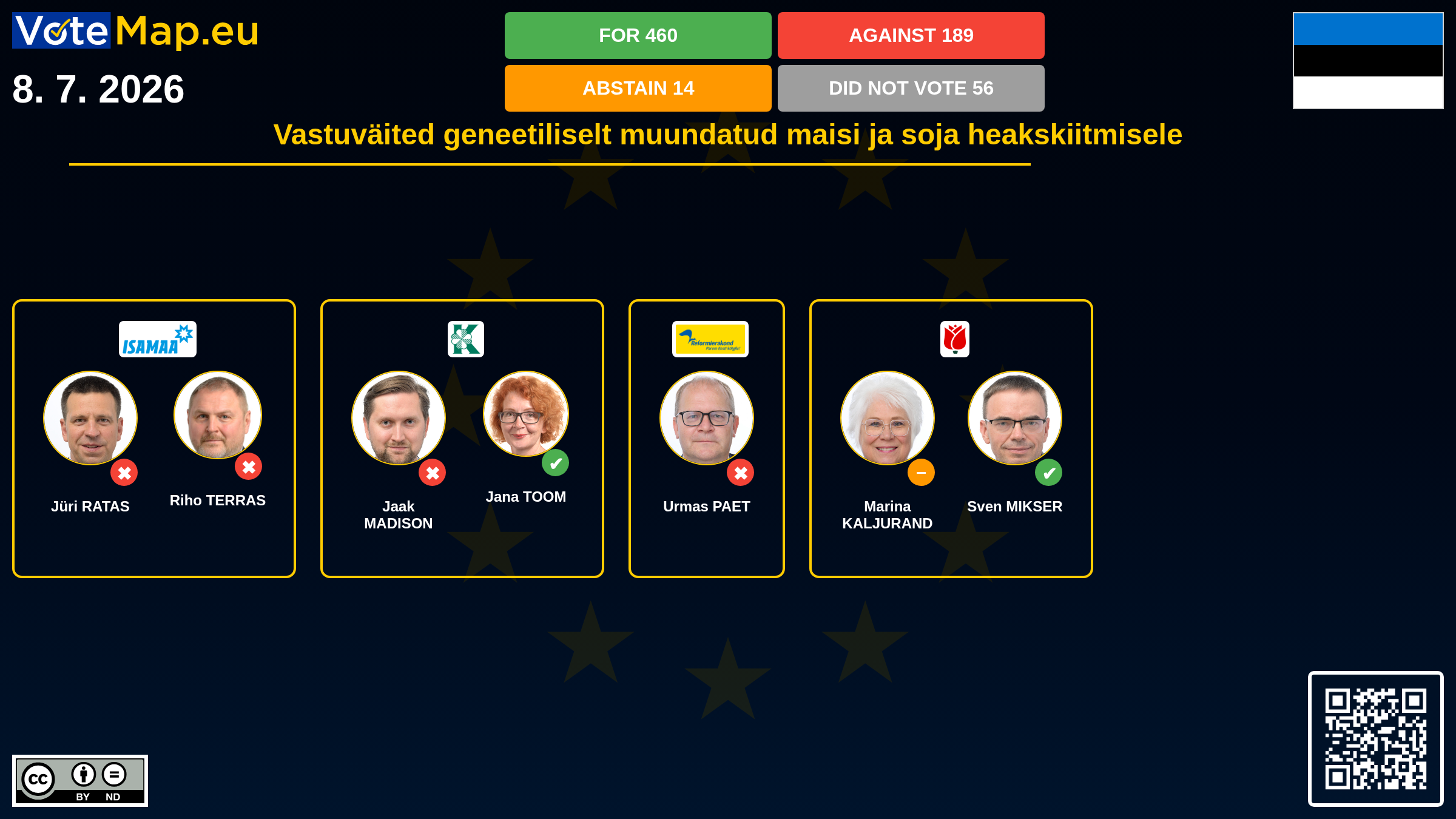
The European Parliament adopted three non-binding objections to the authorisation of two genetically modified maize varieties and one genetically modified soya variety, which the Commission had already granted: by a vote of 460 to 189 to 14, 466:175:16 and 417:167:15. The S&D and Greens/EFA voted in favour, the EPP mostly against, and Renew was split, meaning the pro-European majority was divided. The ECR, PfE and ESN voted predominantly in favour, but did not decide the outcome. The majority of EPP MEPs thus ended up on the losing side in all three votes.
On 29 June 2026, the Commission authorised the placing on the EU market of products derived from genetically modified crops by means of three implementing decisions. It renewed the authorisations for Bayer’s NK603 × T25 maize and MON 87705 soya, and granted new authorisations for Corteva’s DP202216 × NK603 × DAS-40278-9 maize and two of its sub-combinations. These crops may not be grown in the EU; the authorisations relate to the import of food, feed and other products derived from them. Member States did not express any opinion on the proposals either in the Standing Committee or in the Appeal Committee.
The decisions were voted on by way of an objection under Rule 115 of the Rules of Procedure: a resolution by which Parliament expresses its disagreement with a Commission implementing act. The proposals were drawn up by the Committee on the Environment, Public Health and Food Safety (ENVI), with Sirpa Pietikäinen (EPP), Biljana Borzan (S&D), Martin Häusling (Greens/EFA) and Anja Hazekamp (The Left) as co-rapporteurs. Renew was not represented amongst them. The objection is not binding on the Commission; it is a call, not a veto: the resolution calls on the Commission to withdraw its decision, but the Commission is not obliged to comply. The resolution itself notes that the Commission continues to authorise GMOs despite Parliament’s objections and the lack of support from Member States.
The European Food Safety Authority (EFSA) has issued favourable opinions on all three crops. The resolution objects that its assessments did not include long-term toxicological studies and that herbicide residues are not assessed during the authorisation process. All three crops are resistant to glyphosate; both maize varieties are also resistant to glufosinate, the authorisation for which expired in the EU in 2018 and which is classified as toxic to reproduction. The resolution further points out that imports would put EU farmers at a disadvantage, and reiterates that the Commission should not authorise GMOs without a qualified majority of Member States.
The objection to NK603 × T25 maize was passed by 460 votes in favour, 189 against and 14 abstentions. The vote against MON 87705 soya ended 466 to 175 to 16, and the vote against the new maize variety 417 to 167 to 15. There was no debate on any of the objections.
The pro-European majority was split across all three votes. The S&D voted overwhelmingly in favour and the Greens/EFA unanimously in favour; on NK603 × T25 maize, the votes were 111:8:5 and 48:0:0 respectively. The EPP was divided, with the majority voting against: 62 in favour, 112 against, 2 abstentions. The largest number of votes in favour from the EPP came from MEPs from Poland’s Koalicja Obywatelska (10), Greece’s Nea Dimokratia (7), the Croatian HDZ (6), the Hungarian TISZA party (6), the French Les Républicains (5) and the Austrian ÖVP (4). Renew also voted split: 30:41:3 on soya, 37:33:4 on soya and 32:33:3 on the new maize variety.
On the issue of NK603 × T25 maize, the ECR (59:14:1), PfE (59:13:0) and ESN (25:0:1) – that is, the far right – voted predominantly in favour. However, they did not decide the outcome: without their votes, this objection would have passed 317:162, and the remaining two 326:151 and 289:145. The majority of the EPP voted against the far right and ended up on the losing side. The Left, or the far left, supported all three objections unanimously, voting 40:0 on this particular issue.
We collect and visually present data publicly available at the page of European Parliament. Votemap.eu denies any responsibility for possible inconsistencies of the data or its changes after the publication.
Descriptions are created using DeepL Translate machine translation. We apologize for any possible imperfections or inconvenience.