The end of addictive design: protecting young people on social media
2026-09-17
The European Parliament in Strasbourg has approved a report by MEP Sandro Ruotolo (S&D) on the protection of young people on social media by 395 votes to 136, with 80 abstentions. The resolution calls for a ban on ‘addictive design’ on platforms, special provisions for minors and stricter rules for influencers and AI applications. All four centre-left and centre-right groups (EPP, S&D, Renew, Greens/EFA) voted in favour, whilst the far right (ECR, PfE, ESN) voted overwhelmingly against.
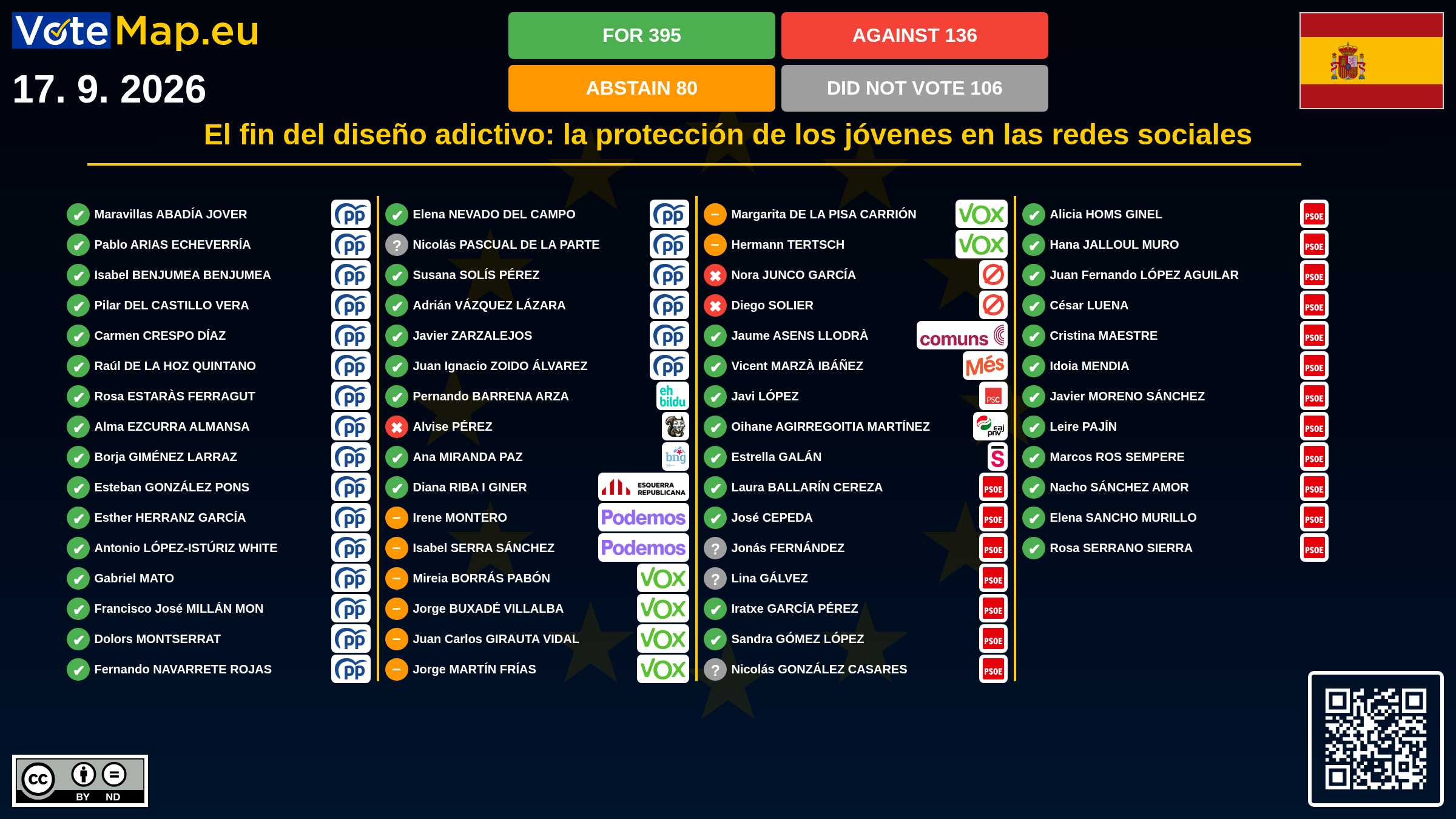
The European Parliament in Strasbourg adopted a non-legislative resolution on the impact of social media and the online environment on young people. This is an own-initiative report (INI) by the Committee on Culture and Education (CULT), led by rapporteur Sandro Ruotolo (S&D). The plenary approved it by a vote of 395 to 136, with 80 abstentions — so by no means without opposition.
The resolution calls on platforms to build in privacy and child safety protections right from the product design stage, and calls for a ban on so-called ‘addictive design’ — endless scrolling, automatic video playback and gaming reward mechanisms designed to keep users online longer than they intend. It proposes a special ‘youth mode’ that would block targeted advertising and restrict features that encourage compulsive use among minors, a European code of conduct for influencers, and ethical standards for ‘AI companion’ apps, including a ban on systems that generate non-consensual sexualised content featuring children. Rapporteur Sandro Ruotolo (S&D) stated during the committee’s discussion of the report: “Responsibility for the safety of children and young people must lie primarily with those who design and manage digital platforms.”
All four main democratic political groups voted in favour of the resolution, and very decisively so. The S&D voted unanimously, with not a single vote against or abstention — unsurprisingly, as the rapporteur is a member of that group. The Greens/EFA were in favour with no votes against, and only a few abstentions. The EPP supported the text by an overwhelming majority, with only isolated votes against or abstentions; its turnout (83.7 per cent) was the lowest of the four democratic groups. Renew also supported the resolution, albeit with slightly less internal unity than the other three groups. In committee, the report was co-negotiated by the shadow rapporteurs Sunčana Glavak (EPP), Hristo Petrov (Renew) and Diana Riba i Giner (Greens/EFA).
By contrast, the far right opposed the motion — the ECR, PfE and ESN all voted in unison, each with a high degree of internal unity. The ECR and ESN expressed their opposition primarily by actively voting against. In the case of PfE, however, a clarification is in order: the group did not cast a single vote in favour, but instead of voting against, roughly two-thirds of its cast votes opted to abstain; only a minority of its MEPs voted actively against. All three far-right groups had their own shadow rapporteurs on the committee and were involved in negotiating the text — but in the plenary session they ultimately rejected it overwhelmingly.
Overall turnout for the vote stood at 85.2 per cent (611 out of 717 seats filled). The ESN had the highest turnout (92.6 per cent), closely followed by the Greens/EFA (92.5 per cent); The Left had the lowest (81.8 per cent), closely followed by PfE (82.1 per cent).
This vote should not be confused with the so-called EU Kids’ Act — a separate legislative proposal from the European Commission, which was presented on the same day. This is a separate act from another institution, still at the very beginning of the legislative process; today’s Parliament resolution is non-legislative and merely recommends to the Commission the direction in which the regulation should proceed.
We collect and visually present data publicly available at the page of European Parliament. Votemap.eu denies any responsibility for possible inconsistencies of the data or its changes after the publication.
Descriptions are created using DeepL Translate machine translation. We apologize for any possible imperfections or inconvenience.