Parliament’s mandate for the EU budget for 2028–2034
2026-04-28
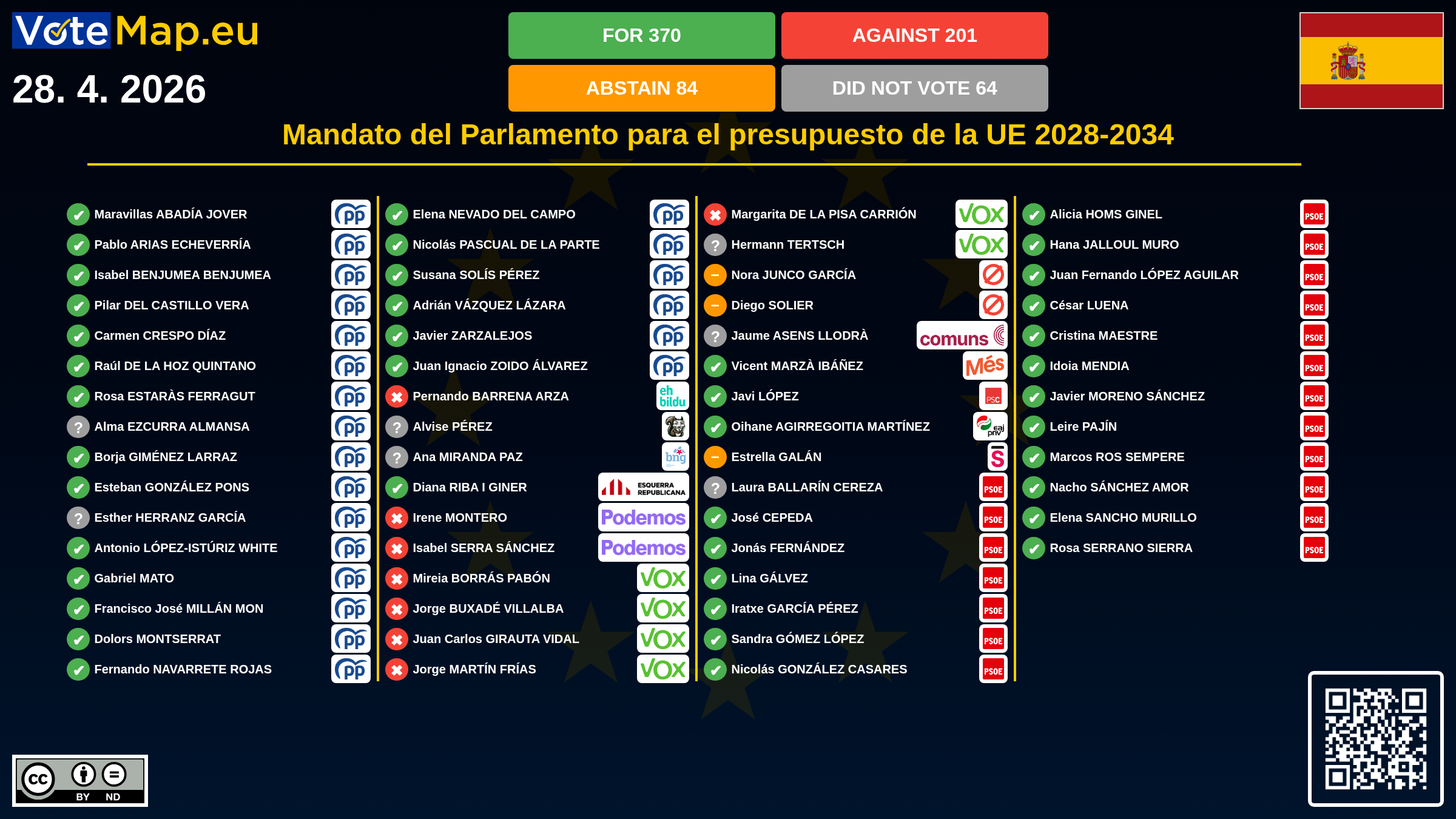
The interim report on the EU’s next multiannual financial framework sets out the Parliament’s position ahead of negotiations with the Council: a budget amounting to 1.27 per cent of the EU’s GNI, separate funding for agriculture and cohesion, and new own resources. It was adopted by 370 votes to 201, with 84 MEPs abstaining. All four groups of the pro-European majority – the EPP, S&D, Renew and Greens/EFA – voted in favour. The ESN and the majority of the PfE voted against, whilst the ECR was split between opposition and abstentions.
The Multiannual Financial Framework (MFF) is the European Union’s long-term budget. It sets spending ceilings for the next seven years. The proposal for the period 2028–2034 was presented by the European Commission. The MFF Regulation is adopted by the Council unanimously, and the Parliament cannot amend it – it can only give or withhold its consent.
The Parliament is therefore adopting an interim report (A10-0105/2026, procedure 2025/0571R(APP)). In it, it sets out in advance the demands with which it will enter negotiations with the Council. This constitutes its negotiating mandate; it is neither an agreement with the Council nor final approval. Parliament will vote on the MFF itself once the Member States have agreed on the text. The report was drawn up by the BUDG Committee, with Siegfried Mureşan (EPP) and Carla Tavares (S&D) as co-rapporteurs.
According to the resolution, the total MFF is to amount to 1.27 per cent of the EU’s gross national income (GNI). In addition to this, 0.11 per cent of GNI is to be set aside separately, outside the MFF ceilings, for the repayment of the NextGenerationEU debt. The resolution rejects the renationalisation of the budget and the ‘one plan per Member State’ approach, which would merge various policies into a single national plan. It calls for separate and adequate funding for agricultural policy (€433.01 billion at current prices), fisheries, cohesion and the ESF+, as well as an increase in funding for asylum, migration and border security (€38.04 billion). It seeks to strengthen the European Competitiveness Fund, Horizon Europe, the CEF and Erasmus+. In the field of external policy, it aims to boost humanitarian aid and support for Ukraine, including the Ukraine Reserve. It proposes a new Solidarity Reserve for natural disasters, amounting to €4 billion per year. It also insists on new EU own resources amounting to approximately €60 billion per year, which would be used to repay the NextGenerationEU debt and finance the budget.
The resolution was adopted by 370 votes in favour, 201 against and 84 abstentions. All four groups of the pro-European majority voted in favour. The EPP (143 in favour, 13 against, 8 abstentions) and the S&D (116 in favour, 8 against, 2 abstentions) spearheaded the report and supported it by a large majority. Renew also voted in favour (54 in favour, 7 against, 10 abstentions), but had the most dissenting votes of the four groups. Greens/EFA was the only group to vote entirely unanimously, with all 46 MEPs voting in favour. There was no cooperation between the EPP and the far right on this vote.
The far-right groups ECR, PfE and ESN did not support the report, but only ESN was united in its opposition, with all its members voting against (27 votes). PfE was predominantly against (57 against, 18 abstentions). The ECR was split into two equal parts: 35 MEPs voted against, 35 abstained and 5 voted in favour. The far-left group, The Left, voted predominantly against (3 in favour, 32 against, 8 abstentions).
No official statements from the EPP, S&D or Renew specifically regarding this vote could be found. Their position is reflected in how they voted. The S&D has long been campaigning for a larger budget: as early as May 2025, Carla Tavares described the 1 per cent GNI ceiling, which applies to the current MFF, as a ‘glass ceiling’ on the group’s website. On behalf of the Greens/EFA, the group’s budget spokesperson, Rasmus Andresen, spoke out on the day of the vote on his personal page, rather than on the group’s website: “If we really want the EU to stand up to Trump and Putin, we must strengthen it” (translation by Votemap). He is advocating a digital tax on large technology firms as a new own resource.
We collect and visually present data publicly available at the page of European Parliament. Votemap.eu denies any responsibility for possible inconsistencies of the data or its changes after the publication.
Descriptions are created using DeepL Translate machine translation. We apologize for any possible imperfections or inconvenience.