New EU Regulation on the Return of Foreign Nationals
2026-06-17
The new Return Regulation replaces the 2008 Directive and allows people without the right of residence to be returned even to third countries with which the EU or a Member State has an agreement, even if they do not originate from those countries. The agreement with the Council was supported by 418 MEPs, with 218 voting against and 30 abstaining. The EPP voted alongside the ECR, PfE and ESN – that is, the far right. The S&D voted against by a large majority and the Greens/EFA by an overwhelming majority, whilst Renew, the group led by rapporteur Malik Azmani, was divided.
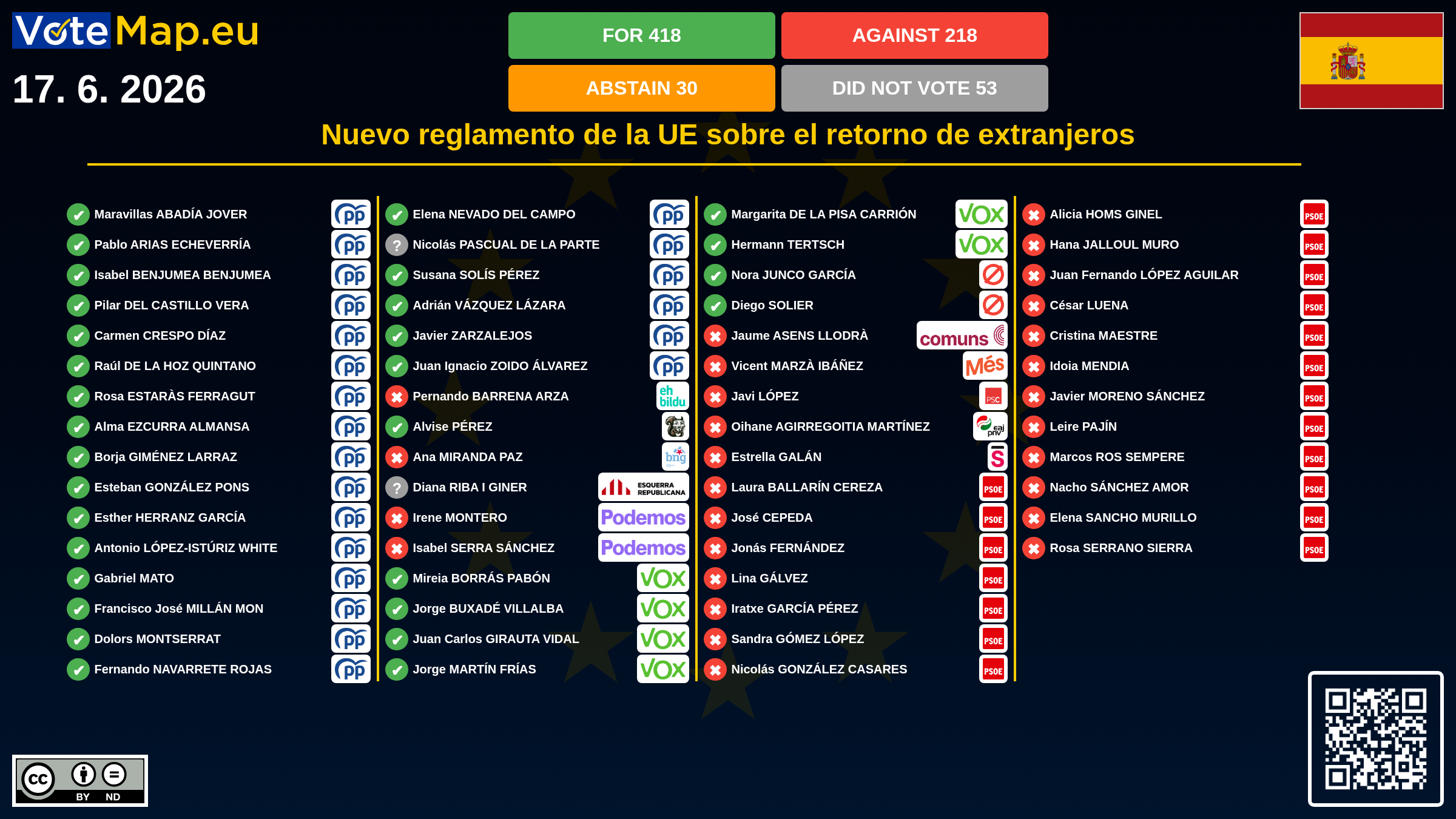
A vote was held on the provisional agreement with the Council of the EU on the regulation concerning the return of third-country nationals residing in the Union without authorisation. The agreement was reached by negotiators from Parliament and the Council in a so-called trilogue, i.e. a three-way meeting with the European Commission. With its approval in plenary, Parliament’s position at first reading is now in line with the final text of the legislation. The Regulation was signed on 7 October 2026 and published in the Official Journal of the EU on 15 October as Regulation (EU) 2026/2280. The rapporteur was Malik Azmani (Renew).
The Regulation replaces the 2008 Return Directive and is directly applicable, without the need for transposition into national law. The detention of a person required to leave may last for a maximum of 12 months in a single Member State. If the person concerned fails to cooperate or their documents are missing, this period may be extended to up to 24 months, and in exceptional circumstances by a further six months at most. An entry ban is normally valid for a maximum of ten years, or up to twenty years in justified cases. In the case of individuals who pose a serious security risk, it may, exceptionally, be for an indefinite period. It is now also possible to return people to a third country other than their country of origin, provided the EU or a Member State has an agreement with that country. Such an agreement must respect international law, including the principle of non-refoulement. Unaccompanied minors cannot be returned there.
418 MEPs voted in favour of the agreement, 218 against, and 30 abstained. The EPP voted overwhelmingly in favour (166 out of 170). It voted alongside the ECR, PfE and ESN – that is, the far right, whose MEPs were all in favour (77, 79 and 26 votes respectively). The votes of the far right did not decide the outcome: without them, the agreement would have had 236 votes in favour against 218.
There was no consensus amongst the EPP, S&D, Renew and Greens/EFA – that is, within the pro-European majority. During the debate, shadow rapporteur François-Xavier Bellamy (EPP) described the regulation as “the end of several decades of powerlessness in the face of illegal immigration” (spoken in French, as translated). The S&D voted against by a large majority: 107 against, 9 in favour and 11 abstentions. Its shadow rapporteur, Murielle Laurent (S&D), warned that the text “paves the way for the detention of unaccompanied minors and families with children” and “prioritises returns to countries that do not respect fundamental rights” (in French). The Greens/EFA voted overwhelmingly against (44 against, 2 in favour). Shadow rapporteur Mélissa Camara (Greens/EFA) described the regulation as “the result of openly acknowledged cooperation between the EPP and the far right” (in French).
Renew, the rapporteur’s group, voted split: 37 in favour, 20 against, 12 abstentions. Malik Azmani (Renew) said during the debate that Europe needs a return system that is “not only effective but also fair”, and in his view the text “achieves precisely that” (in English). However, Fabienne Keller (Renew) also spoke on behalf of Renew, stating that “to accept the adoption of such a mechanism under pressure from the far right would be an admission of Europe’s failure” (in French).
The Left, that is, the far left, voted unanimously against (43 votes).
We collect and visually present data publicly available at the page of European Parliament. Votemap.eu denies any responsibility for possible inconsistencies of the data or its changes after the publication.
Descriptions are created using DeepL Translate machine translation. We apologize for any possible imperfections or inconvenience.