Temporary support for farmers due to fertiliser prices
2026-07-07
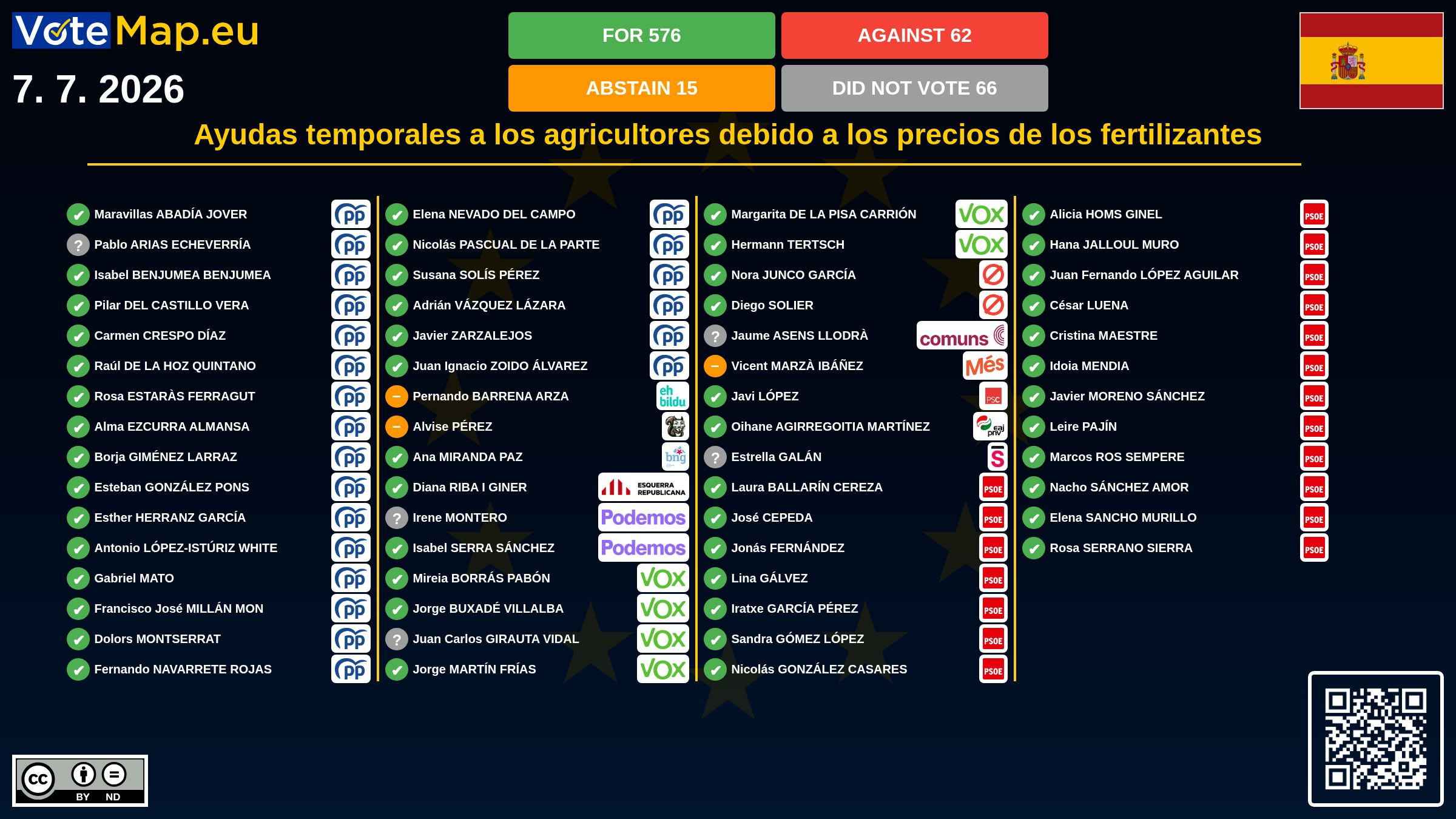
The Commission’s proposal, which allows Member States to provide temporary support to farmers affected by rising fertiliser prices and to pay them advances earlier, was adopted by 576 votes to 62, with 15 abstentions. The EPP voted alongside the ECR, PfE and ESN – that is, the far right; the proposal was also supported by the S&D and Renew. The Greens/EFA voted mostly against it – the only group within the pro-European majority to do so.
Fertiliser prices have risen sharply. According to the adopted text, this is due to the crisis in the Middle East and the de facto closure of the Strait of Hormuz, which have led to price rises for oil, gas and fertilisers. Fertilisers are one of the biggest costs for farmers. When prices rise, farmers may start to use them more sparingly or reduce the area under cultivation, which in turn leads to lower yields. The Commission’s proposal responds to this with three changes to the rules of the Common Agricultural Policy (CAP).
The first change is a new type of support. Member States may introduce it, but are not obliged to do so. It is intended for active farmers who have been hardest hit by the rise in fertiliser prices. It will cover up to 50 per cent of the additional costs of fertilisers incurred as a result of price rises from 1 March 2026. Farmers who have already committed to using less fertiliser may receive up to 80 per cent. The funding comes from the European Agricultural Fund for Rural Development (EAFRD), a fund that already exists under the CAP. The fund will cover up to 65 per cent of eligible expenditure. Member States may contribute their own funds, up to a maximum of 200 per cent of the amount from the fund. A maximum of 25 per cent of the national ceiling for crisis payments may be allocated to this support, and payments must be made by 30 June 2027. Each Member State must set a ceiling per beneficiary or per number of hectares. According to the text, the support must not lead to higher fertiliser application limits than those set by the European Nitrates Directive. Beneficiaries are also to receive information on how to reduce fertiliser use.
The second amendment concerns advances on direct payments. For 2026, Member States may pay farmers advances of up to 75 per cent of payments, instead of the previous 70 per cent. Furthermore, they may pay these advances immediately after an application is submitted; they do not have to wait until 16 October.
The third change is a one-off measure. By 31 August 2026, Member States may increase or reduce the funds earmarked for direct payments for 2027, within the ceilings set by the regulation for each Member State individually.
The proposal was adopted with 576 votes in favour, 62 against and 15 MEPs abstaining. The EPP voted overwhelmingly in favour (170 in favour, 2 against). The S&D group gave the proposal 124 votes in favour, with three of its MEPs abstaining. Renew cast 73 votes in favour, with one MEP abstaining. The Greens/EFA voted mostly against: 39 MEPs against, 4 in favour and 5 abstentions. Among the EPP, S&D, Renew and Greens/EFA groups – that is, within the pro-European majority – there is a dividing line between the first three groups and the Greens/EFA.
The EPP voted alongside the ECR, PfE and ESN – that is, the far right. All three groups supported the motion unanimously: the ECR with 74 votes, the PfE with 75 and the ESN with 25. However, this did not decide the outcome. The EPP, S&D and Renew together had 367 votes, which is more than half of the 653 votes cast. The Left, i.e. the far left, was divided in its vote: 10 in favour, 19 against and 2 abstentions.
The proposal was dealt with under the urgent procedure. It went straight to the plenary, without a report from the Committee on Agriculture, without a rapporteur and without a debate. By voting, Parliament adopted its position at first reading. The Council had already undertaken, in a letter dated 17 June 2026, to approve this position. Once it has been approved, the regulation will be published in the Official Journal of the EU and will enter into force on the day following its publication.
We collect and visually present data publicly available at the page of European Parliament. Votemap.eu denies any responsibility for possible inconsistencies of the data or its changes after the publication.
Descriptions are created using DeepL Translate machine translation. We apologize for any possible imperfections or inconvenience.