Mandate to negotiate on the digital euro
2026-07-09
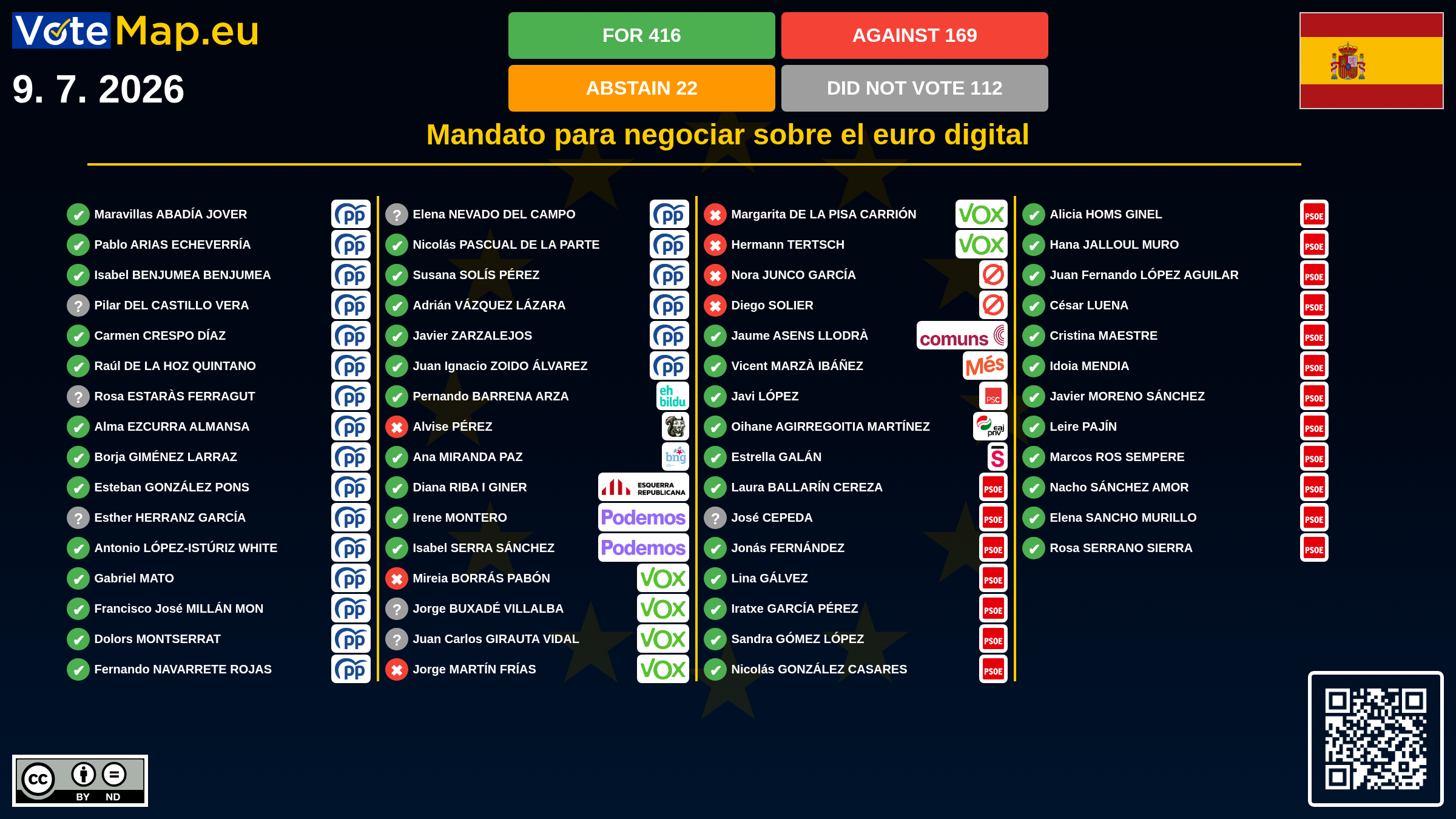
The European Parliament’s negotiating team can now begin talks with the Council on the digital euro. 416 MEPs voted in favour of the mandate, 169 against and 22 abstained. It was supported by the EPP, S&D, Renew and Greens/EFA – that is, the pro-European majority – as well as the majority of MEPs from The Left. The PfE and ESN voted unanimously against it, whilst the ECR was divided. The plenary vote was triggered by an objection raised by the PfE. The basis for the negotiations is the text drawn up by the ECON Committee.
The digital euro is intended to be a new form of the euro. It is digital money issued by the central bank; it can be used by both members of the public and businesses, and is intended to complement, not replace, cash. The regulation was proposed by the European Commission in June 2023. It is being examined in Parliament by the Committee on Economic and Monetary Affairs (ECON), with Fernando Navarrete Rojas (EPP) acting as rapporteur.
This time, the vote was not on the regulation itself, but on the negotiating mandate. The ECON Committee adopted its report on 23 June 2026. At the same time, it decided that its negotiators should begin negotiations with the Council of the EU – where representatives of the Member States’ governments sit – even before the first reading in plenary. The Parliament’s Rules of Procedure (Rule 72) allow for this. However, if a political group or a sufficient number of Members raise an objection to the committee’s decision, the matter is decided by the full plenary. The PfE Group raised an objection. Once the mandate has been approved, the rapporteur’s team proceeds to the negotiations with the text adopted by the committee. They do not, therefore, proceed with a position that the plenary has previously amended through proposed amendments.
416 MEPs voted in favour of the mandate, 169 were against and 22 abstained. The EPP, S&D, Renew and Greens/EFA groups – that is, the pro-European majority – voted in favour. The S&D (111 votes) and Greens/EFA (48) voted unanimously. Within Renew, 61 MEPs voted in favour and 4 against. Within the EPP, to which the rapporteur belongs, 136 MEPs voted in favour, 9 against and 19 abstained. The Left, the far left, also voted largely in favour (34 in favour, 2 against). The PfE (68) and ESN (25) voted unanimously against. The ECR was divided: 20 of its MEPs voted in favour, 43 against and 2 abstained. This time, the EPP did not vote with the ECR, PfE and ESN – that is, the far right – but with the rest of the pro-European majority.
The official summary of the committee’s report in the EP’s Legislative Observatory (OEIL) outlines what the negotiators are bringing to the table. The European Central Bank has the exclusive right to issue the digital euro. It and the national central banks may put it into circulation. Once authorisation for issuance has been granted, there must be a ramp-up period of at least 24 months, followed by a trial run in a real-world environment prior to the first issuance. Member States’ obligation to ensure access to cash remains. Data protection is based on the GDPR, data minimisation and the principle of ‘privacy by design’. The ECB must not have access to any data that could be used to identify a specific individual, and data must not be unlawfully transferred to authorities in third countries. The digital euro would have to be accepted by the majority of businesses. Exceptions are made for the self-employed and small and micro-enterprises that do not accept other digital payments. Basic payment services are to be free of charge, and providers must not circumvent this by imposing account maintenance or inactivity fees. Holdings of digital euros will be subject to a cap. The Commission proposes the level of this cap on the recommendation of the ECB, and it will be reviewed at least once every two years.
Rapporteur Fernando Navarrete Rojas (EPP) said during the debate (in Spanish, translated): “This package protects cash more than ever before in EU law and, in addition, offers the digital euro: another alternative, not an obligation.” Gilles Boyer (Renew) said (in French, translated): “Today we are too dependent on non-European means of payment, particularly American ones, and this dependence must end.” Nikos Papandreou (S&D) said (in English, translated): “The digital euro answers a simple question: who should be in control of Europe’s financial future? The answer is: Europe.”
What happens next: Parliament’s negotiators will seek a compromise text with the Council in a so-called trilogue. If they reach an agreement, the resulting text will go to the plenary for a single confirmatory vote. This means there will be no traditional first reading with amendments.
We collect and visually present data publicly available at the page of European Parliament. Votemap.eu denies any responsibility for possible inconsistencies of the data or its changes after the publication.
Descriptions are created using DeepL Translate machine translation. We apologize for any possible imperfections or inconvenience.