Political prisoners in Cuba: the European Parliament calls for the release of the Navarros
2026-09-17
The European Parliament has adopted a resolution on political prisoners in Cuba, calling for the immediate release of Félix Navarro and his daughter Saylí; the result was 374 in favour, 198 against and 19 abstentions. The EPP, Renew and all three far-right groups (ECR, PfE, ESN) voted in favour, whilst the S&D, Greens/EFA and The Left voted against. Turnout was 82.4 per cent, with the lowest turnout among PfE members and the highest among ECR members.
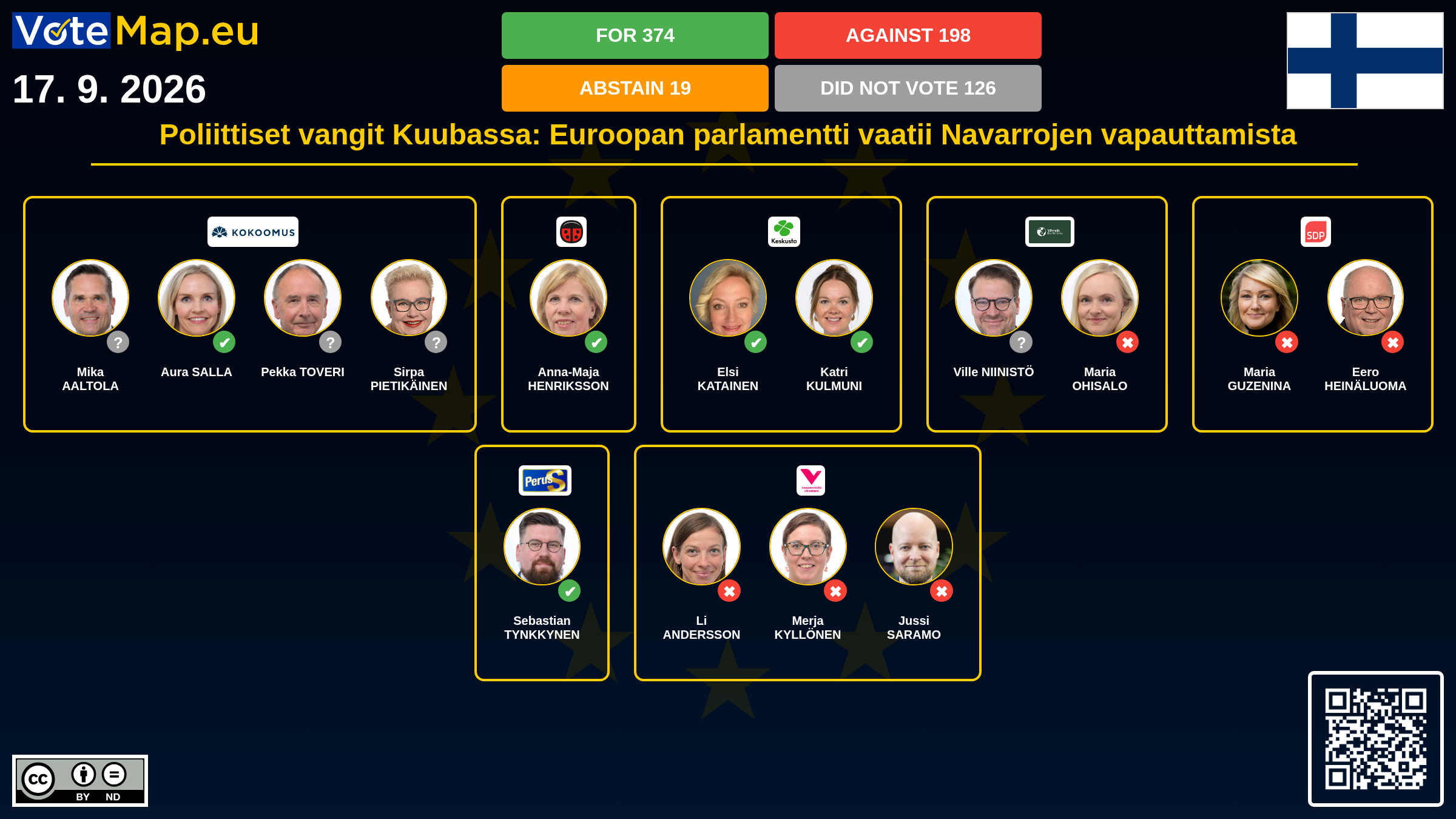
On Thursday 17 September 2026 in Strasbourg, the European Parliament adopted a resolution on political prisoners in Cuba, with particular emphasis on the case of Félix Navarro and his daughter Saylí. The resolution was passed by 374 votes in favour, 198 against, with 19 abstentions. This is an urgent resolution under Rule 150 of the Rules of Procedure – it is not debated in committee and has no rapporteur or shadow rapporteurs. It was preceded by seven separate motions tabled by individual political groups, which were partially merged into a joint text prior to the vote.
According to a European Parliament press release, the resolution condemns the intensified repression and systematic human rights violations perpetrated by the Cuban regime against political prisoners and their families, highlights the absence of due process and the use of torture in detention, and calls for the repeal of the Criminal Code, which uses the forced exile of political opponents as a condition for release. MEPs specifically highlight the case of 72-year-old Félix Navarro and his daughter Saylí, a co-founder of the organisation Damas de Blanco (Sakharov Prize laureates), who were sentenced to nine and eight years’ imprisonment respectively for enquiring about the fate of people arrested during the 2021 protests. They are calling for their immediate and unconditional release, as well as the release of all political prisoners, and are reiterating their call for the suspension of the Agreement on Political Dialogue and Cooperation with Cuba and for EU sanctions against those responsible for the repression, namely Miguel Díaz-Canel.
The vote split the four democratic groups into two pairs, rather than forming a united bloc against the far right. The EPP voted unanimously in favour of the resolution and Renew voted in favour without a single vote against; all three ultra-conservative groups – the ECR, PfE and ESN – also voted in favour. The overwhelming majority of the S&D voted against it, as did the entire Greens/EFA group without a single vote in favour; The Left also joined in the criticism. The core coalition that pushed the resolution through was therefore the EPP, Renew and all three far-right groups combined — this is a pattern where the EPP votes alongside the far right, this time supplemented by Renew, rather than a simplified scheme of two equally sized blocs.
The EPP itself also tabled a motion for a resolution — the consolidated text is ultimately listed under its number — as did Renew, the ECR, PfE, ESN, the S&D together with the Greens/EFA, and The Left on its own. In its press release, the EPP Group described itself as the author of the lead motion and stated that the Socialists, the Greens and the far left had refused to join its initiative – this is the EPP’s assertion regarding the position of the other groups, not their own statements; no direct statement from the S&D, Greens/EFA or Renew regarding this vote could be found.
Turnout for the vote stood at 82.4 per cent of the 717 occupied seats, which is lower than for a typical final vote on an international agreement — this is consistent with the fact that it was a short, urgent resolution at the end of the week. The PfE had the lowest turnout, whilst the ECR had the highest. According to the adopted text, Cuba is holding 1,339 political prisoners, including 38 minors and 463 people with serious physical illnesses. The resolution follows on from an earlier resolution on Cuba from June 2026, which, according to available reports, was sponsored by a similar coalition comprising the EPP, ECR and Renew.
We collect and visually present data publicly available at the page of European Parliament. Votemap.eu denies any responsibility for possible inconsistencies of the data or its changes after the publication.
Descriptions are created using DeepL Translate machine translation. We apologize for any possible imperfections or inconvenience.