A document containing key information on investments
2026-11-12
The agreement on the new format of the key information document for investment and insurance products was adopted by 311 votes in favour and 261 against, with 38 MEPs abstaining. It was passed thanks to the votes of the ECR and PfE, two far-right groups, which joined the EPP and Renew. The S&D and Greens/EFA voted unanimously against. The document will include a summary introduction, and investors will receive it primarily in electronic form. A related agreement on the protection of retail investors failed to pass on the same day (286 in favour, 300 against).
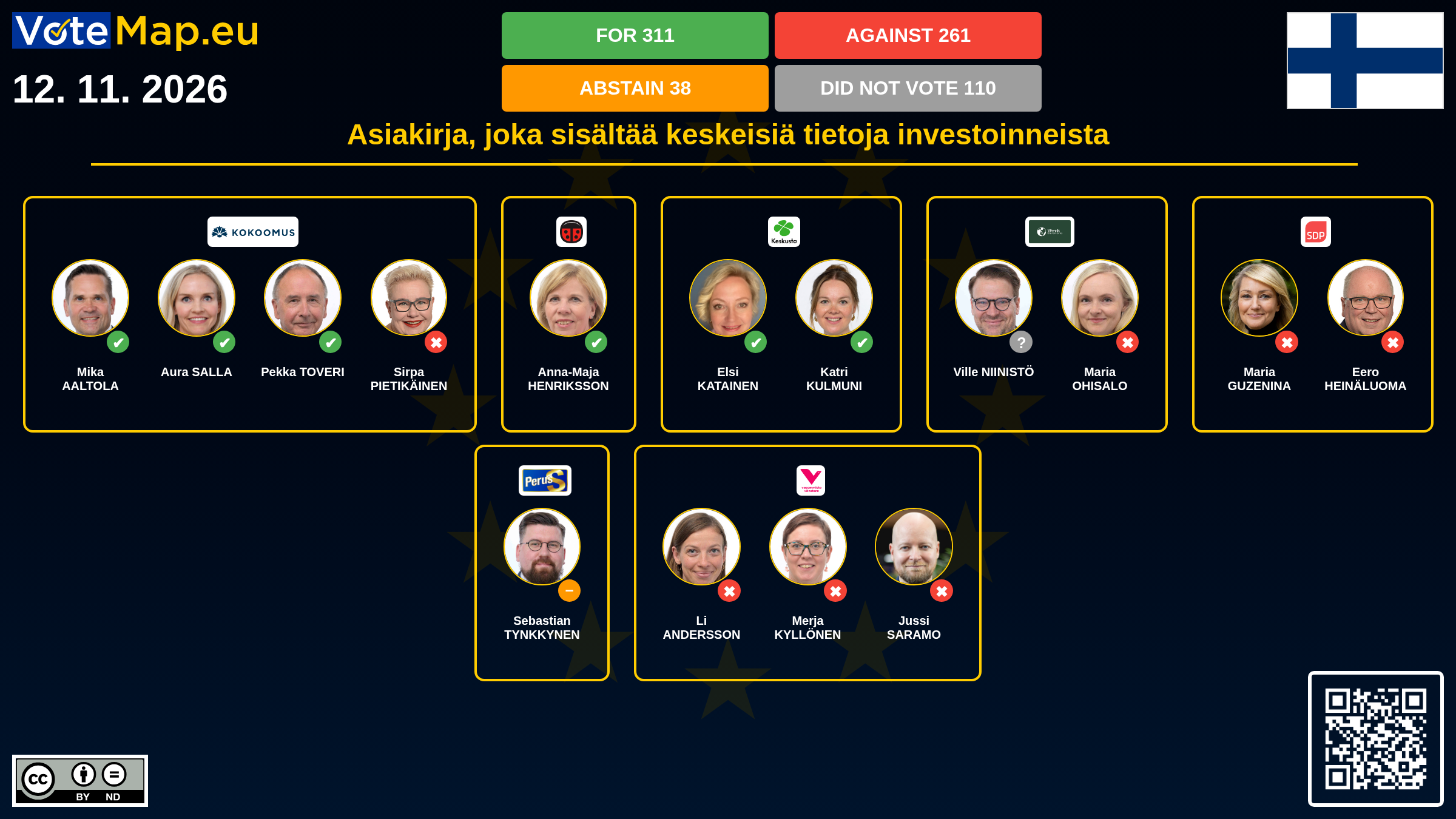
Anyone purchasing an investment product intended for retail investors or an insurance policy with an investment component should receive a key information document (KID). This is a short, standardised document explaining what the product is, how risky it is and how much it costs. The rules governing it are set out in Regulation (EU) No 1286/2014, known by the acronym PRIIPs. A vote was held on a provisional agreement with the Council amending this Regulation. In a letter dated 8 June 2026, the Council confirmed that it would approve the agreement in this form.
The main new feature is the ‘Product at a glance’ section at the start of the document. It sets out the product type, a summary risk indicator, total costs, the recommended holding period and information on insurance cover. The document will be provided primarily in electronic form; a paper version will be available only on request and free of charge. It may take a layered format, with the overview section forming the first layer, and must remain separate from marketing materials. For products with multiple investment options, the manufacturer must provide tools to compare their costs and risks.
The European supervisory authorities – the EBA, EIOPA and ESMA – are to draw up technical standards for the uniform presentation of costs and performance, for example in tables and graphs, within 12 months of the changes coming into force. The Commission is to submit a feasibility study on an EU-wide tool for comparing these products by 31 December 2030. Conversely, some obligations are being relaxed: the document need not be updated if the product is no longer on offer or available on the secondary market, and in the case of repeated transactions based on a previous instruction from the investor, it is sufficient to provide it on the first occasion. With the exception of a few provisions, the new rules will apply 30 months after they enter into force.
The agreement was adopted by 311 votes in favour, 261 against and 38 abstentions. The EPP, S&D, Renew and Greens/EFA – that is, the pro-European majority – were divided. The EPP voted mostly in favour (133 in favour, 26 against, 1 abstention), whilst Renew – to which the rapporteur belongs – voted in favour with the exception of one MEP (65:1). The S&D (115 against) and the Greens/EFA (46 against) voted unanimously against.
The ECR, PfE and ESN – that is, the far right – each voted differently. The ECR voted mostly in favour (53 in favour, 15 against, 2 abstentions), as did the PfE (48 in favour, 13 against, 6 abstentions). Without the votes of these two groups, there would have been 210 votes in favour and 233 against, and the agreement would not have been adopted. It therefore passed thanks to the votes of the ECR and PfE, alongside which the EPP voted. The ESN largely abstained: 21 of its MEPs abstained, two voted in favour and none against. Abstaining, however, does not mean voting against. The Left, i.e. the far left, voted unanimously against (38).
The agreement was negotiated by rapporteur Stéphanie Yon-Courtin (Renew). The shadow rapporteurs for the other groups in the pro-European majority were Ralf Seekatz (EPP), Eero Heinäluoma (S&D) and Vladimir Prebilič (Greens/EFA). When the negotiators reached an agreement in December 2025, Yon-Courtin described the agreement on the strategy for retail investors as “a major step towards a savings and investment union”.
The PRIIPs Regulation is one of two parts of this strategy. The other is the Directive on Investment Advice, Value for Money and Incentives, which was negotiated by the same rapporteur during the same negotiations. It was put to a separate vote on the same day and was rejected: 286 in favour, 300 against and 23 abstentions. The S&D (116 against) and the Greens/EFA (46 against) were opposed, as was the ESN (17 against, 6 abstentions). The EPP (123 in favour, 34 against, 1 abstention), Renew (63 in favour, 3 against, 1 abstention) and PfE (47 in favour, 14 against, 6 abstentions) were mostly in favour, whilst the ECR was split (45 in favour, 21 against, 4 abstentions).
We collect and visually present data publicly available at the page of European Parliament. Votemap.eu denies any responsibility for possible inconsistencies of the data or its changes after the publication.
Descriptions are created using DeepL Translate machine translation. We apologize for any possible imperfections or inconvenience.